Gene Signatures for Personalized Treatment in Colorectal Cancer

Gene Signatures for Personalized Treatment in Colorectal Cancer

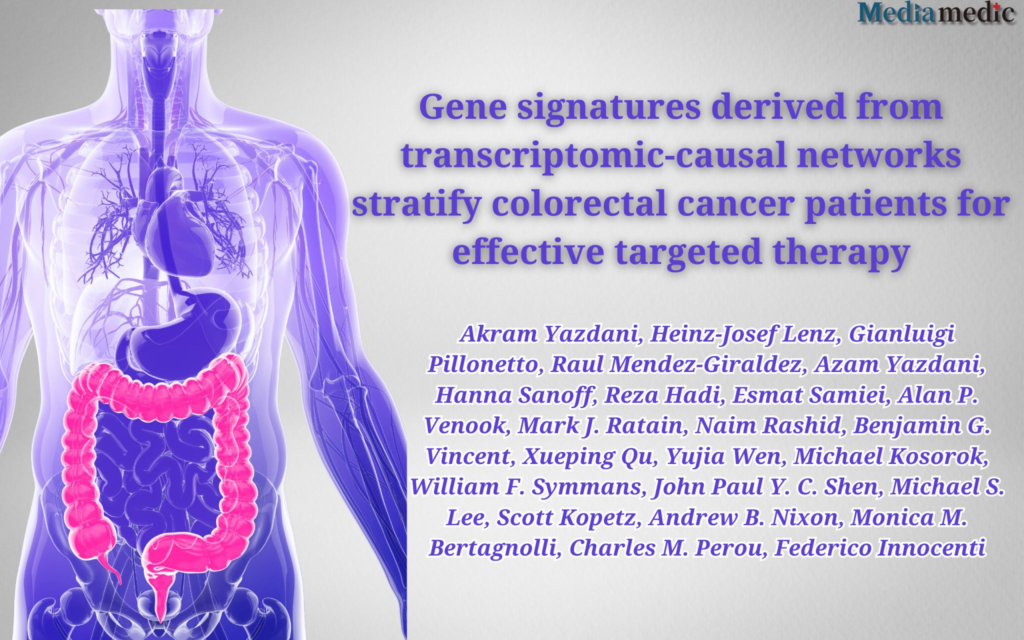
A new study published in Communications Medicine highlights the potential of gene signatures derived from transcriptomic-causal networks to improve patient stratification for targeted therapy in metastatic colorectal cancer (mCRC). By integrating gene interconnectivity into survival analysis, researchers identified distinct gene signatures that predict response to cetuximab or bevacizumab, providing a more personalized approach to treatment.
BREAKWATER Phase 3 Trial: A New Standard for First-Line BRAF V600E-Mutant mCRC Treatment

BREAKWATER Phase 3 Trial: A New Standard for First-Line BRAF V600E-Mutant mCRC Treatment

The BREAKWATER phase 3 trial, published in Nature Medicine, has demonstrated that encorafenib plus cetuximab (EC) with mFOLFOX6 significantly improves objective response rates compared to standard chemotherapy in BRAF V600E-mutant metastatic colorectal cancer (mCRC). The study reports a confirmed objective response rate of 60.9% with EC+mFOLFOX6 compared to 40.0% with standard chemotherapy, with a median duration of response of 13.9 months versus 11.1 months. The interim analysis of overall survival shows a hazard ratio of 0.47, suggesting a clear survival benefit for EC+mFOLFOX6.

Interferon-High Immunophenotype and Immunotherapy Response in Colorectal Cancer

Interferon-High Immunophenotype and Immunotherapy Response in Colorectal Cancer

A new study published in Cancer Cell, provides key insights into the role of the interferon-high (IFN-high) immunophenotype in predicting response to immune checkpoint inhibition (ICI) in colorectal cancer (CRC). By analyzing tumor microenvironment features, the study identifies a subset of both mismatch repair-deficient (dMMR) and mismatch repair-proficient (pMMR) CRCs that exhibit an IFN-high profile, marked by cytotoxic T cells and antigen-presenting macrophages.
Advancing Precision in Colon Cancer Prognostication: Insights from Professor Julien Taieb

Advancing Precision in Colon Cancer Prognostication: Insights from Professor Julien Taieb

Recent research led by Professor Julien Taieb and colleagues provides significant advancements in the prognostic assessment of stage III colon cancer by integrating circulating tumor DNA (ctDNA) and Immunoscore (IS). This post hoc analysis of the PRODIGE-GERCOR IDEA-France and HORG-IDEA-Greece trials demonstrates that ctDNA serves as an independent prognostic marker, while IS provides additional stratification, particularly in ctDNA-negative patients.