



Celebrating Excellence at EBMT 2025: Award Highlights from Florence
The 51st Annual Meeting of the European Society for Blood and Marrow Transplantation (EBMT), held from March 30 to April 2, 2025, in Florence, Italy, was not only a scientific…


ASCO Live Report | Dr. Alexander Olawaiye Presents ROSELLA Trial Results: A New Option on the Horizon for Platinum-Resistant Ovarian Cancer
Editor’s Note: In recent years, novel therapies targeting folate receptor alpha (FRα)—such as mirvetuximab soravtansine-gynx—have offered new hope for patients with FRα-high, platinum-resistant epithelial ovarian, fallopian tube, or primary peritoneal…

NCCN 2025 | Professor Jihong Liu: Strengthening Management and Monitoring Adverse Events in Immunotherapy-Chemotherapy for Endometrial Cancer
Endometrial cancer is one of the most common gynecologic malignancies, with its global incidence on the rise. In recent years, immunotherapy combined with chemotherapy has emerged as a promising strategy, demonstrating significant benefits in prolonging survival and maintaining durable responses in patients with advanced or recurrent endometrial cancer. However, as the use of immuno-chemotherapy becomes more widespread, concerns surrounding its safety profile have also come to the forefront.
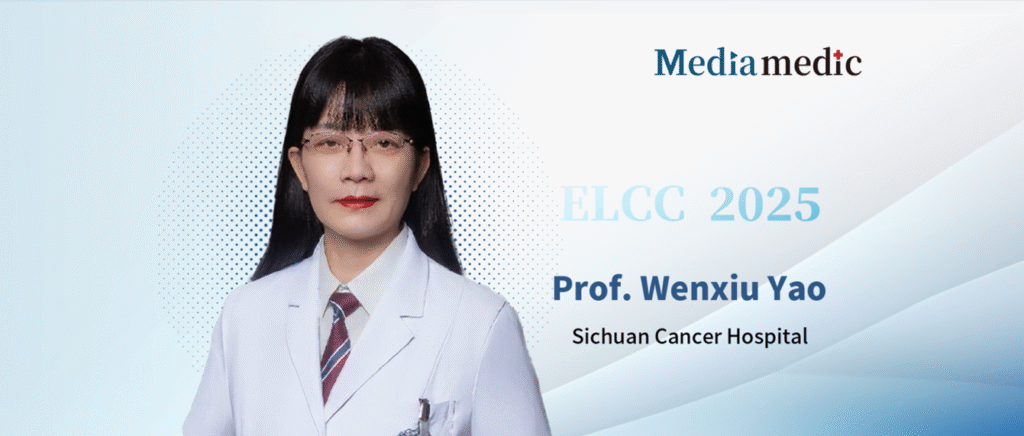
ELCC 2025 | Professor Wenxiu Yao Shares Insights on the Latest Advances in ADC Therapy for Lung Cancer
At the 2024 European Lung Cancer Congress (ELCC) held in Paris, Oncology Frontier conducted an exclusive interview with Professor Wenxiu Yao from Sichuan Cancer Hospital. Professor Yao provided in-depth commentary on the latest research presented at the congress regarding antibody-drug conjugates (ADCs) in the treatment of lung cancer.

ELCC 2025 | Professor Lin Wu: Long-Term Benefit and Individualized Dose Reduction Strategies of Domestic Third-Generation EGFR-TKI in EGFR T790M-Mutated NSCLC
At the 2025 European Lung Cancer Congress (ELCC), the team led by Professor Lin Wu from the Hunan Cancer Hospital, Xiangya Hospital, Central South University, presented long-term follow-up data on ASK120067 (rezivertinib) in patients with locally advanced or metastatic EGFR T790M-mutant non-small cell lung cancer (NSCLC). Oncology Frontier invited Professor Wu to comment on the key findings and clinical implications of the study for our readers.

Blood Science Update|Enhancing Hemophilia A Gene Therapy: Strategic F8 Deletions in AAV8 Vectors
Hemophilia A is a chronic bleeding disorder resulting from a deficiency in coagulation factor VIII (F8). Current treatment strategies rely on frequent F8 replacement therapy, which is limited by its short half-life, high cost, and the risk of inhibitor development. Gene therapy using adeno-associated virus serotype 8 (AAV8) has emerged as a promising modality, offering liver-targeted, long-term transgene expression. This article recently published in Blood Science investigates whether targeted deletions adjacent to the furin cleavage site of F8 can enhance the therapeutic efficacy and safety of AAV8-delivered BDDF8 constructs in a murine model of hemophilia A.