Challenges in HIV Management: Enhancing the Quality of Life for Elderly PLWH, Policy Interventions are Imperative

Challenges in HIV Management: Enhancing the Quality of Life for Elderly PLWH, Policy Interventions are Imperative

IAS current President Sharon Lewin emphasized, "The past 40 years of HIV research tells us that our HIV prevention and treatment work will be effective only when science, policy, and activism come together." At this IAS conference, the concept of primary healthcare (PHC) for HIV, as highlighted in the World Health Organization (WHO) updated HIV management guidelines, was emphasized. The new guidelines suggest that the new HIV policy framework will help decision-makers optimize ongoing work and collaborations, advancing PHC and responses for specific disease groups, including elderly PLWH.
Dr. Hongzhou Lu: NAD Management is Key for HIV Patients, Not Just Changing Medication

Dr. Hongzhou Lu: NAD Management is Key for HIV Patients, Not Just Changing Medication

The use of highly active antiretroviral therapy (HAART) has led to effective virological control in HIV-infected individuals, significantly reducing mortality rates and transforming AIDS into a treatable and manageable chronic disease. Today, one of the main clinical challenges is how to choose more "efficient and less toxic" treatment options to improve patients' quality of life. At the 12th International AIDS Society HIV Science Conference (IAS 2023) held recently, the first randomized controlled trial on switching to integrase strand transfer inhibitor (INSTI)-based therapy to control weight gain was reported. Infectious Disease Frontier invited Dr. Hongzhou Lu from Shenzhen Third People's Hospital, China, to interpret this trial and share insights into the current and future management of non-AIDS defining diseases (NAD) in HIV-infected individuals.
Dr. Wei Cao: Focus on Managing HIV Complications, Further Improving Patient Survival

Dr. Wei Cao: Focus on Managing HIV Complications, Further Improving Patient Survival

The 12th International AIDS Society Conference on HIV Science (IAS 2023) was held from July 23-26, 2023, in Brisbane, Australia. As the largest open scientific conference in the global field of HIV/AIDS, it attracted the participation of experts, medical professionals, community organizations, and healthcare companies worldwide. Dr. Wei Cao from Peking Union Medical College Hospital, Chinese Academy of Medical Sciences, was invited to attend the conference and was interviewed on-site by Infectious Disease Frontier. We have invited Dr. Cao to share the latest developments emerging from this conference and hot topics related to HIV/AIDS treatment.
Dr. Yun He: The Impact of Rapid ART Initiation on HIV Outcomes

Dr. Yun He: The Impact of Rapid ART Initiation on HIV Outcomes

The concept of rapid initiation of antiretroviral therapy (ART) has been proposed for nearly 10 years, and many studies have confirmed the long-term benefits of rapid ART initiation. At the 12th International AIDS Society HIV Science Conference (IAS 2023), Thai scholar Sirinya Teeraananchai reported a study on the impact of rapid ART initiation on the health outcomes of People Living with HIV (PLWH). Dr.Yun He from the Third People's Hospital of Shenzhen, China, was specially invited to comment on the study as follows.
Dr. Hui Wang: Second-line treatment choice for children with HIV infection

Dr. Hui Wang: Second-line treatment choice for children with HIV infection

Currently, the choice of second-line antiretroviral therapy (ART) for children infected with HIV is extremely limited. At the12th International AIDS Society HIV Science Conference (IAS 2023), researchers announced the results of a significant clinical study, the CHAPAS-4 ( Abstract No. OALBB0503), focusing on the long-term treatment outcomes of second-line therapy in children with HIV infections. We specially invited Dr. Hui Wang from the Affiliated Second Hospital of Southern University of Science and Technology, China, to provide a brilliant review of this research.
Dr. Biao Zhu: Common Comorbidities in HIV Patients and Their Antiretroviral Therapy

Dr. Biao Zhu: Common Comorbidities in HIV Patients and Their Antiretroviral Therapy

Although antiretroviral therapy (ART) has greatly reduced the mortality associated with HIV, the morbidity of non-AIDS-related complications associated with HIV remains high. Therefore, it is crucial to understand and assess clinical decision factors for adjusting ART in the context of suppressed HIV RNA. At the recently concluded 12th International AIDS Society HIV Science Conference ( IAS 2023), Dr. A. Cozzi-Lepri of University College London reported a study (Abstract number: EPB0169) that analyzed and evaluated the risk of ART switches in the context of common comorbidities combined with HIV and suppressed HIV RNA. This journal specially invited Dr. Biao Zhu from the First Affiliated Hospital of Zhejiang University School of Medicine, China, to provide a brilliant review of this research.
De-escalation and Escalation Treatment of Early Breast Cancer—Insights from an Interview with Giuseppe Curigliano at SGBCC 2023

De-escalation and Escalation Treatment of Early Breast Cancer—Insights from an Interview with Giuseppe Curigliano at SGBCC 2023

The 18th St. Gallen International Breast Cancer Conference 2023 held in Vienna provided a platform for experts in the field to share their perspectives on the management of early breast cancer. Among the distinguished attendees was Professor Giuseppe Curigliano from the European Institute of Oncology, IRCCS, Milan, Italy. In the interview by Oncology Frontier, he shed light on the concepts of de-escalation and escalation treatment in early breast cancer cases, addressing the potential benefits and challenges in current and upcoming therapeutic strategies.
SGBCC  International Dialogue| Dr. Li Zhu & Dr. Giuseppe Curigliano Discuss the Need for Adjuvant Therapy After Achieving pCR in Neoadjuvant Treatment

SGBCC  International Dialogue| Dr. Li Zhu & Dr. Giuseppe Curigliano Discuss the Need for Adjuvant Therapy After Achieving pCR in Neoadjuvant Treatment

Neoadjuvant therapy has become an integral part of breast cancer treatment, with its increasing application in clinical practice. However, improving the effectiveness of neoadjuvant therapy and optimizing subsequent treatment strategies is a complex issue to consider. At the 18th St.Gallen Breast Cancer Conference (SGBCC 2023), a debate titled "If you achieve pCR after neoadjuvant, do you need adjuvant therapy?" drew global expert attention. Oncology Frontier had  invited Dr. Li Zhu from Shanghai Jiao Tong University School of Medicine, First People's Hospital, and Dr. Giuseppe Curigliano from the University of Milan School of Medicine to engage in an in-depth discussion on this topic.
SGBCC 2023 | Academician  Binghe Xu: Breast Cancer Treatment and Research – An Asian Perspective

SGBCC 2023 | Academician  Binghe Xu: Breast Cancer Treatment and Research – An Asian Perspective

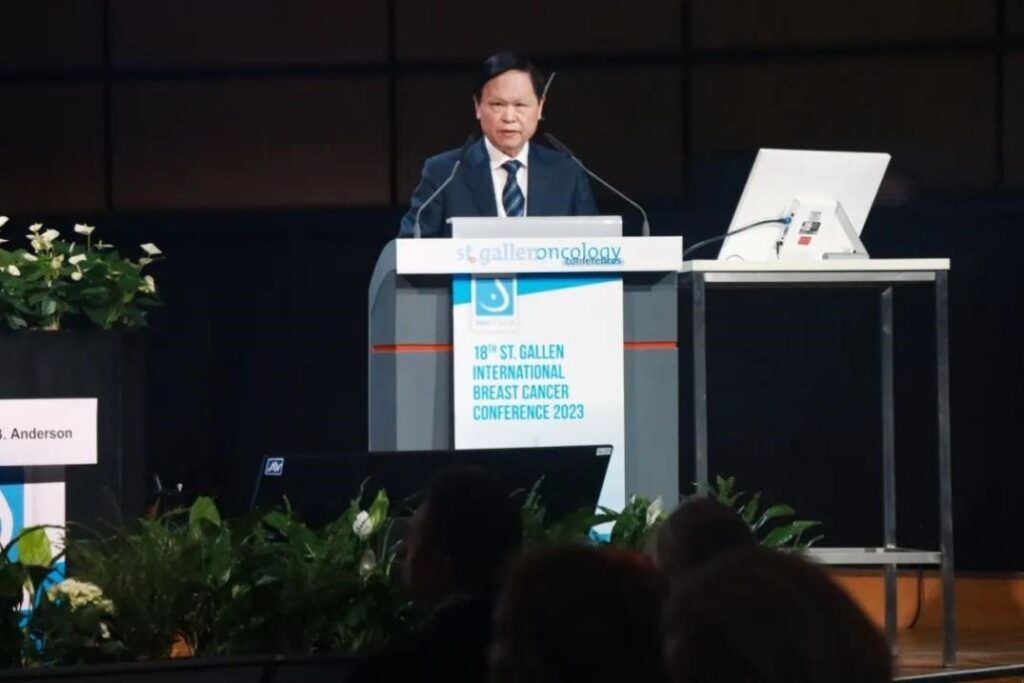
The 18th St.Gallen International Breast Cancer Conference (SG-BCC 2023) was held in Vienna, the "City of Music," from March 15 to 18, 2023. Academician Binghe Xu  from the Cancer Hospital of the Chinese Academy of Medical Sciences delivered a presentation titled "Breast Cancer Treatment and Research - An Asian Perspective" during the "Session 10: Global Perspective on Breast Cancer Treatment." After his presentation, Academician Binghe Xu  had an interview with Oncology Frontier to discuss related content.
Dr. Jian Zhang Discusses with Dr. Harbeck: Is Chemotherapy Necessary for ER+/HER2- Breast Cancer Patients with Low Genetic Risk but High Clinical Risk

Dr. Jian Zhang Discusses with Dr. Harbeck: Is Chemotherapy Necessary for ER+/HER2- Breast Cancer Patients with Low Genetic Risk but High Clinical Risk

The 18th St. Gallen International Breast Cancer Conference (SG-BCC 2023) was held in Vienna, the "City of Music," from March 15 to 18, 2023. Breast cancer experts from around the world gathered at this conference to discuss the most cutting-edge and controversial topics in the diagnosis and treatment of early-stage breast cancer, leading to the formation of the updated St. Gallen International Expert Consensus on Early Breast Cancer every two years. Oncology Frontier invited Dr. Jian Zhang from Fudan University Affiliated Cancer Hospital to have an in-depth discussion with Dr. Nadia Harbeck from the University of Munich on the topic of whether chemotherapy is needed for patients with low genetic risk but high clinical risk (ER+/HER2-) breast cancer.