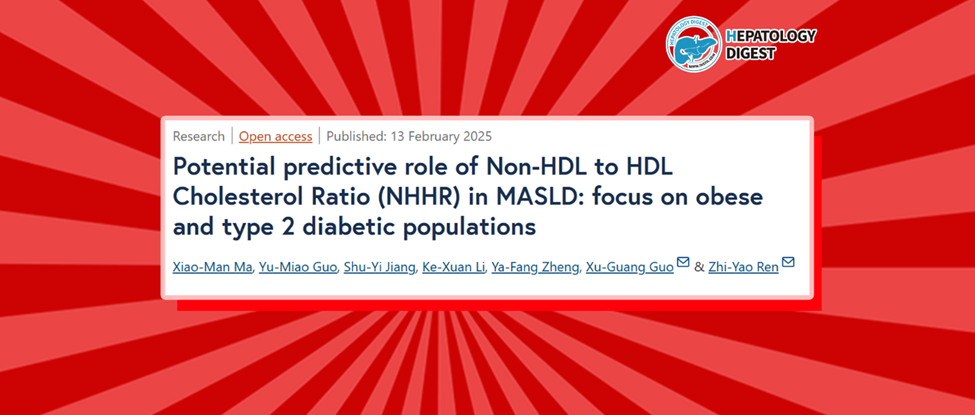
NHHR Shows Great Potential in Predicting MASLD in Obese and Type 2 Diabetes Populations
Editor’s Note: Metabolic dysfunction-associated steatotic liver disease (MASLD) affects approximately one-quarter of the global adult population, imposing a significant health and economic burden. However, there are currently no approved treatments…
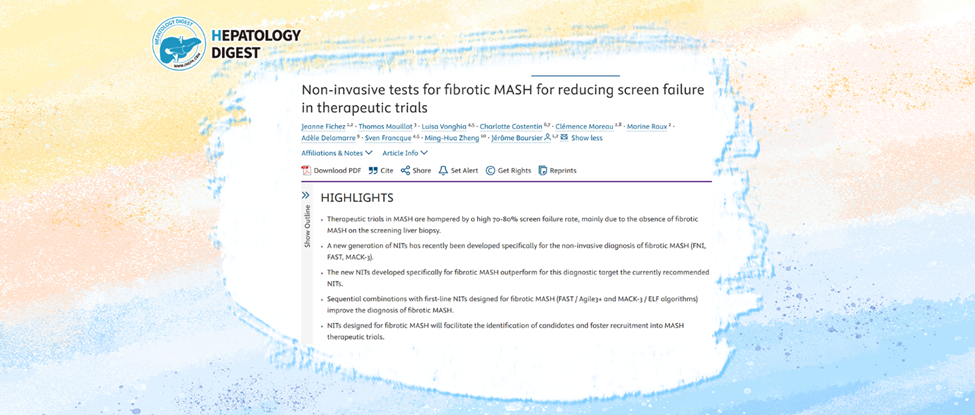
New Non-Invasive Screening Strategies Improve MASH Clinical Trials by Reducing Screening Failure Rates
Editorial Note: Metabolic-associated steatohepatitis (MASH) is a subtype of metabolic-associated fatty liver disease (MASLD), characterized by hepatic steatosis, lobular inflammation, and hepatocellular ballooning, with a high risk of progressing to…
Professor Xichun Hu’s Team: Lerociclib plus letrozole versus placebo plus letrozole in HR+/HER2- advanced or metastatic breast cancer
Editor's Note: The 2024 American Society of Clinical Oncology (ASCO) Annual Meeting concluded successfully. At this conference, two studies from Professor Xichun Hu’s team at Fudan University Shanghai Cancer Hospital…
Research Progress丨Analysis of Platinum Intolerance and Treatment Outcomes in First-Line Treatment of Advanced Urothelial Carcinoma Patients
Advanced urothelial carcinoma (UC) patients have a poor prognosis with a low 5-year survival rate. Since the 1980s, platinum-based chemotherapy has been the standard first-line therapy for locally advanced or metastatic UC (la/mUC), but the benefits are limited. The real-world tolerance and treatment outcomes of platinum therapy remain unclear. This year's study analyzed data from advanced UC patients in the United States. This article summarizes and organizes the findings for our readers.
ASCO GI 2025 | Dr. Anna Dorothea Wagner:Dual-Target Therapy Shows No Survival Benefit in HER2-Positive Gastric Cancer
The 2025 American Society of Clinical Oncology Gastrointestinal Cancers Symposium (ASCO GI 2025) successfully concluded on January 25. One of the most closely watched presentations at the conference was the release of results from the EORTC-1203—INNOVATION trial (Abstract LBA331), capturing the attention of oncologists worldwide. Oncology Frontier had the exclusive opportunity to interview Dr. Anna Dorothea Wagner, a medical oncologist from Lausanne University Hospital in Switzerland, to discuss the study’s findings. Below is a summary of our conversation.
ASCO GI 2025 | Dr. Zhenyu Lin: Short-Course Radiotherapy Plus Targeted, Immuno-, and Chemotherapy for High-Risk LA
Editor's Note: The neoadjuvant treatment landscape for locally advanced rectal cancer (LARC) continues to evolve, with emerging research indicating that incorporating immunotherapy can significantly enhance the pathological complete response (pCR)…
Advancing Early-Stage Breast Cancer Monitoring with ctDNA Structural Variant Detection
A recent study published in Clinical Cancer Research (Jan 9, 2025) highlights the potential of structural variant (SV)-based circulating tumor DNA (ctDNA) detection in early-stage breast cancer (EBC). Unlike traditional…
ASCO GI 2025 | Dr. Xiufeng Liu’s In-Depth Analysis of CheckMate 9DW and CARES-310 Study Updates
The landscape of systemic therapy for hepatocellular carcinoma (HCC) has undergone a major transformation, shifting from single-agent targeted or immunotherapies to dual immune checkpoint inhibitors and immune-targeted combination regimens. The 2025 ASCO Gastrointestinal Cancers Symposium (ASCO GI), held on January 23, 2025, highlighted two pivotal studies—CheckMate 9DW and CARES-310—focusing on dual immunotherapy strategies for previously untreated unresectable hepatocellular carcinoma (uHCC) and the impact of viral infection status on treatment outcomes.
Dr. Xiangrui Meng: “VEGF-TKI + PD-1 Inhibitor + Chemotherapy” as a Potential New Treatment Option for PD-L1-Negative Advanced Gastric Cancer
In recent years, the emergence and breakthrough progress of multiple targeted and immunotherapy drugs, along with their combination regimens, have brought significant transformation to the systemic treatment of esophageal and gastric cancer. The field has evolved from monotherapy with targeted or immune agents to an era of dual or multi-immunotherapy combinations.