ASCO 2024| Meta-Analysis of Short-Term Recurrence Risk in HR+/HER2- Early Breast Cancer Patients Undergoing Endocrine Therapy

ASCO 2024| Meta-Analysis of Short-Term Recurrence Risk in HR+/HER2- Early Breast Cancer Patients Undergoing Endocrine Therapy

Multiple studies have demonstrated that both lymph node-positive and lymph node-negative stage II or III HR+/HER2- early breast cancer patients are at risk of recurrence, and the recurrence rate gradually increases over time. At the 2024 ASCO conference, a study conducted a systematic literature review and meta-analysis to evaluate the 3-year and 5-year recurrence risk in early breast cancer patients, emphasizing the need for treatment intensification in specific patient groups. This article provides a summary of the study.
Dr. Qiang Liu: Can Triple-Negative Breast Cancer Be Treated Without Chemotherapy?—Exploring Precision Medicine Guided by Biomarkers in Breast Cancer

Dr. Qiang Liu: Can Triple-Negative Breast Cancer Be Treated Without Chemotherapy?—Exploring Precision Medicine Guided by Biomarkers in Breast Cancer

In recent years, significant advancements have been made in the treatment of triple-negative breast cancer (TNBC), particularly in the field of biomarker research. To delve deeper into this, Cancer Outlook invited Dr. Qiang Liu from Sun Yat-sen Memorial Hospital, Sun Yat-sen University to provide an in-depth analysis of two recent landmark studies. These studies explore the prognostic value of tumor-infiltrating lymphocytes (TILs) in early-stage TNBC patients who have not undergone chemotherapy. The findings from these studies reveal a correlation between TIL levels and patient survival, offering a new perspective for identifying patients with a good prognosis who may not require chemotherapy. Additionally, Professor Liu shares insights from his own research on circulating tumor DNA (ctDNA) in breast cancer treatment, underscoring the importance of precision medicine in managing TNBC.
The 5th Lymphoma & Myeloma Immunotherapy and Targeted Therapy Conference | Dr. Kai Fu Discusses Research Progress and a New Prognostic Model in the North American Mantle Cell Lymphoma Program (NAMCLP) 

The 5th Lymphoma & Myeloma Immunotherapy and Targeted Therapy Conference | Dr. Kai Fu Discusses Research Progress and a New Prognostic Model in the North American Mantle Cell Lymphoma Program (NAMCLP) 

On July 20, 2024, the 5th Lymphoma & Myeloma Immunotherapy and Targeted Therapy Conference, part of the Gaobo Medical Academic Conference, was successfully held in Beijing. With the core themes of "Precision, Integration, and Innovation," the conference closely followed the latest developments and cutting-edge topics from the 29th Annual Congress of the European Hematology Association (EHA 2024) and the 2024 American Society of Clinical Oncology (ASCO) Annual Meeting. During the event, Dr. Kai Fu from Roswell Park Comprehensive Cancer Center delivered an insightful presentation on "Progress Reports From the Northern American MCL Consortium." In an exclusive interview with Hematology Frontier, Professor Fu discussed the research progress of the North American Mantle Cell Lymphoma Program (NAMCLP) and the significance of a novel prognostic model for mantle cell lymphoma (MCL). The following is a summary of the interview.
International Lung Cancer Conference | Dr. Yuehong Wang: Exploring a New Model for Comprehensive Lung Cancer Management in the AI Era

International Lung Cancer Conference | Dr. Yuehong Wang: Exploring a New Model for Comprehensive Lung Cancer Management in the AI Era

At the International Lung Cancer Conference (CLC 2024) held from August 9-11, Dr. Yuehong Wang from The First Affiliated Hospital, Zhejiang University School of Medicine delivered a keynote presentation titled "Exploring a New Model for Comprehensive Lung Cancer Management in the AI Era." This article provides a brief overview of her report.
International Lung Cancer Conference | Dr. Nan Bi: Optimizing MRIgART Processes to Improve the Treatment of Brain Metastases in Lung Cancer

International Lung Cancer Conference | Dr. Nan Bi: Optimizing MRIgART Processes to Improve the Treatment of Brain Metastases in Lung Cancer

Radiation therapy plays a crucial role in the treatment of brain metastases from lung cancer. At the recent International Lung Cancer Conference (CLC 2024), Dr. Nan Bi from the Cancer Hospital , Chinese Academy of Medical Sciences and Peking Union Medical College, delivered a keynote presentation titled "Advances in Precision Radiotherapy for Brain Metastases in Lung Cancer." The presentation focused on the necessity, safety, and technical challenges of using MRI-guided Adaptive Radiotherapy (MRIgART) for treating brain metastases. This article provides a brief overview of the report.
Highlights of the Zhongshan-Specific Colorectal Cancer Forum with Emphasis on Precision Diagnosis, Treatment, and Public Screening

Highlights of the Zhongshan-Specific Colorectal Cancer Forum with Emphasis on Precision Diagnosis, Treatment, and Public Screening

The Guangzhou Colorectal Cancer Summit Forum and the 22nd Guangdong Provincial Colorectal Cancer Academic Conference were successfully held from August 5-10, 2024. Reporters from Oncology Frontier conducted an in-depth interview with the conference chair, Dr. Gong Chen from the Sun Yat-sen University Cancer Center, focusing on the highlights of the conference and the precision diagnosis and treatment of colorectal cancer. This article summarizes the interview.
B J Hepatol | Xiaolong Qi / Jie Shen: High Prevalence o+f Liver Fibrosis in the General Population of China

B J Hepatol | Xiaolong Qi / Jie Shen: High Prevalence o+f Liver Fibrosis in the General Population of China

On July 28, 2024, the Journal of Hepatology (CAS 1st Tier, IF: 26.8), a leading international journal in hepatology, published a prospective study conducted by the LiverHome research group. This study, based on the general population in China, assessed the prevalence of fatty liver disease and liver fibrosis, providing the latest evidence for chronic liver disease screening in China. The study's corresponding authors are Xiaolong Qi, a CHESS founder, and Jie Shen from Shunde Hospital of Southern Medical University. The co-first authors are Shanghao Liu (Zhongda Hospital, Southeast University) and Heng Wan (Shunde Hospital of Southern Medical University).
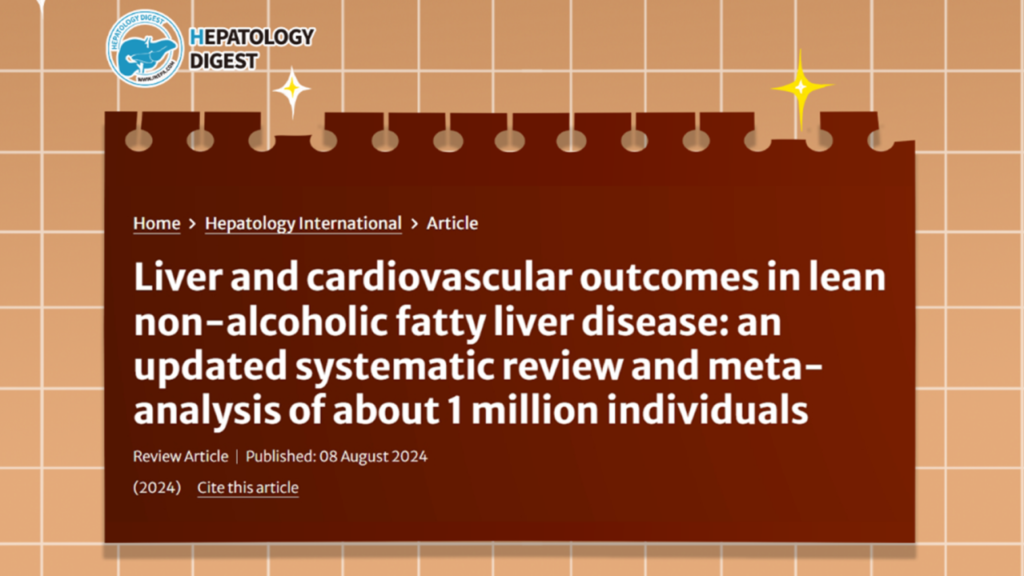
Hepatol Int | Higher Risk of Liver-Related Mortality in Lean MAFLD Patients Compared to Non-Lean Patients

Hepatol Int | Higher Risk of Liver-Related Mortality in Lean MAFLD Patients Compared to Non-Lean Patients

While metabolic-associated fatty liver disease (MAFLD) has traditionally been associated with obesity and metabolic syndrome, recent studies indicate that a significant prevalence of MAFLD also exists among lean individuals. These patients typically do not exhibit traditional obesity-related risk factors, such as a high body mass index (BMI) or large waist circumference, yet their livers are affected by pathological changes similar to those seen in obese individuals. Recently, a research team led by Dr. Matheus Souza from the Federal University of Rio de Janeiro School of Medicine published a systematic review and meta-analysis that delves into the liver and cardiovascular risks in lean MAFLD patients compared to their non-lean counterparts. The findings offer new insights for clinical practice and public health strategies concerning MAFLD.
AIDS 2024 | WHO-Recommended Triple HIV Testing Algorithm Significantly Improves Diagnostic Accuracy

AIDS 2024 | WHO-Recommended Triple HIV Testing Algorithm Significantly Improves Diagnostic Accuracy

In 2023, the World Health Organization (WHO) recommended that countries with low HIV prevalence adopt a triple testing approach to confirm HIV-positive diagnoses. Specifically, WHO advises countries with an HIV prevalence below 5% to use three consecutive tests to ensure a 99% diagnostic accuracy. The proportion of positive HIV tests in a population can impact diagnostic accuracy, and when the HIV positivity rate is below 5%, at least three consecutive tests are required to guarantee a 99% accuracy rate in diagnosis.
AIDS Dialogue | Acute HIV Infection Detection: A Critical Battle to Block Transmission and Improve Prognosis

AIDS Dialogue | Acute HIV Infection Detection: A Critical Battle to Block Transmission and Improve Prognosis

Early detection and treatment of HIV play a crucial role in AIDS prevention and control. A critical battlefield is emerging with increasing importance—the timely detection of acute HIV infection (AHI). AHI refers to the period from the entry of the HIV virus into the body until antibodies become detectable, typically occurring within a few weeks to a few months after infection. During this period, the virus replicates rapidly within the body, leading to a sharp increase in viral load, reaching its peak concentration. Consequently, individuals with AHI are at high risk of transmitting HIV and are a key focus for controlling the spread of the virus. At the 25th International AIDS Conference (AIDS2024), Infectious Diseases Frontier(IIDF) invited Dr. Eduard Sanders from the Aurum Institute in Johannesburg, South Africa, and Dr. Hugo Xi, Senior Medical Director of Scientific and Clinical Affairs at Abbott, to discuss the strategic importance and urgency of AHI detection. They emphasized the immense potential of innovative fourth-generation rapid HIV screening tests in identifying highly infectious individuals. Faced with challenges such as high testing costs, limited data, and false positives, they call for increased public awareness of AHI and advocate for policy adjustments and technological advancements to ensure more people benefit from this crucial testing.