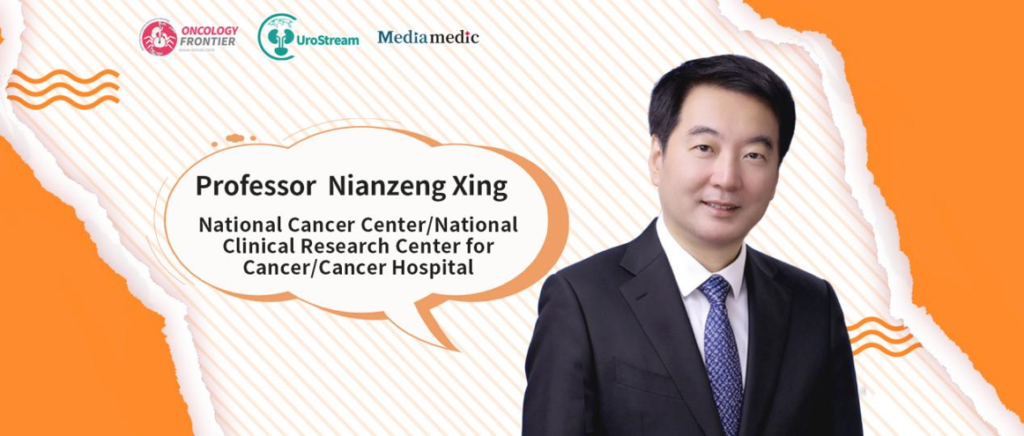
The 2026 Yanqi Lake Academic Conference for Urologists was successfully held in Beijing. During the meeting, Conference Chair Professor Nianzeng Xing, Vice President of the National Cancer Center / Cancer Hospital, Chinese Academy of Medical Sciences, shared his personal journey during the special session “From a Skilled Commander to a Strategic Leader.” He reflected on his transformation from a surgeon striving for technical perfection in the operating room to a discipline leader committed to cultivating teams and advancing the field as a whole.Oncology Frontier · UroStream had the privilege of conducting an exclusive interview with Professor Nianzeng Xing to further explore the growth trajectory of surgeons, the core principles of team building, and how standardized training can help elevate the overall quality of urologic oncology care across China.
Q1. During the “From a Skilled Commander to a Strategic Leader” session, you described your transition from focusing on performing excellent surgery yourself to enabling your entire team to achieve surgical excellence. Could you share what experiences or turning points led to this fundamental shift in perspective?
Professor Nianzeng Xing
Nianzeng Xing
“Surgery is the core therapeutic tool of every surgeon. A high-quality operation can significantly shorten recovery time and improve treatment outcomes, and this has always been the professional pursuit of urologists.
For young surgeons, mastering advanced surgical skills requires relentless practice and refinement. Only through repeated clinical experience—combined with continuous reflection, summarization, and optimization—can a surgeon gradually develop a personal operative style and technical system, eventually transforming experience into consistent clinical capability.
As my own clinical experience accumulated and my professional expertise advanced, my professional aspirations also evolved profoundly. Once I progressed from being a young physician to a senior surgeon capable of independently performing complex procedures, I no longer felt satisfied simply with performing good surgery myself. Instead, I became increasingly committed to sharing the knowledge and techniques I had accumulated over many years with colleagues and younger generations of physicians.
In many ways, this reflects a developmental journey that every doctor should experience: from studying medicine, to practicing medicine, and ultimately to teaching medicine and passing it forward.
Passing on one’s skills and helping young physicians grow rapidly is both the responsibility and mission of our generation.
It was based on this philosophy that, during this conference, I shared my approach to simplifying and systematizing complex surgical procedures by organizing them into structured workflows and concise operative mnemonics.
Through this method, younger surgeons can more easily remember the key technical points and challenges of surgery while gaining a clearer understanding of the complete procedural process. In doing so, the learning curve can be shortened substantially and the difficulty of training reduced.
I truly enjoy this kind of work because an individual’s time and energy are ultimately limited. No matter how many operations I personally perform each day, the number of patients I can treat will always be finite.
However, if I can teach these techniques to many more physicians—enabling them all to master standardized and highly refined surgical skills—then countless more patients will ultimately benefit. To me, that represents the greatest value and accomplishment of being a physician.”
Q2. As Vice President of the Cancer Hospital, Chinese Academy of Medical Sciences, you must balance maintaining excellence in clinical urologic surgery while also leading team development. How do you manage these dual responsibilities? What effective approaches have you found for improving team surgical performance and mentoring young physicians?
Professor Nianzeng Xing
“I currently serve as Vice President of the National Cancer Center / Cancer Hospital, Chinese Academy of Medical Sciences, and this role certainly comes with significant administrative responsibilities.
However, I have always believed that I am first and foremost a urologic surgeon. Therefore, I must continue dedicating substantial time to frontline clinical practice, including surgery, outpatient care, and multidisciplinary consultations for complex cases.
Only by remaining deeply rooted in clinical medicine can one maintain sharp clinical insight and continue advancing technically.
Surgery is fundamentally a highly collaborative discipline. No complex urologic operation can be completed successfully by the lead surgeon alone. A successful procedure requires close coordination among the first assistant, second assistant, scrub nurse, circulating nurse, anesthesiologist, and many other team members.
Therefore, building a technically strong and highly coordinated team is essential for improving the overall quality of departmental care.
Over the years, our department has consistently remained aligned with international academic frontiers, firmly focusing on the central direction of specialty development—namely, minimally invasive surgery—as the key driver for enhancing our clinical capabilities.
At the same time, we established clear goals for international academic branding and long-term strategic development: using academic and disciplinary advancement as the foundation, while taking minimally invasive surgery as the core clinical approach to promote high-quality departmental growth comprehensively.
Through the collective efforts of the entire team, we have built not only an outstanding surgical team, but also a clinically driven research platform focused on solving real-world problems. This has enabled us to achieve a series of important breakthroughs in both basic and translational research in urologic oncology, addressing many longstanding clinical challenges.
As a department leader, my greatest hope today is to see young physicians grow rapidly and eventually become independent leaders in their own right.
Our hospital has established a comprehensive graduate training system and standardized residency training program. Based on each young physician’s strengths and career goals, we develop individualized professional development plans tailored to their future direction.
In addition, in 2018 I initiated the National Cancer Center Elite Training Program in Urologic Oncology, which recruits outstanding urologists from across China who are passionate about the field of urologic oncology.
This program adopts a mentorship-based teaching model combined with hands-on surgical instruction, aiming to systematically teach standardized treatment concepts and the latest minimally invasive techniques in urologic oncology while promoting nationwide consistency in clinical practice.
China is geographically vast, and substantial disparities in healthcare resources and medical standards still exist across regions. In some grassroots areas, the diagnosis and treatment of urologic tumors remain insufficiently standardized.
To date, our elite training program has successfully trained more than 200 outstanding physicians from throughout the country. After returning to their local institutions, these physicians have become key leaders in regional urologic oncology practice, with many later advancing to positions such as hospital vice president or department chair.
Importantly, they are not only promoting standardized care locally, but are also training younger physicians themselves, creating a positive cycle of mentorship and professional succession.
Through this continuously expanding network of influence, we are steadily advancing the standardization of urologic oncology care across China, enabling more patients to access high-quality medical services closer to home.
I firmly believe that, as long as we continue these efforts persistently, the overall standard of urologic oncology care in China will improve significantly.”