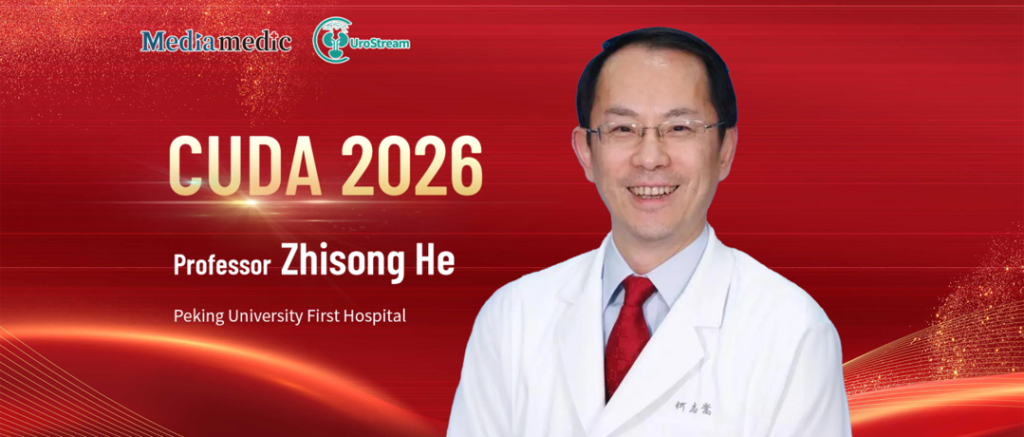
The 2026 Annual Meeting of the Chinese Urological Association (CUDA) was held in Zhengzhou under the theme "Collaboration and Innovation." The conference focused on key topics including precision diagnosis and treatment of urologic diseases, comprehensive cancer management, and multidisciplinary team (MDT) care, showcasing China's latest advances in technological innovation and the standardization of clinical practice.During the meeting, UroStream interviewed Prof. Zhisong He from Peking University First Hospital to discuss the development of China’s tiered healthcare system, strengthening clinical capacity at primary healthcare institutions, and the evolving relationship between systemic therapy and surgery in modern urologic oncology.
UroStream:
As an advisor to this year’s CUDA Annual Meeting, how would you evaluate the overall design and strategic direction of the conference?
Prof. Zhisong He:
Building upon the experience accumulated over many years, I believe this year’s CUDA Annual Meeting has reached an even higher level overall.
The conference theme, “Collaboration and Innovation,” aligns closely with China’s broader vision for the future of medicine.
On one hand, after years of development, Chinese urology has progressed from following international advances to keeping pace with them, and in certain areas has even become a global leader. Overall, the specialty is developing very well.
On the other hand, because China is a geographically vast country, there remains considerable room for improvement in the capabilities of primary healthcare institutions. Strengthening education and training at the grassroots level therefore remains an important priority.
From the perspective of conference organization, this year’s program not only retained the traditional disease-specific subspecialty sessions but also placed greater emphasis on medical education, translational medicine, and capacity building for primary care physicians, resulting in a more comprehensive and balanced scientific program.
Attendance also reached a record high this year, reflecting both the rapid development of the specialty and the strong interest from the urology community.
UroStream:
You have devoted many years to the surgical management of upper urinary tract tumors. Regarding surgical standardization in primary hospitals, what is the most important message you hoped to convey during this meeting?
Prof. Zhisong He:
China has established comprehensive quality control systems for hospital management, specialty development, and disease-specific care.
Many people mistakenly believe that quality control is primarily about pursuing increasingly advanced surgical techniques. In reality, its fundamental purpose is to promote standardization and consistency in healthcare delivery.
The essence of quality control is to improve the overall quality of medical services, particularly by strengthening standardized clinical practice among physicians working in primary healthcare settings.
In reality, China’s leading academic centers have already achieved internationally competitive standards, whereas significant opportunities for improvement still exist at the grassroots level.
Within the framework of China’s tiered healthcare system, primary hospitals are not expected to perform procedures at the same technical level as national referral centers. Instead, each institution should have a clearly defined role.
For physicians working in primary hospitals, the priority is mastering national quality standards, understanding the essential requirements for accurate diagnosis, and following standardized treatment pathways.
We do not encourage primary hospitals to pursue highly complex surgical procedures indiscriminately.
Providing high-quality routine surgery and standardized patient care already represents a strong foundation and is entirely consistent with the principles of tiered healthcare.
Conversely, pursuing highly sophisticated procedures without first establishing standardized basic care not only limits sustainable development but may also expose patients to unnecessary medical risks.
Therefore, I hope physicians at primary institutions will remain grounded in clinical reality and focus on delivering standardized, evidence-based care to their patients.
UroStream:
This year’s conference emphasizes precision medicine and comprehensive cancer management. How do you view the evolving relationship between systemic therapy and surgery in contemporary clinical decision-making?
Prof. Zhisong He:
This is an excellent question because it reflects one of the central themes of modern clinical practice.
Our treatment philosophy has evolved from simply treating diseases to treating patients, emphasizing comprehensive management throughout the entire course of care.
From the moment a patient is diagnosed, careful risk stratification is required in order to determine the most appropriate individualized treatment pathway.
Surgery remains a fundamental and indispensable component of treatment.
However, we must also recognize that the optimal treatment plan for any individual patient cannot be determined by surgery alone. Instead, it results from a comprehensive evaluation of all available therapeutic options.
Today, we have entered the era of multidisciplinary team (MDT)-based comprehensive care.
Although surgery remains critically important, perioperative systemic therapy, treatment for advanced disease, and radiotherapy have likewise become essential components of the overall treatment strategy. These modalities complement one another and together form a complete continuum of care.
Within this framework, different specialties should be viewed as collaborators rather than competitors.
In clinical practice, we occasionally observe that some physicians become defensive when colleagues from other specialties become involved in patient management. In my opinion, this attitude is unnecessary.
Whether one practices surgery, medical oncology, or radiation oncology, each specialty addresses a different aspect of the same disease, while pursuing the same ultimate objective—achieving the best possible outcomes for patients.
Therefore, closer collaboration among specialties should always be centered on improving patient benefit.
This philosophy was well reflected in this year’s conference program, which devoted substantial attention to multidisciplinary collaboration.
Overall, surgery, systemic therapy, and radiotherapy are all indispensable components of modern urologic oncology, and only through genuine collaboration within an MDT framework can patients receive truly optimal care.
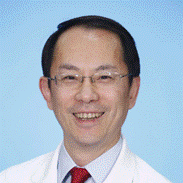
Prof. Zhisong He