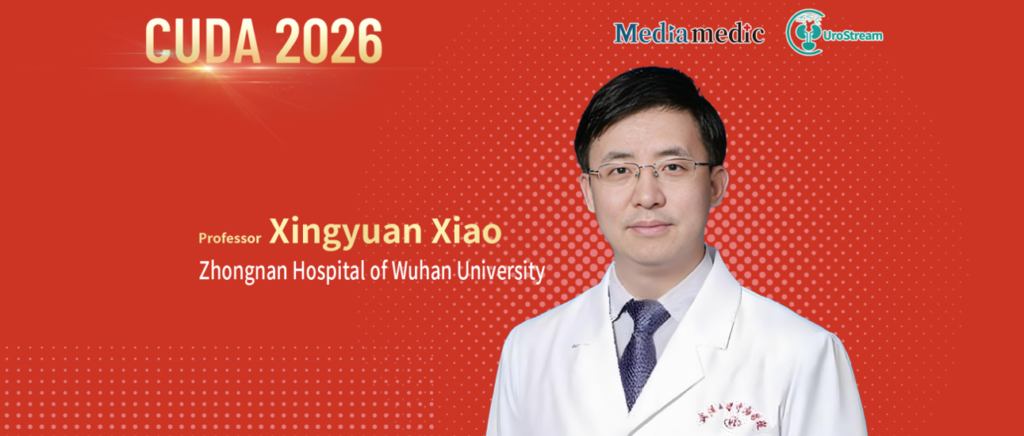
The 2026 Annual Meeting of the Chinese Urological Doctor Association (CUDA 2026) was held in Zhengzhou, Henan, from June 11 to 14. Prof. Xingyuan Xiao of Zhongnan Hospital of Wuhan University has long been engaged in the clinical management and research of urologic diseases, with extensive experience in integrating traditional Chinese medicine (TCM) and Western medicine for urologic cancers and treatment-related complications.During CUDA 2026, Oncology Frontier – UroStream interviewed Prof. Xiao about translating the clinical value of integrated Chinese and Western medicine into evidence-based practice, as well as the role and challenges of multidisciplinary team (MDT) care in the comprehensive management of urologic cancers.
Oncology Frontier – UroStream: Traditional Chinese medicine’s collateral disease theory has shown potential advantages in chronic urologic diseases and supportive cancer care. How can modern research methodologies be used to translate its clinical value into scientific evidence that gains international recognition?
Prof. Xingyuan Xiao:
As clinicians at Zhongnan Hospital of Wuhan University, we have long explored the integration of traditional Chinese and Western medicine in cancer treatment, particularly in bladder cancer, where we have accumulated considerable clinical experience.
One of the major challenges facing integrated Chinese and Western medicine is how to transform clinical experience into high-quality evidence-based medical data that can be recognized by both Chinese and international colleagues.
This goes beyond simply demonstrating therapeutic efficacy. A more fundamental challenge is establishing a relationship between the traditional concept of “collaterals” and modern pathophysiological processes such as angiogenesis, fibrosis, and the immune microenvironment, and subsequently incorporating treatments based on this theoretical framework into standardized clinical research. This represents one of the key challenges in current translational research.
One potential advantage of TCM in cancer care is its role in reducing treatment-related toxicity while supporting therapeutic benefit. For example, patients with non-muscle-invasive bladder cancer may develop chemical cystitis, urinary frequency, urgency, and dysuria following intravesical therapy. These adverse effects can substantially compromise treatment adherence and quality of life.
Our clinical observations suggest that therapies based on collateral disease theory, including traditional Chinese herbal formulations aimed at promoting blood circulation and improving collateral flow, as well as acupuncture, may have potential in alleviating local microcirculatory disturbances and inflammatory responses.
Although some studies have reported encouraging findings, large-scale, multicenter randomized controlled trials remain lacking. This is precisely one of the key questions our current major research project seeks to address: how can symptom improvements achieved through collateral disease theory-based interventions be translated into quantifiable patient-reported outcomes (PROs) and objective inflammatory biomarkers?
With support from China’s health authorities and the National Administration of Traditional Chinese Medicine, our team is leading a major research project evaluating integrated Chinese and Western medicine for bladder cancer based on collateral disease theory.
The study uses a randomized, controlled, double-blind design. Its primary endpoints include improvement in lower urinary tract symptoms following intravesical therapy and changes in quality-of-life scores, while alterations in collateral-related biomarkers are also being explored. The project is now in its second year and has accumulated a growing body of clinical data.
Ultimately, we hope that robust evidence will allow us to establish standardized integrated treatment and complication-management strategies, enabling patients to achieve broader overall benefits throughout their treatment journey rather than focusing solely on tumor control.
Oncology Frontier – UroStream: How do you view the role of the MDT model in comprehensive urologic cancer management, and what are the major challenges to its broader implementation in clinical practice?
Prof. Xingyuan Xiao:
The multidisciplinary team (MDT) model has become one of the core strategies in modern cancer management and is explicitly recommended by both international guidelines, such as those from the EAU, and China’s CUA guidelines.
However, MDT implementation still faces certain limitations in real-world practice, particularly in bladder cancer.
Unlike breast and colorectal cancers, where relatively mature molecular classifications and precision-targeted strategies have been established, precision molecular classification and corresponding targeted therapies for bladder cancer remain largely under clinical investigation. A broadly applicable standardized pathway has yet to emerge.
Consequently, MDT decision-making in bladder cancer sometimes lacks sufficiently strong evidence to support specific recommendations, which can limit the practical clinical value of multidisciplinary discussions.
I therefore believe that the future development of MDT care should focus on two priorities: expanding the population that can benefit and improving the degree of individualization.
Within this framework, TCM may represent an important but currently underappreciated component.
For bladder cancer, MDT discussions currently focus primarily on questions such as how to select among surgery, radiotherapy, chemotherapy, and immunotherapy. By comparison, treatment-related complications—including chemical cystitis following intravesical therapy, postoperative lower urinary tract symptoms, and immune-related adverse events—as well as the management of patients’ long-term quality of life often receive less attention.
These are precisely areas in which TCM may offer complementary value.
If TCM physicians are formally incorporated into MDT teams, traditional Chinese medicine interventions could be introduced throughout the management of appropriate patients—for example, syndrome-specific herbal formulations or acupuncture—with predefined efficacy assessment points and clear criteria for treatment discontinuation.
Such an approach could allow a broader range of patients to derive tangible benefits from MDT care while more fully realizing the principle of patient-centered, comprehensive management throughout the disease course.
This may represent a promising direction for the further evolution of MDT-based care in urologic oncology.
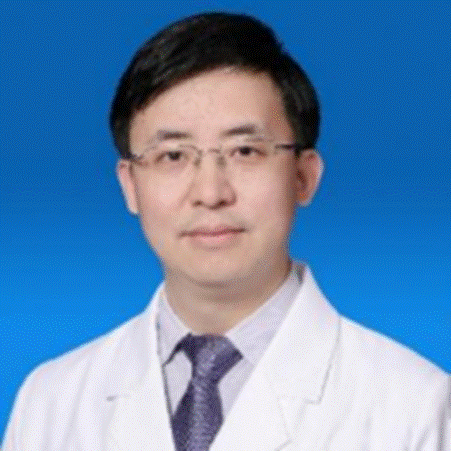
Prof. Xingyuan Xiao
Zhongnan Hospital of Wuhan University