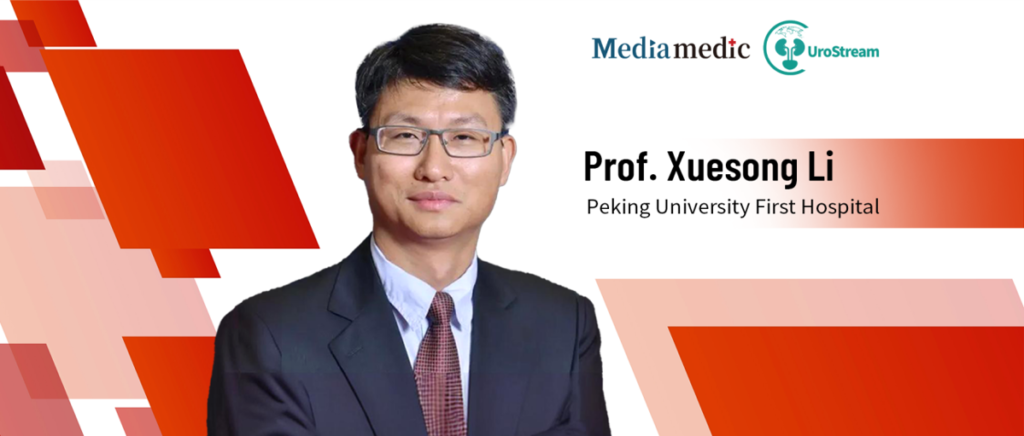
The 2nd Peking University Urology Academic Forum focused on the integrated and collaborative management of benign and malignant diseases of the upper urinary tract. As conference chair, Professor Xuesong Li from the Department of Urology at Peking University First Hospital shared his team’s long-standing experience and insights into the field’s major clinical challenges, key innovations, and future directions.Oncology Frontier – UroStream has compiled highlights from the interview for our readers.
Building an Integrated Framework for Upper Urinary Tract Disease Management
Oncology Frontier – UroStream:
As chair of this year’s forum, you identified “integrated collaborative management of benign and malignant upper urinary tract diseases” as one of the central themes. What inspired this focus?
Professor Xuesong Li:
Thank you to Oncology Frontier for the invitation.
At the 2nd Peking University Urology Academic Forum, I presented on the topic of “Collaborative Innovation and Leadership in Upper Urinary Tract Diseases.” Over the past 15 years, my two subspecialty areas—upper urinary tract oncology and upper urinary tract reconstruction—have gradually developed a strong synergistic relationship.
Malignant upper urinary tract tumors, including renal pelvic carcinoma and ureteral carcinoma, represent a particularly distinctive category of urologic malignancies in China. Meanwhile, upper urinary tract reconstruction primarily addresses hydronephrosis caused by congenital anomalies, injury, or malignancy.
These two fields naturally intersect. From diagnosis to treatment, and from novel technologies and concepts to innovative devices, there is substantial room for collaborative innovation. More importantly, both categories of disease share common challenges, including diagnostic complexity, rigid treatment demands, and strong dependence on advanced technologies and equipment. These factors create an ideal foundation for integrated management.
Key Innovations in Integrated Diagnosis and Treatment
Oncology Frontier – UroStream:
You have long focused on collaborative innovation in upper urinary tract diseases. In current clinical practice, what key advances have been achieved in integrated management strategies for high-risk upper tract urothelial carcinoma and upper urinary tract reconstruction?
Professor Xuesong Li:
Upper urinary tract malignancies have several unique characteristics in China. Epidemiologically, they may be associated with exposure to aristolochic acid-containing traditional herbal medicines. Over the past decades, this has contributed to a higher proportion of ureteral malignancies, more frequent renal insufficiency, and generally lower tumor stage among Chinese patients.
These characteristics provide a strong rationale for kidney-sparing approaches.
Kidney preservation requires a broad range of reconstructive techniques, including ileal ureter substitution, renal autotransplantation, and patch reconstruction methods—areas in which we have accumulated extensive expertise over many years in upper urinary tract reconstruction.
At the same time, numerous novel therapies are emerging, including antibody–drug conjugates (ADCs) targeting different molecular pathways, as well as innovative applications of radiotherapy. Together, these therapeutic advances are reshaping kidney-sparing strategies for upper urinary tract tumors.
In addition, domestically developed medical technologies—such as advanced laser systems and surgical robots—have further accelerated progress. The integration of new devices, concepts, technologies, and therapies has enabled China to maintain a leading position in the integrated management of benign and malignant upper urinary tract diseases, with the potential to become an international leader in the field.
Future Directions: Precision Diagnosis, Technological Innovation, and Global Leadership
Oncology Frontier – UroStream:
Current frontiers in upper urinary tract disease management include precision imaging, minimally invasive techniques, and targeted or immunotherapy. In your view, what are the future directions for integrated management of benign and malignant upper urinary tract diseases? As conference chair, what breakthroughs do you hope this forum will help promote?
Professor Xuesong Li:
Chinese urologists are well positioned to play an important role in shaping the future of upper urinary tract disease management, including advances in diagnosis, treatment, technology, clinical concepts, and medical devices.
In diagnostics, we have focused on noninvasive urine-based testing. By integrating next-generation sequencing (NGS) and combinational mutation analysis, we have increased the sensitivity and specificity of urinary diagnostics to over 95%.
We have also combined ADC therapies with novel targeted PET-CT imaging to address the issue of tumor heterogeneity in biopsy sampling while establishing correlations with treatment response.
In addition, we are actively characterizing novel disease phenotypes. For example, in the field of upper urinary tract disorders, we identified a benign polypoid condition characterized by three defining features: multiple annular ureteral strictures, ureteral tortuosity, and multiple polyps. We named this condition MASTUMP syndrome and are currently investigating its pathogenic genes through genomic sequencing.
Discovering a previously unrecognized disease phenotype in the field of upper urinary tract reconstruction is particularly meaningful.
We are also paying close attention to high-end domestically developed medical devices, including Chinese-made laser systems and robotic platforms. These technologies provide surgeons with greater precision during upper urinary tract oncologic and reconstructive procedures, contributing to improved recovery, enhanced safety, and fewer complications.
Looking ahead, we aim to further deepen patient-centered interdisciplinary collaboration and continue exploring new integrated models of diagnosis and treatment.
Through this forum, we hope to organically integrate the achievements accumulated over more than a decade by the two Peking University urology teams specializing in upper urinary tract oncology and reconstruction. Our goal is not only to better serve patients, but also to generate more internationally influential “China solutions” for the global urologic community.
Expert Profile

Professor Xuesong Li Department of Urology Peking University First Hospital