Editor's Note: The combination of immune checkpoint inhibitors and antibody-drug conjugates (ADCs) is rapidly expanding from the first-line treatment of advanced disease into the perioperative setting, fundamentally reshaping the treatment landscape of urothelial carcinoma (UC). As global research momentum continues to accelerate, Chinese-developed immunotherapy–ADC combinations are emerging as important contributors to this evolving field.At the 2026 ASCO Annual Meeting, two oral presentations from China highlighted key advances in genitourinary oncology. Professor Jun Guo and Professor Xinan Sheng of Peking University Cancer Hospital presented long-term follow-up data from a study evaluating toripalimab plus 9MW2821 in advanced urothelial carcinoma (Abstract 4518), demonstrating durable deep responses and promising efficacy signals in patients with impaired renal function. Meanwhile, Professor Dingwei Ye and Professor Yijun Shen of Fudan University Shanghai Cancer Center reported preliminary findings from a perioperative study of adebrelimab plus SHR-A2102 in muscle-invasive bladder cancer (MIBC) (Abstract 4506).
Together, these studies span both advanced and perioperative disease settings, illustrating how immunotherapy–ADC combinations are extending beyond metastatic disease into earlier stages of treatment. During ASCO 2026, Oncology Frontier invited Professor Yijun Shen to discuss the significance of these findings and share his perspectives on the role of immunotherapy–ADC strategies across the entire urothelial carcinoma treatment continuum.
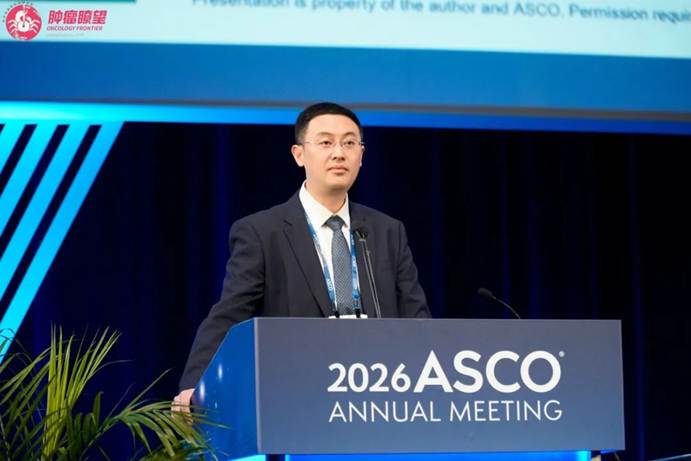
01. Global Momentum: Immunotherapy–ADC Combinations Are Redefining the Treatment Paradigm in Urothelial Carcinoma
Professor Yijun Shen:
Before focusing on Chinese studies, it is important to first understand the broader international landscape.
At this year’s ASCO Annual Meeting, the EV-302/KEYNOTE-A39 study presented 3.5-year follow-up data, further reinforcing the position of enfortumab vedotin (EV) plus pembrolizumab as the standard first-line treatment for advanced urothelial carcinoma.
In the perioperative setting, the EV-303/KEYNOTE-905 study not only established this combination as a new standard for cisplatin-ineligible patients with muscle-invasive bladder cancer, but also demonstrated through patient-reported outcomes (PROs) that improved efficacy was achieved without compromising postoperative quality of life.
Collectively, these studies are driving the field toward increasingly precise treatment strategies that place greater emphasis on both long-term survival and quality of life.
Against this backdrop, Chinese-developed regimens such as toripalimab plus 9MW2821 and adebrelimab plus SHR-A2102 are gradually transitioning from followers to active participants in global scientific dialogue, contributing important clinical evidence and a distinctive Chinese perspective to the ongoing evolution of urothelial carcinoma treatment.
02. Toripalimab Plus 9MW2821: Chinese Innovation Shines on the International Stage
Professor Yijun Shen:
This phase Ib/II study, led by Professor Jun Guo and Professor Xinan Sheng of Peking University Cancer Hospital, evaluated the combination of the domestically developed PD-1 inhibitor toripalimab and the Nectin-4-targeting ADC 9MW2821 in patients with locally advanced or metastatic urothelial carcinoma (a/mUC).
9MW2821 utilizes site-specific conjugation technology and differs structurally from enfortumab vedotin, potentially resulting in distinct pharmacokinetic characteristics.
When first presented at ASCO last year, the study generated considerable excitement with an objective response rate (ORR) of 87.5% among treatment-naïve patients. This year’s presentation provided updated data with a median follow-up of 16 months.
Among 47 evaluable patients, the ORR reached 83.0%, while the complete response (CR) rate was 12.8%.
One particularly noteworthy finding was that all patients who achieved a complete response have maintained their remission to date. The patient with the longest ongoing response has now remained in remission for more than two years, suggesting that toripalimab plus 9MW2821 may offer deep and durable responses for a subset of patients.
In addition, the median progression-free survival (PFS) was 12.9 months, the 18-month overall survival (OS) rate was 68.1%, and the median OS has not yet been reached.
The safety profile remained consistent with previous reports. Based on these encouraging early findings, a pivotal phase III trial is currently underway.
The value of this study extends beyond its impressive overall efficacy results. Subgroup analyses identified a particularly important potential advantage: the combination demonstrated encouraging activity in elderly patients and in those with impaired renal function.
This observation is highly relevant because renal impairment is common among patients with urothelial carcinoma. Bladder cancer itself can lead to obstructive nephropathy through ureteral obstruction, while patients with upper tract urothelial carcinoma frequently have only a single functioning kidney following nephroureterectomy. Consequently, the use of platinum-based chemotherapy is often limited.
Previous studies have shown that approximately half of patients with muscle-invasive bladder cancer are ineligible for cisplatin-based neoadjuvant chemotherapy due to inadequate renal function.
Toripalimab, as an immune checkpoint inhibitor, is not dependent on renal clearance and therefore possesses an inherent pharmacokinetic advantage in patients with renal dysfunction. Although historical data regarding ADC use in this population have been limited, the findings from Abstract 4518 provide an important new direction for future investigation.
03. Adebrelimab Plus SHR-A2102 Demonstrates Early Promise in the Perioperative Setting
Professor Yijun Shen:
If Abstract 4518 highlighted the efficacy and durability of immunotherapy–ADC combinations in advanced disease, our team’s Abstract 4506 explored the same strategy in an earlier treatment setting.
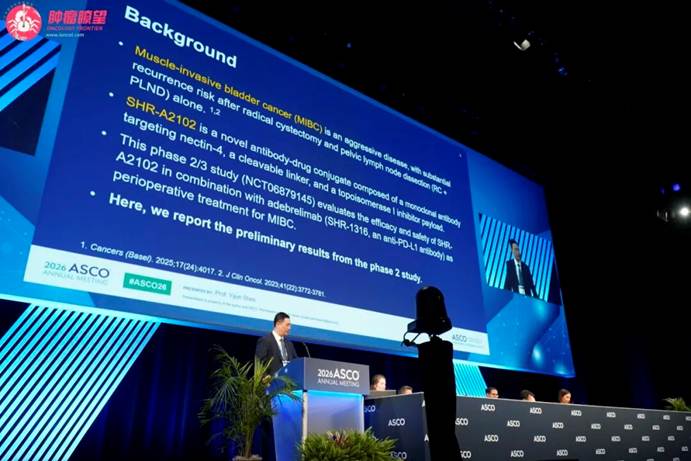
The study evaluated the combination of the Chinese-developed PD-L1 inhibitor adebrelimab and the Nectin-4-targeting ADC SHR-A2102 as perioperative treatment for muscle-invasive bladder cancer. The results presented at ASCO represent the preliminary findings from the phase II portion of the study.
Eligible patients had cT2–4aN0M0 or T1–4aN1M0 MIBC. During the neoadjuvant phase, patients received four cycles of adebrelimab plus SHR-A2102, followed by radical cystectomy with pelvic lymph node dissection (RC+PLND). Postoperatively, patients received five cycles of SHR-A2102 and thirteen cycles of adebrelimab as adjuvant therapy.
A total of 37 patients were enrolled. Among the 27 patients who underwent surgery, the pathological complete response (pCR) rate reached 48.1%, while 59.3% achieved pathological downstaging (pDS). The treatment was generally well tolerated and demonstrated a manageable safety profile.
Importantly, among patients with creatinine clearance below 60 mL/min, the pCR benefit appeared unaffected, a finding that closely mirrors the trend observed in Abstract 4518.
While long-term outcomes still require confirmation in phase III studies, this represents the first major report of a Chinese-developed Nectin-4 ADC in the perioperative setting and clearly demonstrates the potential of moving this therapeutic strategy into earlier stages of disease management.
04. Looking Ahead: From Advanced Disease to the Perioperative Setting, Chinese Immunotherapy–ADC Combinations Are Shaping a New Blueprint for Urothelial Carcinoma Treatment
Professor Yijun Shen:
When these two studies are viewed together, a clear developmental trajectory emerges.
Abstract 4518 demonstrated the promising efficacy and remarkable durability of a Chinese-developed immune checkpoint inhibitor–ADC combination represented by toripalimab in advanced urothelial carcinoma.
Meanwhile, Abstract 4506 explored the curative potential of the same therapeutic concept in the perioperative setting.
Together, these studies provide compelling evidence that immune checkpoint inhibitors combined with Nectin-4-targeted ADCs are fundamentally transforming the treatment landscape of urothelial carcinoma across multiple stages of disease.
Particularly encouraging is the continued international recognition of toripalimab as a leading example of Chinese innovation in immuno-oncology. Its clinical data have repeatedly been featured at major international conferences such as ASCO and ESMO, with successful applications extending from melanoma and nasopharyngeal carcinoma to urothelial carcinoma, steadily expanding the global influence of Chinese-developed therapies.
In the highly competitive field of immunotherapy–ADC combinations for genitourinary cancers, toripalimab plus 9MW2821 has demonstrated the potential to stand alongside enfortumab vedotin plus pembrolizumab while offering unique advantages, particularly in providing effective treatment options for patients with renal impairment.
This represents an important Chinese contribution to the global management of urothelial carcinoma and reflects the broader evolution of China’s oncology innovation ecosystem—from following international trends, to advancing in parallel, and increasingly leading in selected areas of innovation.
The scientific highlights of this year’s ASCO meeting extended well beyond the oral presentations. Numerous poster presentations from Chinese investigators also showcased promising new approaches and generated valuable insights for distinct patient populations, further enriching the future treatment landscape of urothelial carcinoma.
About the Expert

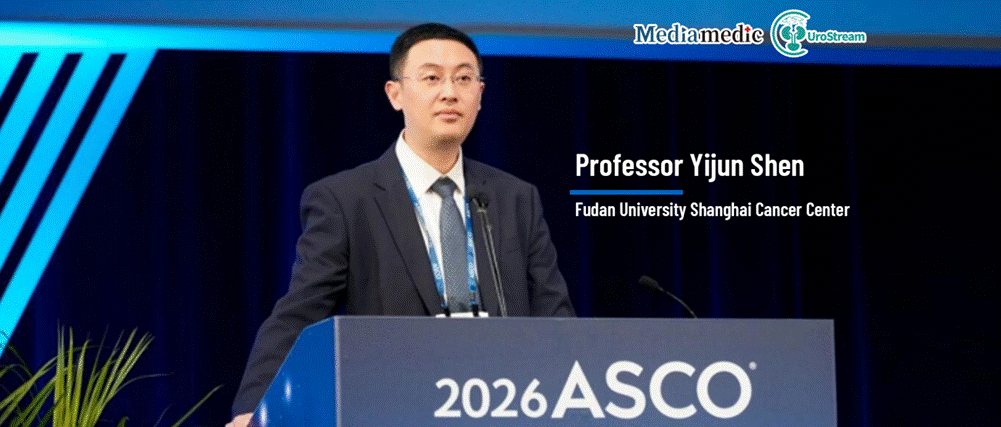
Professor Yijun Shen