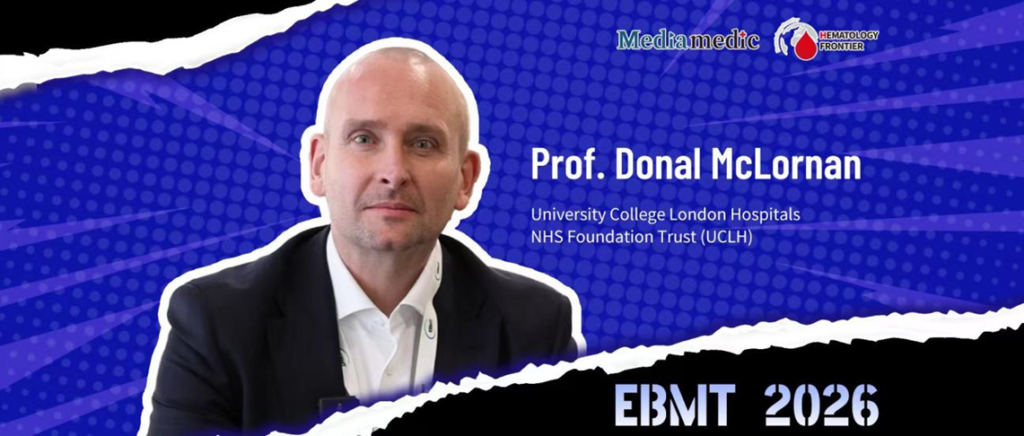
Myelodysplastic/myeloproliferative neoplasm (MDS/MPN) overlap syndromes are rare hematologic malignancies characterized by marked clinical heterogeneity and significant diagnostic and therapeutic challenges. Allogeneic hematopoietic stem cell transplantation remains a key treatment option; however, the lack of standardized criteria for assessing post-transplant remission and relapse represents a major unmet clinical need.Professor Donal McLornan, from University College London, Chair of the Chronic Malignancies Working Party of the European Society for Blood and Marrow Transplantation (EBMT), and Co-Chair of its Scientific Council, shared his expert insights at the 2026 EBMT Annual Meeting. His discussion focused on establishing remission criteria following transplantation, approaches to remission assessment, and strategies integrating novel therapies with transplantation—offering valuable guidance for clinical practice.
Professor Donal McLornan:
“My name is Donal McLornan, and I am from University College London. Currently, I serve as Chair of the Chronic Malignancies Working Party of the European Society for Blood and Marrow Transplantation (EBMT) and Co-Chair of its Scientific Council. It is a pleasure to attend the 26th EBMT Annual Meeting in the beautiful city of Madrid.
One of the most common questions patients ask within the first year after a successful bone marrow transplant is: ‘Doctor, am I cured?’ MDS/MPN overlap syndromes are rare conditions. According to EBMT registry data, approximately 150 to 200 patients with MDS/MPN overlap syndromes undergo transplantation annually outside of chronic myeloid leukemia (CML) cohorts.
These patients exhibit significant heterogeneity, both in their pre-transplant clinical phenotypes and in the treatments that lead them to transplantation. Therefore, defining remission is of critical importance.
In collaboration with expert hematopathologists, our primary objective is to integrate bone marrow morphological remission with molecular remission, cytogenetic remission, and chimerism data. This integrated approach is essential not only for evaluating transplant outcomes at the registry level, but also for informing the design of future clinical trials. Most importantly, it enables clinicians to clearly communicate to patients whether they have achieved a functional cure.
Assessing remission in these patients is inherently complex, due to heterogeneity in clinical presentation, molecular hematologic features, and bone marrow architecture. To address this, we follow several key principles. At least two post-transplant time points should be defined for bone marrow trephine biopsy evaluation. Critical parameters include normalization of cellularity, reversal of abnormal marrow architecture, and sufficient time for resolution of fibrosis, where present. Based on experience in myelofibrosis, complete fibrosis resolution typically requires 6 to 12 months.
Accordingly, at least two bone marrow trephine biopsies are required to define complete bone marrow remission. In parallel, molecular data must be incorporated, including droplet digital PCR, next-generation sequencing, conventional cytogenetics, and chimerism analyses (such as CD34-specific or lineage-split chimerism). Integration of these multidimensional data is essential to accurately distinguish complete remission, persistent disease, and relapse.
Currently, novel agents are being used in combination with conventional chemotherapy and hypomethylating agents as bridging therapy prior to transplantation. However, there is a critical need to reposition transplantation as a therapeutic platform—serving as the foundation for subsequent post-transplant interventions.
Despite successful transplantation, relapse rates for MDS/MPN overlap syndromes remain high, at approximately 30% to 40% within the first two years. Therefore, it is crucial to implement maintenance strategies, including hypomethylating agents, JAK inhibitors, and therapies tailored to the molecular profile of individual patients. Such approaches are key to reducing relapse risk and improving long-term outcomes.”
Conclusion
Professor Donal McLornan’s insights address key clinical challenges in the management of MDS/MPN overlap syndromes following bone marrow transplantation. His work provides a scientifically grounded framework for defining remission, improving the accuracy of response assessment through multidimensional evaluation, and optimizing the integration of novel therapies with transplantation.
Standardized remission criteria help overcome challenges posed by disease heterogeneity, while advanced diagnostic tools enhance precision in clinical decision-making. At the same time, innovative combination strategies incorporating post-transplant maintenance therapies offer new avenues to reduce relapse rates and improve patient outcomes.
Progress in medicine is driven by addressing unmet clinical needs. The efforts of EBMT and the global research community in rare hematologic malignancies not only advance standardization in transplantation practice but also reflect a patient-centered approach to care. These advances bring renewed hope for prolonged survival and improved quality of life for patients with MDS/MPN overlap syndromes, while also providing valuable models for international collaboration and the standardized management of rare diseases.