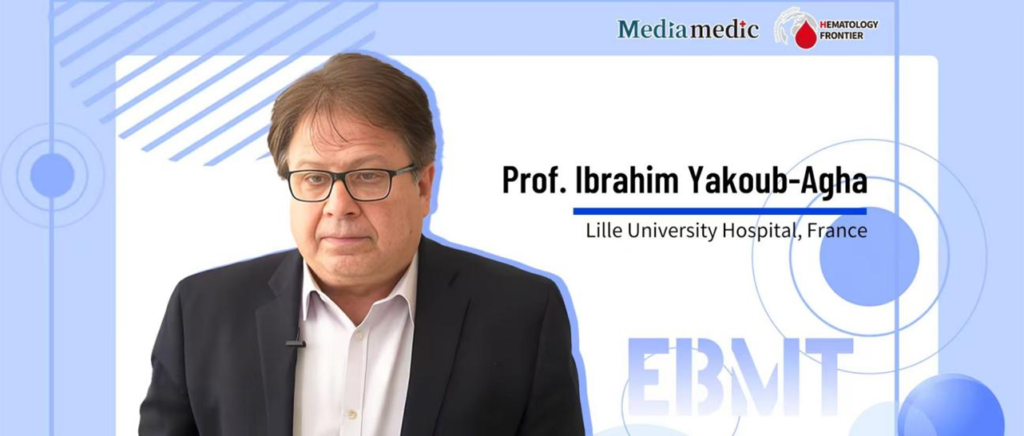
As a leading global academic organization in transplantation and cellular therapy, the European Society for Blood and Marrow Transplantation (EBMT) has long been committed to advancing clinical research, optimizing patient management, and fostering international collaboration. In the era of rapid progress in cell and gene therapies, EBMT is entering a new phase of opportunity.During the meeting, current EBMT President Professor Ibrahim Yakoub-Agha, from Lille University Hospital in France, outlined the Society’s strategic vision and priorities, offering valuable insights for the global medical community.
Professor Ibrahim Yakoub-Agha:
“As President of EBMT, several priorities will guide my tenure. Foremost among these is further strengthening the EBMT registry, which is already a robust and highly valuable resource. It is essential to enhance this platform so that it better supports meaningful research and enables individual centers to more effectively analyze and benchmark their clinical performance.
Another key priority is to deepen EBMT’s global partnerships, particularly with regions such as China, Asia, Africa, and South America. This effort is critically important. We have established a Global Committee with regional subcommittee leaders, and our goal is to work collaboratively to explore how EBMT can support colleagues in these regions, while also benefiting from their contributions to the Society’s development. Through such partnerships, EBMT can further consolidate its leadership in transplantation and cellular therapy.
At the organizational level, we are also focused on streamlining internal structures and processes to improve efficiency and responsiveness.
With regard to CAR-T cell therapy, EBMT—together with the European Hematology Association (EHA)—has played a pivotal role in developing clinical guidelines and harmonizing practices across Europe and beyond. Over the years, we have generated extensive evidence on CAR-T–related complications and patient management.
More recently, efforts have expanded to include harmonization of academic CAR-T manufacturing processes, quality control standards, and production protocols, ensuring high-quality therapeutic products. In terms of regulation, such harmonization—both in clinical management and manufacturing—can provide regulatory agencies with greater confidence, thereby facilitating broader adoption of CAR-T therapies in academic centers.
At the same time, commercially available CAR-T products remain essential, given the increasing number of patients and the expanding role of these therapies in clinical practice.
As mentioned, the Global Committee aims to engage colleagues from diverse regions worldwide. Importantly, the vision for the EBMT registry extends beyond data collection and publication. It should function as a practical tool that allows centers to evaluate their outcomes, benchmark against international standards, and identify opportunities for improvement.
Ultimately, our mission is to improve patient care. Disease knows no borders, and improving outcomes for patients worldwide remains our shared goal. While there is still progress to be made, this direction is clear. The EBMT registry will continue to play a central role in supporting advances in areas such as allogeneic transplantation and emerging cellular therapies, including CAR-T.”
Conclusion
Professor Ibrahim Yakoub-Agha’s perspective clearly outlines the core principles guiding EBMT’s future: data as the foundation, collaboration as the bridge, and patients at the center.
The EBMT registry is evolving from a passive data repository into a dynamic platform that empowers centers to reflect, benchmark, and continuously improve. Global collaboration is also advancing beyond academic exchange, with the development of a truly interconnected network spanning China, Asia, Africa, and South America—facilitating shared learning and capacity building.
Notably, in response to the rapid evolution of innovative therapies such as CAR-T, EBMT has taken a proactive role in standardizing patient management, manufacturing processes, and quality control. These efforts not only provide a strong scientific basis for regulatory decision-making but also open new pathways for academic institutions to participate in cutting-edge therapeutic development.
This “borderless” vision of medicine represents one of the most valuable principles in modern hematology and cellular therapy. Regardless of geography, every patient should have equitable access to safe, effective, and innovative treatments.
EBMT’s vision serves as a powerful reminder: the ultimate value of medical innovation lies not in publications or patents, but in its ability to reach and benefit every patient in need. From Europe to Asia, from commercial products to academic manufacturing, from registry data to clinical decision-making—only through breaking barriers and working together can we extend the promise of cure to patients around the world.
This is not only EBMT’s mission, but a shared goal for the global medical community.