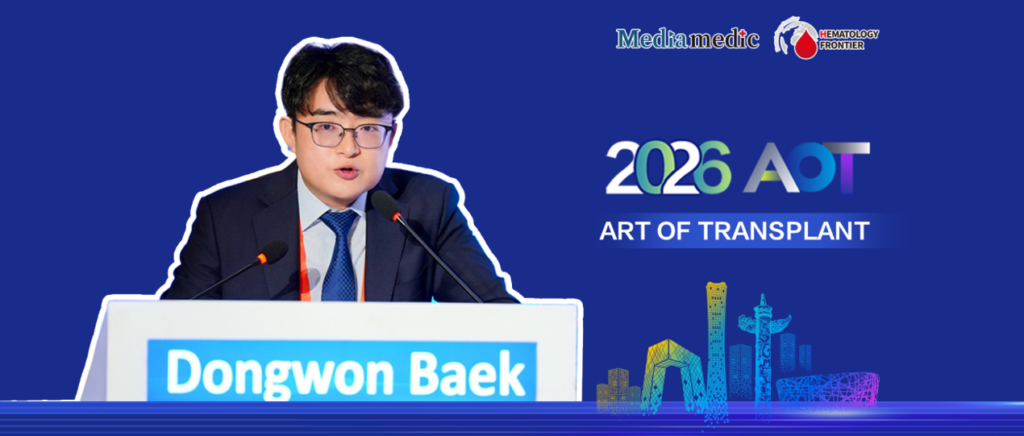
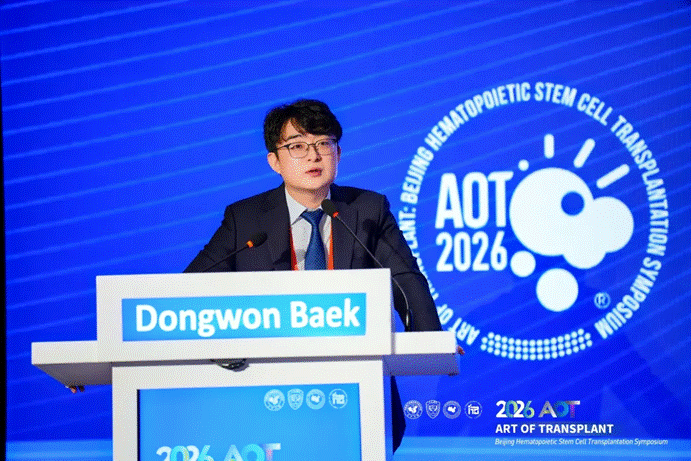
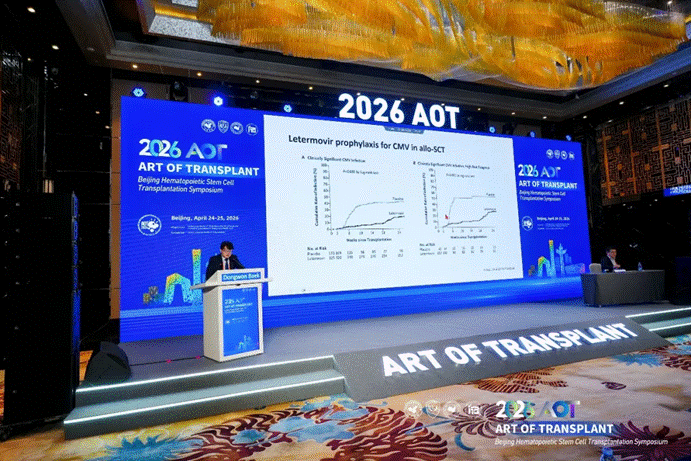
To comprehensively improve public health and strengthen strategies for the prevention and treatment of major diseases, medical innovation and international collaboration have become key drivers of clinical progress. Against this backdrop, the 2026 Beijing International Hematopoietic Stem Cell Transplantation Conference (AOT) was successfully held in Beijing from April 24 to 25, 2026. Organized by the Hematology Branch of the China International Exchange and Promotive Association for Medical and Health Care and hosted by the National Clinical Research Center for Hematologic Diseases and the Peking University Institute of Hematology, this year’s conference centered on the theme “The Art of Transplantation.” The meeting brought together leading experts in hematology from around the world to discuss cutting-edge innovations and future trends in hematopoietic stem cell transplantation.During the conference, Oncology Frontier – Hematology Frontier invited Professor Dong-won Baek from Kyungpook National University Hospital, South Korea, for an exclusive interview. The discussion focused on key clinical issues in the prevention of post-transplant infections, with Professor Baek sharing his academic perspectives and clinical experience to provide valuable insights for patient management.
Q1、Professor Baek Dong-won, you have been deeply engaged in the field of hematopoietic stem cell transplantation (HSCT) clinical practice and infection prevention and control for many years. Combining your research experience, what are the main core risk factors for post-transplant infection? What targeted suggestions do you have for infection prevention and control in different types of transplantation?
In clinical practice, the assessment of transplantation-related risks is typically based on a comprehensive evaluation of the Hematopoietic Cell Transplantation‑Specific Comorbidity Index (HCT‑CI) and the patient’s age. For elderly patients, risk factors remain a central consideration in risk stratification. Hematopoietic stem cell transplantation is primarily divided into two categories: autologous transplantation and allogeneic stem cell transplantation. In autologous transplantation, since the patient’s own stem cells are used, the risk of post‑transplant infection is relatively low and generally not a major concern. However, in the case of allogeneic stem cell transplantation, patients undergo a period of neutropenia and immunosuppression after the procedure, and some also require immunosuppressive agents such as corticosteroids. Consequently, they are at high risk for opportunistic infections, making prophylaxis against such infections essential.
Q2、Based on your profound accumulation in the prevention and control of post-transplant complications, what are the key details that are most likely to be overlooked in clinical practice in the whole-process infection prevention? What core prevention strategies do you recommend for patients with long-term immunosuppression due to cGVHD?
Patients with chronic graft‑versus‑host disease (cGVHD) often require long‑term treatment with corticosteroids and other immunosuppressants, leading to sustained immune suppression, which makes opportunistic infections a key clinical focus. These patients are susceptible to cytomegalovirus (CMV) reactivation or CMV disease, as well as viral infections such as COVID‑19 and influenza, along with infections caused by encapsulated bacteria. Therefore, appropriate antiviral agents and prophylactic antibacterial drugs are used in clinical practice to reduce the incidence of these infections. Moreover, due to prolonged corticosteroid use, some patients may develop Pneumocystis jirovecii pneumonia (PCP), underscoring the importance of PCP prophylaxis.
Q3、Combining your clinical research achievements, what clinical difficulties still exist in the current prevention of post-transplant infection? In the field of future precise prevention, what key research directions do you think are worthy of attention?
Among patients undergoing allogeneic hematopoietic stem cell transplantation, approximately 30% to 40% will develop severe graft‑versus‑host disease (GVHD). Currently, these patients usually require control with immunosuppressants such as corticosteroids. Hence, one of the primary goals in clinical management is to develop agents that can effectively treat GVHD without causing broad immunosuppression. The development of such drugs represents an important future direction in clinical therapy.
Expert Profile
Dong-won Baek, MD, PhD
- Education
2009 Seoul National University, Bachelor’s Degree
2013 Kyungpook National University School of Medicine, Master of Medicine
2019 Kyungpook National University Graduate School, Ph.D. (Internal Medicine)
- Professional Experience
2014 – 2018 Resident, Department of Internal Medicine, Kyungpook National University Hospital
2018 – 2019 Fellow, Department of Hematology-Oncology, Kyungpook National University Hospital
2019 – Present Assistant Professor, Kyungpook National University Hospital / Chilgok Kyungpook National University Hospital
- Professional Memberships
Active Member, American Association for Cancer Research
Active Member, American Society of Hematology
Active Member, European Hematology Association
Active Member, Korean Association for Cancer Research
Active Member, Korean Society of Hematology
Active Member, Korean Society for Hematopoietic Stem Cell Transplantation
Active Member, Korean Society of Internal Medicine
- Awards & Honors
2018 Scholarship Recipient, Korean Cancer Study Group
2019 Academic Award, Korean Cancer Study Group
2021 Excellent Paper Award, Korean Society of Hematology