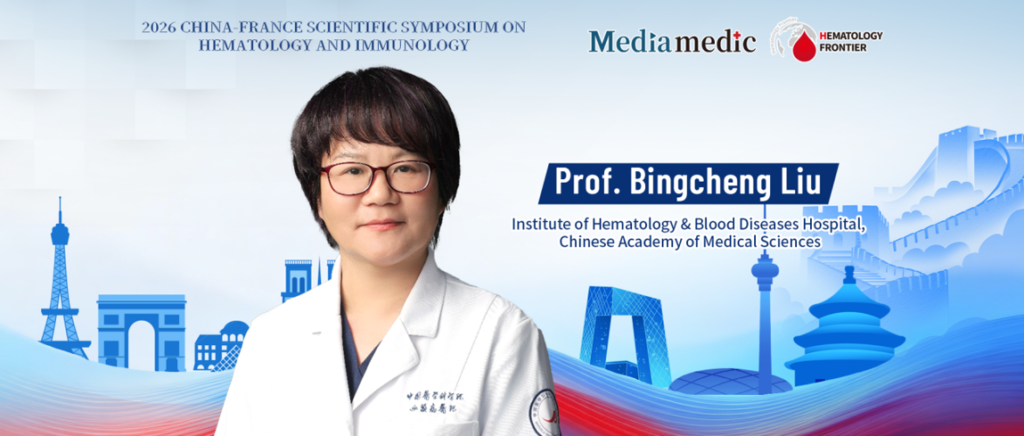
Editor's Note: The 2026 China-France Scientific Symposium on Hematology and Immunology was held in Beijing from September 11 to 13, 2026. Building on the longstanding tradition of China-France exchanges in hematology, this year's conference further expanded into the intersection of hematology and immunology, bringing together renowned experts in hematology and immunology from China and France to explore cutting-edge developments and exchange academic perspectives. On this occasion, Oncology Frontier – Hematology Frontier interviewed Professor Bingcheng Liu of the Institute of Hematology & Blood Diseases Hospital, Chinese Academy of Medical Sciences, who provided an in-depth analysis of the exploration of B-cell acute lymphoblastic leukemia (B-ALL) from personalized immunity to precision immunotherapy, including breakthrough advances in B-ALL immunotherapy, precision stratification strategies, and the optimal sequencing and integration of different immunotherapeutic approaches.Oncology Frontier – Hematology Frontier: Your presentation at this conference focused on “Exploring B-ALL from Personalized Immunity to Precision Immunotherapy.” What breakthrough advances have been achieved in immunotherapy for B-cell acute lymphoblastic leukemia (B-ALL) in recent years? What changes in treatment philosophy are reflected in the evolution from “personalized immunity” to “precision immunotherapy”?
Professor Bingcheng Liu: In recent years, the treatment landscape of B-ALL has undergone major changes with the introduction of immunotherapy. The overall trend has been a transition from traditional intensive chemotherapy, including transplantation, toward immunotherapy combined with chemotherapy. The core objective is to maintain and improve treatment efficacy while reducing chemotherapy intensity and gradually exploring chemotherapy-free approaches.
First-line immunotherapeutic agents represented by blinatumomab have demonstrated clinical benefits that have expanded from patients with relapsed/refractory disease to those who are MRD-positive and even MRD-negative, with significant overall survival benefits. At present, immunotherapy represented by blinatumomab has essentially been incorporated into first-line treatment and has become a standard option in regions and centers where it is available.
Overall, the introduction of immunotherapy has significantly improved overall survival among patients with B-ALL. Regarding the reduction or elimination of chemotherapy, chemotherapy-free approaches have been explored in Philadelphia chromosome-positive (Ph-positive) B-ALL, with preliminary evidence supporting their feasibility. In addition, among older patients, chemotherapy-free regimens combining the CD19-targeted agent blinatumomab with the CD22-targeted agent inotuzumab ozogamicin have also demonstrated encouraging improvements in efficacy.
In terms of CAR-T cell therapy, immunotherapy has demonstrated the potential to induce deep remissions in patients with relapsed/refractory disease. Some patients with relapsed/refractory B-ALL can even achieve relatively durable survival following immunotherapy without relying on transplantation. In addition, the use of dual-target CAR-T cells, inotuzumab ozogamicin, and CD19-targeted antibody-based therapies has made progress in overcoming antigen-mediated immune escape.
Importantly, immunotherapy is reshaping the entire treatment pathway of B-ALL. From induction to consolidation and maintenance, and from MRD eradication to bridging before transplantation, immunotherapy is now being integrated throughout the disease-management continuum.
The evolution from “personalized immunity” to “precision immunotherapy” reflects a fundamental transformation in the treatment decision-making model. In the past, when immunotherapy was not available, treatment was essentially based on a one-size-fits-all chemotherapy approach. Today, treatment decisions have shifted from a uniform strategy toward refined stratification based on genomics—the patient’s baseline genetic background—combined with minimal residual disease (MRD), allowing the overall treatment strategy to be adjusted accordingly.
For different molecular subtypes, specific immunotherapies and targeted therapies can be incorporated, with dynamic MRD negativity serving as an important basis for treatment modification. This enables more precise interventions aimed at reducing toxicity while improving efficacy and facilitating chemotherapy de-escalation or elimination.
This conceptual shift is reflected not only in the selection of therapeutic agents but also in a deeper understanding of the biological nature of the disease and in dynamic, comprehensive management throughout the entire disease course.
Oncology Frontier – Hematology Frontier: In precision immunotherapy for B-ALL, how should individualized treatment strategies be developed according to patients’ molecular and biological characteristics, immune microenvironment, and treatment response? What biomarkers or testing approaches are currently available to guide treatment decisions?
Professor Bingcheng Liu: When developing individualized treatment strategies, we primarily consider the patient’s baseline genetic background, integrate dynamic changes in MRD during treatment, and take into account the patient’s physical condition and financial circumstances to formulate an overall treatment strategy.
With regard to genetic background, according to the ICC or WHO classification, we emphasize the importance of baseline genomics in determining the biological nature of the disease. For patients with Ph-positive B-ALL, for example, the preferred approach is a BCR-ABL-targeted tyrosine kinase inhibitor (TKI) combined with blinatumomab. In some patients, inotuzumab ozogamicin may also be incorporated. In other words, the priority is generally given to TKI-based therapy combined with immunotherapy.
In Ph-positive ALL, overall survival has improved significantly in the majority of patients receiving targeted treatment with a TKI combined with a bispecific antibody. However, we have also observed that for patients with IKZF1-plus alterations or other high-risk features such as TP53 mutations, immunotherapy alone—even when combined with low-intensity chemotherapy—may not be sufficient to achieve a cure. For these patients, while intensifying immunotherapy, early transplantation evaluation should also be performed.
Another very important component of the overall treatment strategy is treatment response, particularly dynamic MRD monitoring. In patients who remain MRD-positive after induction, combining immunotherapy can accelerate the clearance of residual disease. After MRD clearance, immunotherapeutic consolidation may further improve survival.
MRD is not only a core indicator for evaluating treatment efficacy but also a critical decision point for treatment modification. Whether to continue immunotherapeutic consolidation after achieving MRD negativity, whether to proceed to transplantation bridging, and whether the patient can enter maintenance therapy all need to be determined individually based on dynamic changes in MRD, together with the patient’s genetic and molecular background.
Regarding the immune microenvironment, relevant studies are already underway, including investigations into the effects of myeloid-derived suppressor cells (MDSCs), regulatory T cells, and metabolic competition on the bone marrow microenvironment. These factors may influence immune therapy, particularly T-cell function, and may also affect the persistence of CAR-T cells.
However, there are currently no definitive clinical strategies specifically targeting these factors, and related research remains ongoing. In the future, with the application of technologies such as single-cell sequencing and spatial transcriptomics, more precise characterization of the immune microenvironment may provide new evidence for individualized selection of immunotherapy strategies.
Oncology Frontier – Hematology Frontier: How should different immunotherapeutic approaches—including chimeric antigen receptor T-cell (CAR-T) therapy, bispecific antibodies, and antibody-drug conjugates—be optimally integrated and sequenced in B-ALL? What are your expectations for the future development of this field?
Professor Bingcheng Liu: It is still difficult to provide a definitive answer to this question, and we can only discuss it based on the available evidence.
Based on current clinical studies, including both prospective and retrospective data, in patients with newly diagnosed B-ALL, bispecific antibodies are increasingly being incorporated into chemotherapy backbones, including during induction, consolidation, and maintenance therapy.
At the early stage, antibody-based therapies were added to an established chemotherapy backbone. Increasingly, however, the focus has shifted toward determining how chemotherapy intensity can be reduced after immunotherapy is incorporated.
In this regard, progress has been particularly rapid in Ph-positive ALL, where chemotherapy-free regimens combining a TKI with a bispecific antibody have become relatively mature. Among older patients, combinations involving CD19- or CD22-targeted antibody-based therapies have also achieved favorable efficacy.
For young adult patients, a considerable proportion of those who previously required intensive chemotherapy may now potentially benefit from combined immunotherapy approaches that allow chemotherapy intensity to be reduced. Therefore, antibody-based therapies are being used extensively in the first-line setting.
Another extremely important component of immunotherapy is CAR-T cell therapy. For single-target CAR-T therapies directed against CD19 or CD22, there is already substantial clinical evidence for CD19-targeted CAR-T therapy.
For patients who relapse after immunotherapy, dual-target CAR-T cells have an important role as salvage treatment. They are particularly valuable when immunotherapy is used as a bridge to transplantation after relapse.
Looking ahead, the sequencing and integration of immunotherapeutic approaches will increasingly depend on a comprehensive assessment of disease biology, dynamic MRD changes, and the immune microenvironment.
How to integrate bispecific antibodies into first-line therapy, how to sequence CAR-T therapy in relapsed/refractory disease, and how to use antibody-based therapies as bridging strategies before and after transplantation are all important clinical questions that remain to be answered.
With the accumulation of more prospective clinical data, immunotherapy strategies for B-ALL are expected to make a further transition from experience-based treatment sequencing toward precision-based sequential therapy.
Expert Profile

Professor Bingcheng Liu
Leukemia Diagnosis and Treatment Center, Institute of Hematology & Blood Diseases Hospital, Chinese Academy of Medical Sciences
- MD, Chief Physician, and Director of the Hematology Ward
- Standing Committee Member, Leukemia Branch, Chinese Medical Education Association
- Committee Member, Geriatric Oncology Committee, Tianjin Anti-Cancer Association
- Standing Committee Member, Cellular Therapy Committee, Tianjin Precision Medicine Society
- Standing Committee Member, Hematologic Disease Rehabilitation Committee, Tianjin Rehabilitation Medicine Association
- Committee Member, Geriatric Oncology Committee, Tianjin Anti-Cancer Association