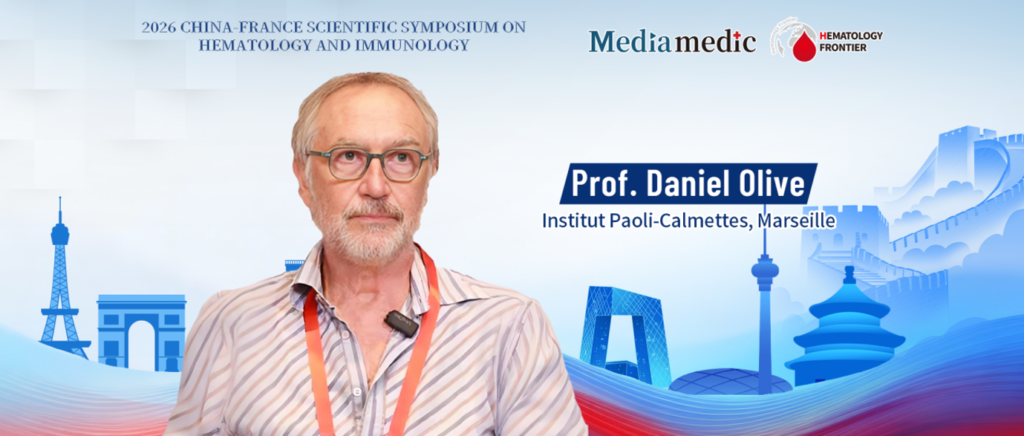
Editor's Note: As autumn arrives and the harvest season begins, China and France are joining hands to open a new chapter of collaboration. Hosted by the Chinese Medical Doctor Association and the Chinese Society for Immunology, and organized by the Hematology Physicians Branch of the Chinese Medical Doctor Association and the National Clinical Research Center for Hematologic Diseases–Institute of Hematology, Peking University, the 2026 China-France Scientific Symposium on Hematology and Immunology was held in Beijing from September 11 to 13, 2026. During the conference, Oncology Frontier – Hematology Frontier interviewed Professor Olive Daniel of the Institut Paoli-Calmettes in Marseille, who shared in-depth insights into the key pathways for translating immune-regulatory research from basic science to clinical application, the current status and challenges of translational medicine, and the complementary strengths and prospects for collaboration between China and France in hematology and immunology.Oncology Frontier – Hematology Frontier: You have long been dedicated to research on immune co-stimulatory molecules and immune-regulatory mechanisms, and have helped advance a number of research findings into clinical development. In your view, what are the most critical breakthroughs and criteria for determining whether a basic immunological discovery can become a therapeutically promising target?
Professor Olive Daniel: Translating basic scientific concepts into drugs that can ultimately be used to treat patients has always been our goal. This process generally begins with a solid scientific understanding, followed by systematic validation of the underlying concept to ensure that it is feasible to advance further. Before entering the translational phase—for example, collaborating with a biotechnology company or pharmaceutical company and ultimately developing a product for patients—all key parameters must be established and clearly defined in advance.
Once these conditions have been met and a decision is made to proceed, the next step is to seek patent protection and systematically evaluate the multiple levels of work that need to be completed before entering a Phase I clinical trial. Here, I am primarily referring to the development of antibody-based drugs, because the development costs of such products are extremely high, typically requiring several million euros in investment.
Taking the French system as an example, at this stage we need to seek financial support from investors. Only after convincing investors with comprehensive and robust data will they provide funding to strengthen the research and development capabilities, enabling more extensive translational research and the production of products that meet Good Manufacturing Practice (GMP) standards and are suitable for clinical use in patients. Depending on the type of product, safety testing may also need to be conducted in non-human primate models, particularly for innovative products entering first-in-human trials, in order to ensure their safety.
This represents the ideal translational pathway. However, the process is often extremely time-consuming, which poses a major challenge for researchers. A lengthy development cycle means that researchers must continuously rely on funding or devote substantial time and effort to fundraising. This is one of the shortcomings of the current translational system. In the case of the work I am presenting at this conference, for example, the entire process from basic research to final clinical translation took 26 years.
Personally, as a physician with an MD and a research background, I have been able to cope with these challenges, and fortunately, I obtained venture capital support relatively early, which allowed us to conduct clinical trials. However, in most cases, this process is extremely complicated for researchers. This is the first major limitation of the system.
The second limitation is that it is not easy to identify venture capital firms or pharmaceutical companies that can be convinced by the available data and are willing to invest. This stage involves considerable uncertainty and depends on market trends, timing, the direction of capital flows, and the investment preferences of individual funds. For example, funding for immunology and immunotherapy research has declined in recent years because capital has increasingly shifted toward emerging hot fields such as artificial intelligence.
There is another critical issue: how to give researchers the confidence that they can successfully translate their discoveries from the laboratory to the clinic. This is one of the most complex parts of the process. If researchers need to establish a biotechnology company, they must identify a CEO with a skill set different from their own. However, there is a limited pool of such talent.
In France, for example, researchers often lack the experience and capabilities needed to handle extensive administrative tasks and communicate with regulatory authorities and venture capital investors. They therefore require systematic support. Although the process is full of challenges, if we have confidence in the scientific value of a project, we must confront these difficulties and find ways to overcome them.
Oncology Frontier – Hematology Frontier: Several of your immune-regulatory antibodies have successfully progressed from the laboratory into clinical development. Based on your experience, what are the key steps that basic research findings must go through before becoming clinical treatments? How can researchers better bridge basic discoveries with the actual treatment needs of patients?
Professor Olive Daniel: France has a strong tradition of basic research, which is one of its major strengths. In recent years, France has gradually expanded its focus toward translational research, with increasingly abundant resources becoming available.
We have established Technology Transfer Offices (TTOs). Once a research project has achieved Proof of Concept (POC), the TTO can provide initial funding to support further development and assist with matters such as patent applications.
However, the stage after proof of concept presents considerable challenges. A recent survey conducted in France highlighted this problem: after this stage, many projects struggle to progress for various reasons. The central difficulty is that government funding is limited, making it critical to convince different investors to provide subsequent financial support. Therefore, while France performs well in the early stages, the subsequent stages are considerably more complex.
The first issue concerns patent timelines. Once a patent has been filed, the inventor has 18 months to convince others to provide additional funding to continue development. Today, so-called “startup studios” have emerged in the United States, Europe, France, and China, and these organizations may provide some assistance.
At this stage, inventors need to further strengthen their research findings. However, the study I mentioned found that in most cases, inventors are unable to secure sufficient follow-up funding, leading many TTOs to discontinue the relevant patents after 18 months.
Under these circumstances, inventors have two options: either purchase the patent themselves—as I did when the TTO was unwilling to continue supporting it—or seek investors, which is also what I did. However, finding investors is not always successful.
There is therefore a certain degree of resource wastage and risk during this process, creating an obstacle for young researchers. Once they understand these realities, they may have to reduce the time they devote to basic research and student supervision. This can pose risks to their academic careers because the number of publications they produce may decline.
Overall, France’s translational research system has two sides. On the one hand, TTOs provide an important initial impetus and support for early-stage research. On the other hand, collaboration with industry and various forms of financial support remain insufficient, and there is an urgent need to strengthen support at this level.
Oncology Frontier – Hematology Frontier: Immunotherapy is currently moving from simple immune activation toward more precise immune regulation. Looking ahead, which areas of immune regulation do you believe have the greatest potential for clinical translation? How can China and France further strengthen collaboration?
Professor Olive Daniel: I believe there is a high degree of complementarity between China and France. As I mentioned earlier, there are significant differences in the types of research conducted in the two countries, and this has become broadly recognized.
China has demonstrated remarkable efficiency in biotechnology. Take CAR-T cell therapy as an example. China was among the earliest countries to develop BCMA-targeted CAR-T therapy, which was subsequently approved in the United States. This demonstrates China’s strong capabilities in this field, and this is also something I have observed during my participation in this conference.
China also possesses numerous cutting-edge technologies. For example, one of the presentations at this conference showcased a technology that is at the international forefront. More importantly, the Chinese central and local governments provide substantial financial support in this area. In this respect, France is far behind China.
In terms of complementarity, sharing these different resources would be an effective approach.
Second, once we reach the stage of having a product, China has access to a much larger patient population. This is something I observed during my visit to Beijing. The number of patients available in China is far greater than the number we can access in France.
When conducting a Phase I clinical trial in France, depending on the disease, it can be difficult to recruit patients quickly. For industry, however, completing clinical trials as quickly as possible is critical in order to reduce costs and obtain as much information as possible within the shortest possible time, allowing them to determine whether further development should proceed.
China has a significant advantage in this respect. One of these advantages is the large patient population at the hospitals I visited, which can accelerate the screening process and help us determine whether a project should continue to move forward. France can also accomplish this, but its efficiency is not comparable to that of China.
Of course, one limitation is that there are differences between Eastern and Western populations. For example, there may be differences in immune responses. However, because our ultimate goal is to develop treatments that can be applied globally, this could also serve as a way of rapidly evaluating whether a therapy can be used in both Western and Eastern populations.
In addition, during my exchanges over the past few days, I observed that China has many excellent and highly skilled PhD students. They asked very insightful questions and demonstrated a strong interest in research.
Therefore, we could establish postdoctoral and student exchange programs to strengthen and enhance our ability to develop projects rapidly through complementary approaches.
In this situation, we are not competitors; we are complementary partners. For example, if we could establish a joint China-France agreement, clearly define certain areas in a formal document, and develop a five-year plan—as I understand from my discussions with the foundation working here—I believe there are many ways in which we could collaborate.
Expert Profile
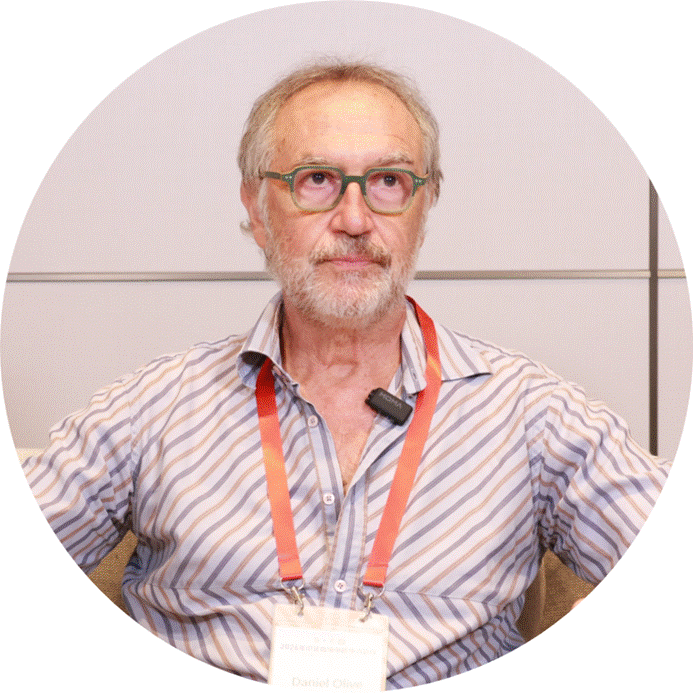
Professor Olive Daniel
Institut Paoli-Calmettes, Marseille
Professor Olive Daniel is a co-founder of Imcheck Therapeutics (2015), Emergence Therapeutics and Alderaan Biotechnology (2019), Stealth IO (2021), and Lurus (2024). He also serves as a member of the Scientific Advisory Boards (SABs) of Alderaan, Emergence Therapeutics, Phosphogam, Hepaistos Pharma, Odimma, and Stealth IO, as well as a member of the Clinical Advisory Board (CAB) of Imcheck Therapeutics.
Emergence Therapeutics was acquired by Eli Lilly in 2023, while Imcheck Therapeutics was acquired by Ipsen in 2025.
At present, three monoclonal antibodies developed by Professor Daniel are undergoing clinical trials, with development being pursued by different companies: one is in Phase I clinical development (Emergence Therapeutics/Eli Lilly), one is in Phase I/II clinical development (Ose Immunotherapeutics), and another is in Phase II clinical development—ICT01 from Imcheck Therapeutics (NCT04243499).
In 2025, ICT01 received Orphan Drug Designation from both the U.S. Food and Drug Administration (FDA) and the European Medicines Agency (EMA) for the treatment of acute myeloid leukemia (AML).