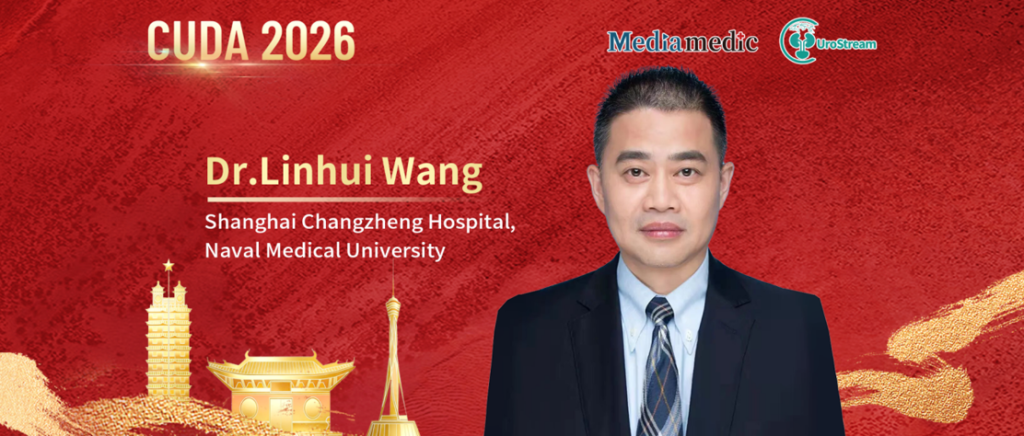
Hosted by the Chinese Medical Doctor Association (CMDA) and the Chinese Urological Association of the CMDA (CUDA), the 2026 CUDA Annual Meeting was held in Zhengzhou, Henan Province, from June 11–14, 2026. Continuing the discipline's mission of "Healthy China, Urology at the Forefront," this year's conference was themed "Collaboration and Innovation for Future Development." The scientific program featured in-depth discussions on precision surgery, advances in minimally invasive techniques, and the evolving role of robotic surgery through expert lectures, live surgical demonstrations, and multidisciplinary forums.Against this backdrop, Oncology Frontier – UroStream interviewed Professor Linhui Wang of the Department of Urology, Changhai Hospital, The First Affiliated Hospital of Naval Medical University, to discuss recent advances in minimally invasive precision surgery for renal cancer, the standardization of nephron-sparing surgery, and the current landscape and future prospects of both domestic and imported robotic surgical systems.
Oncology Frontier – UroStream: You have extensive experience in minimally invasive precision surgery for renal cancer. At this year’s CUDA meeting, what emerging technologies and surgical trends attracted the greatest attention in the renal cancer sessions?
Professor Linhui Wang:
Renal cancer remains one of the major malignancies encountered in urologic practice. In mainland China, approximately 75,000 new cases are diagnosed each year, making it a significant public health concern.
One important challenge is that many patients are still diagnosed at an advanced stage. Routine health examinations therefore remain the most effective strategy for detecting renal cancer early. Early-stage renal tumors typically produce few, if any, characteristic symptoms, and we currently lack reliable serum tumor biomarkers. As a result, diagnosis depends largely on imaging modalities such as ultrasound and computed tomography (CT). Promoting standardized health screening to facilitate early detection and early treatment remains one of our highest clinical priorities.
Renal cancer continued to be a major focus of discussion at this year’s CUDA meeting. For patients with localized disease, the goal of surgery has evolved from simply removing the tumor to maximizing preservation of functional renal parenchyma while maintaining oncologic safety.
Achieving this objective depends on advances across multiple aspects of surgical care.
During the preoperative phase, artificial intelligence-assisted imaging and high-resolution three-dimensional reconstruction allow surgeons to better define the anatomical relationship between the tumor and critical structures, including the renal artery, renal vein, and collecting system, thereby facilitating more precise surgical planning.
Intraoperatively, robot-assisted surgery combined with image-guided navigation further enhances surgical precision, making it possible to completely remove malignant tissue while preserving as much healthy kidney tissue as possible. This approach translates directly into improved postoperative renal function.
At the same time, several technical strategies designed to protect renal function—including minimizing warm ischemia time, performing zero-ischemia partial nephrectomy, and using renal hypothermia when appropriate—have become important components of modern nephron-sparing surgery.
Together, these advances are driving renal cancer surgery toward an era of greater precision and improved functional preservation.
Oncology Frontier – UroStream: What do you consider the greatest challenges to optimizing and standardizing nephron-sparing surgery for renal cancer?
Professor Linhui Wang:
The widespread adoption of high-quality nephron-sparing surgery ultimately depends on establishing comprehensive and standardized training systems.
Promoting physician education and surgical training is one of the core missions of the Chinese Urological Association of the Chinese Medical Doctor Association (CUDA). Only through large-scale, standardized educational programs can nephron-sparing techniques be successfully disseminated to hospitals at different levels and to surgeons with varying degrees of experience, allowing more patients to benefit from these procedures.
At present, significant regional differences still exist in the quality and availability of nephron-sparing surgery.
Going forward, our priorities should therefore include further standardizing surgical techniques while strengthening structured training programs, particularly for physicians practicing in primary and regional medical centers.
The rapid expansion of robotic surgery makes systematic training even more essential. Only through continuous education and standardized instruction can nephron-sparing surgery become more widely available while maintaining consistent quality across different institutions.
Oncology Frontier – UroStream: How do you view the respective roles of the da Vinci Surgical System and domestically developed robotic platforms in nephron-sparing surgery for renal tumors? What are your expectations for their future development?
Professor Linhui Wang:
Since the da Vinci Surgical System was first introduced into China in 2006, robot-assisted surgery has fundamentally transformed urologic practice. It has significantly improved the precision of tumor resection while reducing surgical invasiveness, leading to substantial benefits for patients.
Over the past several years, domestically developed robotic surgical systems have advanced rapidly. Many platforms have successfully completed clinical validation and are now being introduced into routine clinical practice across multiple specialties, including urology, gynecology, thoracic surgery, and general surgery. These systems have already accumulated considerable clinical experience.
From a technical perspective, the leading domestic robotic platforms have achieved performance levels that are increasingly comparable to those of imported systems in many key parameters, reflecting the rapid maturation of China’s robotic surgery ecosystem.
Looking ahead, I believe continued technological innovation and broader clinical adoption will enable domestic surgical robots to achieve even greater advances. In time, they have the potential not only to reach international standards but also to become global leaders in selected areas, contributing significantly to both the Chinese and international surgical communities.