The 2026 CACA Cancer Prevention and Screening Conference recently opened in Hangzhou, bringing together leading oncologists, researchers, and industry experts from across China to discuss advances in cancer prevention, early detection, multidisciplinary collaboration, and translational research. Hosted by the Chinese Anti-Cancer Association (CACA) and its Cancer Prevention and Screening Committee, the meeting aligns with the goals of the Healthy China 2030 initiative by promoting earlier intervention throughout the cancer care continuum.During the conference, Oncology Frontier spoke with Professor Benlong Yang, Secretary-General of the Chinese Anti-Cancer Association Integrated Breast Cancer Committee and a breast surgeon at Fudan University Shanghai Cancer Center, about the current landscape of breast surgery in China and the evolving role of surgeons in the era of precision medicine.
Oncology Frontier: During the breast cancer session, “Multidimensional Classification, Prevention, and Early Screening,” you presented an overview of the current state of breast surgery in China. Could you summarize the latest developments in surgical management, including breast-conserving surgery, reconstruction, and the most significant trends in recent years?
Professor Benlong Yang:
As of 2026, under the leadership of Professor Jiong Wu and many other experts, the Chinese Anti-Cancer Association Breast Cancer Committee, together with several national breast cancer organizations, has completed four nationwide surveys evaluating breast cancer surgery in China. The first was conducted in 2008, and the most recent survey was completed in 2025.
The findings clearly demonstrate steady progress over the past two decades. Approximately one-third of Chinese patients with breast cancer now undergo breast-conserving surgery, while the breast reconstruction rate has risen substantially, with nearly half of patients receiving reconstructive procedures. These advances have translated into meaningful improvements in postoperative quality of life.
Despite this progress, important gaps remain.
Although breast conservation and reconstruction have become increasingly common, some surgeons have yet to fully embrace more recent treatment concepts. For example, among patients with one or two positive sentinel lymph nodes, the proportion who undergo omission of completion axillary lymph node dissection (ALND) remains below 50%, despite clear recommendations in both Chinese and international guidelines.
Further progress in surgical de-escalation will therefore require efforts on multiple fronts. We need more high-quality clinical research generated within China to strengthen the evidence base for innovative surgical approaches. At the same time, clinicians must become more willing to incorporate emerging evidence and updated guideline recommendations into daily practice so that more patients can truly benefit from less extensive surgery.
Oncology Frontier: As Secretary-General of the Chinese Anti-Cancer Association Integrated Breast Cancer Committee, how do you view the changing role of breast surgeons in the era of precision medicine? Within today’s multidisciplinary framework of comprehensive patient management, how should surgical decision-making evolve to maximize the value of local therapy while avoiding overtreatment?
Professor Benlong Yang:
Precision medicine has fundamentally reshaped the role of breast surgeons.
As systemic therapies have become increasingly effective, many tumors shrink substantially before surgery. Cases that once required extensive, technically demanding operations can now often be managed with far less invasive procedures. Consequently, surgeons play a different role than they did in the past, and our work has become increasingly focused on precision rather than the extent of surgery.
In my view, breast cancer surgery has always been an individualized process—essentially a form of tailored treatment. Every patient requires a unique surgical plan. Decisions regarding incision placement, the extent of tissue resection, and reconstructive techniques should all be customized rather than standardized.
The rapid development of artificial intelligence and big data offers tremendous opportunities to make surgical planning even more precise. Before treatment begins, we can perform comprehensive assessments that incorporate molecular subtype, disease stage, patient preferences, lifestyle, and functional needs.
For example, some patients enjoy archery, while others are passionate about mountaineering or swimming. Understanding these personal priorities allows us to tailor surgical techniques to preserve the nerves and blood vessels that are particularly important for those activities, thereby maximizing postoperative function and overall quality of life.
At the same time, minimally invasive approaches—including endoscopic and robotic breast surgery—are developing rapidly in China. These technologies not only expand our surgical options but also allow us to pursue outcomes that matter deeply to patients, such as smaller and better-concealed incisions and more natural-feeling breast reconstruction.
Alongside technological innovation, however, we must also prioritize standardization and consistency in surgical practice. It is essential to expand training opportunities for surgeons working in primary and regional hospitals so that advanced techniques and standardized procedures become widely accessible. Ultimately, patients should receive the same high-quality surgical care regardless of where they are treated.
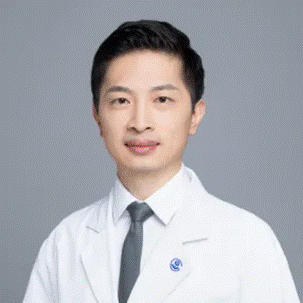
Professor Benlong Yang
Secretary-General, Chinese Anti-Cancer Association Integrated Breast Cancer Committee
Fudan University Shanghai Cancer Center