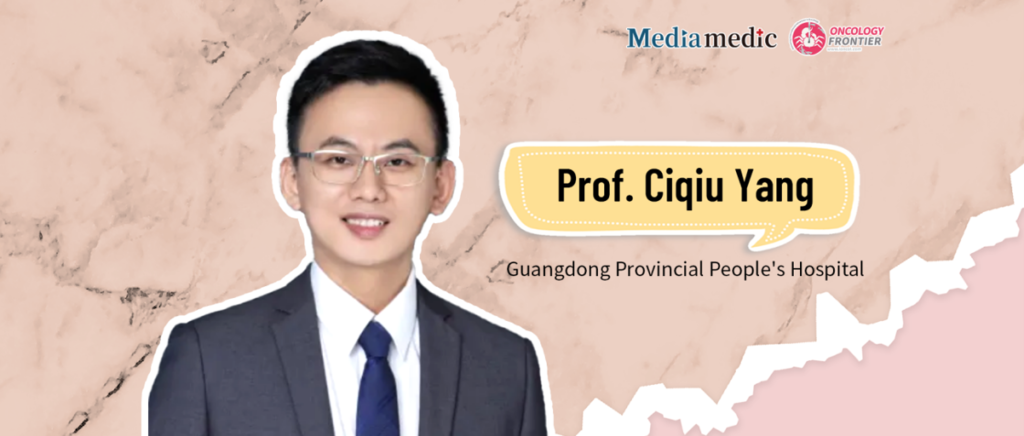
The Samsung Club National Young Breast Cancer Experts Conference recently concluded in Zhengzhou, bringing together emerging leaders from China's four major breast cancer academic organizations to discuss precision oncology, talent development, and multidisciplinary collaboration.During the meeting, Professor Ciqiu Yang from Guangdong Provincial People’s Hospital delivered a presentation entitled “From Small Observations to Significant Contributions: Integrating Research into Everyday Clinical Practice.” Following his presentation, Oncology Frontier spoke with Professor Yang about identifying meaningful research questions from routine patient care, cultivating a “micro-research” mindset, and helping young physicians balance the demands of clinical practice and scientific investigation.
Oncology Frontier: You described the relationship between clinical practice and research using the phrase “accumulating small observations into meaningful achievements,” which reflects a philosophy of long-term commitment. How do you identify research questions worth pursuing in daily clinical practice? Could you share an example of how an apparently minor clinical observation eventually evolved into a meaningful research project?
Professor Ciqiu Yang:
The phrase “accumulating small observations into meaningful achievements” reflects an ideal we strive toward. Accumulating those small observations is something we can all do, but whether they ultimately become meaningful scientific contributions depends on how we pursue the research and where it eventually leads.
Today, much of clinical research is understandably focused on large Phase III randomized controlled trials published in leading journals or their specialty counterparts. However, everyday clinical practice presents countless smaller questions that are equally deserving of careful investigation.
One example I discussed during my presentation was taxane-associated acute pain syndrome (T-APS), one of the most common chemotherapy-related complications. Patients frequently experience bone pain, muscle aches, numbness, and other symptoms of peripheral neuropathy during treatment. Finding effective ways to alleviate these adverse effects represents an important clinical challenge.
About five or six years ago, our team initiated a study focusing on this issue. We investigated whether the selective COX-2 inhibitor etoricoxib could reduce these chemotherapy-induced symptoms. Through a carefully designed clinical study, we demonstrated that prophylactic administration of etoricoxib significantly reduced both the incidence and severity of docetaxel-induced T-APS, while also showing potential to alleviate taxane-induced peripheral neuropathy. The study was eventually published in the European Journal of Cancer (EJC).
I believe this illustrates how meaningful research often begins with a very practical clinical problem. By addressing a common adverse event that affects patients every day, we were able to generate valuable evidence that may ultimately improve supportive care for many more patients.
Oncology Frontier: Clinician-scientists often struggle with fragmented time and large volumes of clinical data that are difficult to standardize. What habits are essential for integrating research into routine clinical practice? Could you share how you have developed your own “micro-research” workflow—from recording clinical observations to organizing data and engaging your team?
Professor Ciqiu Yang:
Under the leadership of Professor Kun Wang, our department has never viewed itself as a purely clinical service. From the very beginning, we have emphasized integrating clinical care with translational research, ensuring that both activities follow the same overarching direction.
Providing excellent patient care remains our primary responsibility. We must perform high-quality surgery and deliver comprehensive postoperative management. Yet every patient we treat also presents potential scientific questions.
These questions arise naturally during routine practice. They may relate to technical aspects of surgery, challenges encountered during treatment, or adverse effects associated with systemic therapies. Some of these issues are addressed in existing guidelines, while others remain unanswered.
Whenever an important question emerges, it becomes an opportunity for clinical research.
Because these projects originate directly from everyday clinical practice, we do not view research and patient care as competing priorities. Rather, research is embedded within our daily work.
Of course, conducting research requires additional effort, including study design, data collection, statistical analysis, and manuscript preparation. However, these responsibilities are part of what is expected of physicians working in leading academic medical centers. If we aspire to build a department that advances the field, scientific research cannot be considered an optional activity—it must become an integral part of our routine professional responsibilities.
Oncology Frontier: Young physicians today face increasing pressure from both clinical responsibilities and research expectations. In your opinion, what advantages does this gradual, observation-driven research approach offer compared with simply following popular research trends? What advice would you give to young clinicians who hesitate because they worry that their “small discoveries” may not be important enough?
Professor Ciqiu Yang:
Clinical medicine and research have both become increasingly demanding. Many people describe this as an increasingly competitive environment.
In my opinion, we should avoid two extremes.
One is becoming entirely publication-driven—someone who writes papers well but cannot provide excellent patient care. The opposite extreme is equally problematic: being an outstanding surgeon who has no understanding of scientific research. Neither reflects the mission of a major academic medical center.
Instead, we should integrate research naturally into our clinical work so that the two become inseparable. Research should not be viewed as something separate from patient care but rather as an extension of it.
After all, surgery allows us to help one patient at a time. However, if we can generate robust clinical evidence through research, we may be able to redefine treatment strategies or improve standards of care, ultimately benefiting countless patients beyond those we personally treat.
That, I believe, is the greatest value of clinical research.
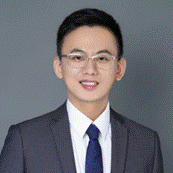
Professor Ciqiu Yang
Guangdong Provincial People’s Hospital