Recently, the team led by Professor Nengwang Yu from the Department of Urology at Qilu Hospital of Shandong University published a research article entitled “Spermine oxidase-DOX conjugates reshape tumor microenvironment via carbonyl stress to potentiate bladder cancer chemotherapy” in Materials Today Bio (CAS Q1; Impact Factor: 10.2).Professor Nengwang Yu served as the senior corresponding author. Associate Researcher Huimin Geng from the Department of Neurosurgery and Dr. Zhao Zhang, a postdoctoral fellow in the Department of Urology, were co-corresponding authors. Dr. Yingying Xu, Chengyang Zhao, and Dr. Yaohai Wu were co-first authors. Qilu Hospital of Shandong University was the primary affiliation for both the first and corresponding authors.
Novel Carbonyl Stress Strategy Enhances Chemotherapeutic Efficacy
Tumor antioxidant defense mechanisms often diminish the effectiveness of standard anticancer therapies, resulting in suboptimal treatment responses and limited systemic tolerability. Conventional pro-oxidant approaches aim to increase reactive oxygen species (ROS) levels; however, their efficacy is frequently constrained by reliance on a single ROS-generating mechanism and the rapid elimination of ROS within the tumor microenvironment.
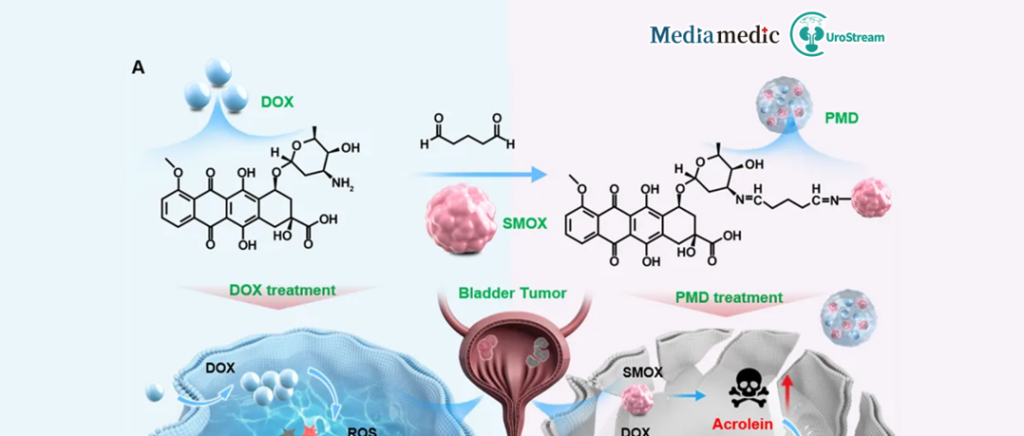
In this study, the investigators developed an innovative therapeutic strategy that exploits spermine oxidase (SMOX) to catalyze endogenous substrates and generate acrolein (ACR), a highly cytotoxic aldehyde. By inducing a destructive carbonyl stress microenvironment, this approach enhances the antitumor activity of chemotherapy.
To achieve this, the researchers conjugated SMOX with doxorubicin (DOX) and co-encapsulated the complex within mesoporous silica nanoparticles, creating an integrated delivery platform termed PMD.
The PMD platform locally induces carbonyl stress and oxidative damage, sensitizing both orthotopic bladder tumor cells and subcutaneous xenograft tumors to doxorubicin, thereby reducing the dose of chemotherapy required to achieve therapeutic efficacy.
Multiple Mechanisms Drive Antitumor Activity
Mechanistic investigations revealed that acrolein exerts antitumor effects through several complementary pathways:
- Inducing mitochondrial dysfunction and promoting lipid peroxidation
- Binding to glyceraldehyde-3-phosphate dehydrogenase (GAPDH), leading to upregulation of the tumor suppressor protein p53
- Suppressing the expression of glycolytic enzymes
- Inhibiting Ras signaling and attenuating the Warburg effect
- Regulating redox homeostasis within the tumor microenvironment
Together, these mechanisms contribute to enhanced tumor cell susceptibility to chemotherapy and improved antitumor efficacy.
Promising Translational Potential
Importantly, the PMD platform demonstrated robust antitumor activity following both intravesical administration and systemic delivery, highlighting its versatility and potential for clinical translation.
These findings suggest that carbonyl stress–based therapeutic strategies may represent a promising new approach not only for bladder cancer treatment but also for a broader range of malignant tumors.
Sustained Commitment to Urologic Oncology Research
Professor Nengwang Yu’s team has long been dedicated to both clinical and translational research in urologic malignancies. Their work has received support from multiple funding sources, including:
- The National Natural Science Foundation of China (General Program)
- National Health Commission Clinical Research Special Projects
- The Taishan Scholars Program
- The Shandong Provincial Natural Science Foundation Joint Fund
The group has produced a series of influential studies published in leading journals, including European Urology, Journal of Controlled Release, Theranostics, and Chemical Engineering Journal.
The original article is available via DOI: 10.1016/j.mtbio.2026.103222.