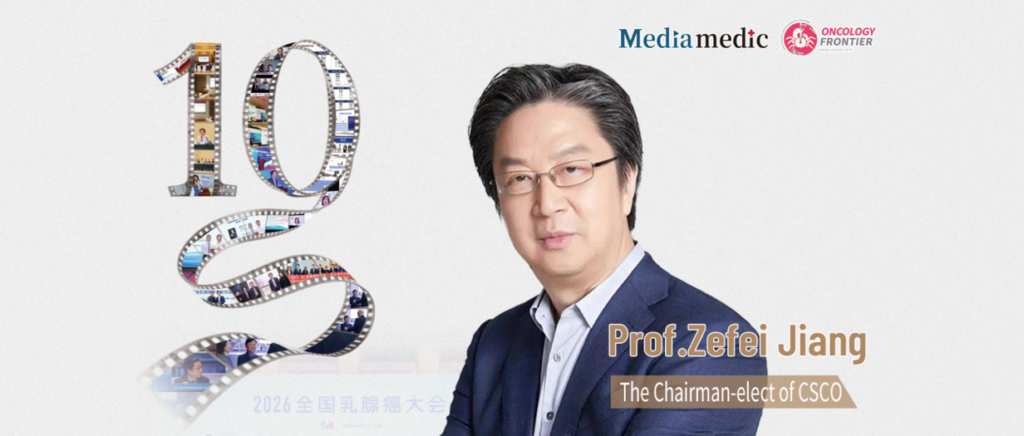
Editor’s Note: Along the long journey of breast cancer prevention and treatment, the successful convening of the 2026 National Breast Cancer Conference stands as a shining milestone. Even more significant is the 10th anniversary of the Breast Cancer Committee of the Chinese Society of Clinical Oncology (CSCO BC). Over the past decade, CSCO BC has grown from its inception into a major driving force in China’s breast cancer field, achieving remarkable progress in clinical research, guideline development, promotion of standardized care, and international academic collaboration.During the recently held 2026 National Breast Cancer Conference, Professor Zefei Jiang, President-Elect of CSCO, sat down with Oncology Frontier to reflect on the original mission behind the establishment of CSCO BC, discuss its contributions to enhancing China’s international academic influence in breast cancer, and share his vision for the future global role of China’s breast cancer community.
01
Oncology Frontier: Congratulations on the successful opening of the 2026 National Breast Cancer Conference. Looking back on the remarkable decade-long development of CSCO BC, what was the original vision behind founding the organization?
Professor Zefei Jiang: Ten years ago, CSCO BC was established as a secondary academic branch under the umbrella of CSCO. Over the subsequent decade, the organization has continued to grow and mature under the guidance and support of CSCO leadership and distinguished senior experts, including Professor Jun Ma, Professor Shukui Qin, Professor Yilong Wu, and Professor Jin Li.
Looking back, Professor Yongmei Yin, Professor Qingyuan Zhang, and I served as the initiators of the first CSCO BC committee after receiving support from CSCO headquarters. From the very beginning, we had a clear mission: to conduct clinical research, develop clinical guidelines, promote standardized diagnosis and treatment, and bring China’s breast cancer expertise onto the international stage.
Over the past decade, through the collective efforts and support of many colleagues, we have achieved substantial progress. For ten consecutive years, we have updated and released the CSCO BC Guidelines, providing authoritative guidance for breast cancer management in China. Together with CSCO BC experts, we have participated in major international academic platforms such as ESMO Asia, ESMO, ASCO, and the St. Gallen International Breast Cancer Conference, significantly enhancing China’s international academic visibility.
Through the collaborative efforts of experts from the first, second, and third CSCO BC committees, we have conducted numerous domestic and international clinical studies, with several important findings published in leading international journals.
In addition, together with Academician Erwei Song, Professor Yongmei Yin, and generations of CSCO BC committee members, we have continued to uphold the spirit of “unity, inheritance, and collaboration,” carrying out many cooperative clinical research projects. National initiatives such as the “National Science and Technology Innovation 2030” cancer program have also progressed smoothly.
Looking back on these ten years, although there are inevitably some regrets, we have done everything within our ability and successfully accomplished many of the goals we originally set out to achieve.
02
Oncology Frontier: What contributions has CSCO BC made toward enhancing the international academic influence of China’s breast cancer field? What are your expectations for China’s future position on the global academic stage?
Professor Zefei Jiang: CSCO has consistently been committed to international engagement and extensive global collaboration, maintaining close relationships with organizations such as ASCO, ESMO, and the St. Gallen International Breast Cancer Conference.
Among these partnerships, the exchanges between CSCO BC and St. Gallen have become particularly active in recent years. We frequently invite St. Gallen experts to China for academic exchange programs, including the “St. Gallen China” initiative. Likewise, the establishment of the “Voice of China” session at the St. Gallen Conference represents another important symbol of this collaboration.
Looking ahead, there will be even more mutual exchanges between both sides. During next year’s St. Gallen Conference, we plan to jointly organize a dedicated China session with St. Gallen and CSCO BC to showcase China’s research achievements and academic presence.
In addition, during next year’s National Breast Cancer Conference, we plan to once again invite experts from Europe, North America, and Southeast Asia to participate in activities related to “St. Gallen China” or “St. Gallen Asia.”
Based on this momentum, I firmly believe that under the leadership of the new CSCO BC committee, Chinese breast cancer experts will continue to actively conduct clinical research, strengthen international collaboration, and generate an even greater Chinese influence on the global academic stage—allowing more powerful Chinese voices to be heard worldwide.
03
Oncology Frontier: CSCO BC has actively promoted the incorporation of both domestically developed innovative therapies and international breakthrough drugs into clinical guidelines and routine practice. In your view, what role has the committee played in advancing collaboration among industry, academia, research, and clinical medicine to improve cancer prevention and treatment? How can these efforts be further strengthened in the future?
Professor Zefei Jiang: The development of the CSCO BC Guidelines has always adhered to a core principle: balancing international advances, accessibility within China, and the collective perspectives of Chinese experts.
We strictly follow internationally recognized standards and evidence-based medicine while simultaneously taking into account China’s real-world clinical environment and treatment accessibility.
Take pharmaceuticals as an example. For domestically developed innovative agents such as the tyrosine kinase inhibitor pyrotinib, China has conducted a large number of high-quality clinical studies, and the resulting academic achievements have been published internationally. However, because these products are not available overseas, they are often absent from international guidelines. In contrast, we are able to incorporate them into the CSCO BC Guidelines at the earliest opportunity.
Similarly, for international innovative therapies such as trastuzumab deruxtecan (T-DXd), although the products originate internationally, Chinese investigators have played critically important roles in their clinical development. In some cases, China has even become the first country globally to approve specific indications. Under such circumstances, we also move rapidly to include these therapies in the guidelines.
The CSCO BC Guidelines are updated annually through a rigorous yet highly efficient process. Discussions typically begin on January 10, with finalization completed by the end of February. During the revision process, if newly approved drugs, new indications, or reimbursement updates emerge, we promptly adjust recommendation levels accordingly.
In addition, we are currently collaborating with artificial intelligence companies to develop an intelligent digital version of the guidelines. Through this platform, recommendation levels can be dynamically updated in real time. The system will also integrate factors such as medical insurance reimbursement and reimbursement ratios, helping clinicians and patients identify the most appropriate, efficient, and feasible treatment strategies throughout the course of care.