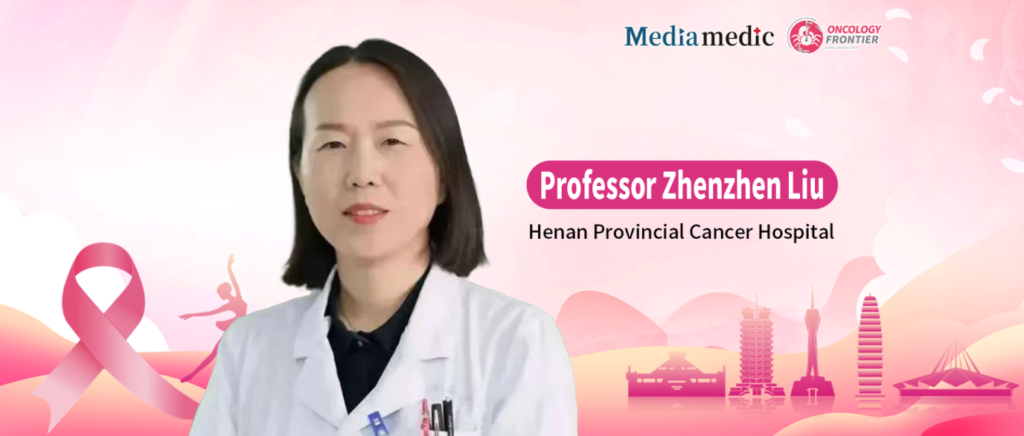
Editor’s Note: With the warmth of spring invigorating the Central Plains, the 18th Northern Breast Cancer HOT Conference was successfully held in Zhengzhou from April 16–18, 2026. During the meeting, Oncology Frontier conducted an exclusive interview with the conference chair, Professor Zhenzhen Liu from Henan Cancer Hospital. In the interview, she discussed the conference’s major highlights, the development of specialty center models, and both the challenges and practical value of promoting multidisciplinary team (MDT) care at the grassroots level.01
Oncology Frontier: As Chair of this year’s Northern Breast Cancer HOT Conference, what do you consider the major highlights and most noteworthy aspects of the meeting for attendees?
Professor Zhenzhen Liu: This year marks the 18th edition of the HOT Conference. Over the past eighteen years, we have continuously relied on this academic platform to explore advances in breast cancer treatment, which has played an important role in both academic development and talent cultivation in the breast cancer field within Henan Province.
Many experts have participated continuously from the very first conference through the eighteenth edition, accompanying us throughout this entire journey. I would therefore like to express my sincere gratitude to all colleagues for their longstanding support.
The defining feature of this year’s conference remains consistent with previous editions: closely following the latest domestic and international research advances and academic frontiers.
The meeting brought together many leading breast cancer experts from across China. Rather than simply interpreting published literature, many invited speakers shared original research findings and exploratory work from their own areas of expertise. In addition to discussing therapeutic advances, they also exchanged valuable insights into discipline development and departmental construction, which I believe represents one of the conference’s major highlights.
In addition, we specifically invited a large number of young and mid-career experts to participate, showcasing the distinct roles played by senior, mid-career, and younger generations in advancing the discipline. Through academic presentations and interactive discussions, younger physicians were able to broaden their academic perspectives and further their professional development, which carries tremendous value for their future growth.
From the perspective of program design, the conference opened with live surgical demonstrations focused primarily on breast cancer surgery. The sessions highlighted implant-based reconstruction—particularly second-stage implant reconstruction—and covered procedures such as contralateral symmetry adjustment, autologous DIEP flap reconstruction, expander-to-implant exchange surgery, and advanced oncoplastic breast-conserving surgery.
Importantly, these live demonstrations were not intended merely as technical showcases. Instead, they were designed to reflect real-world clinical practice and emphasize how advanced surgical techniques can ultimately be translated into minimally invasive, patient-centered care. This philosophy represents the core spirit of the conference.
02
Oncology Frontier: During the conference, you presented on the topic of “Specialty Center Models and Multidisciplinary Practice.” Based on this theme, how can different levels of medical institutions—including cancer specialty hospitals, general hospitals, and county-level hospitals—develop breast cancer specialty centers according to their own circumstances? What challenges in this area still require attention?
Professor Zhenzhen Liu: The development of a medical specialty is closely related to its historical evolution, departmental planning, contributions to the hospital, institutional support, and the broader healthcare landscape of the province in which it operates.
The core advantage of the specialty center model I discussed lies in breaking down disciplinary barriers, improving the patient experience, and truly achieving patient-centered care. This model can significantly enhance diagnostic and treatment efficiency while also supporting the professional development of healthcare providers.
However, in real-world practice, not every hospital can simply replicate the same specialty-center model.
Breast cancer management involves collaboration among multiple disciplines, including surgery, medical oncology, radiation oncology, pathology, and imaging. In specialized cancer hospitals, these subspecialties are often more evenly developed, making it easier to establish integrated specialty centers.
By contrast, general hospitals or prefecture-level hospitals may face challenges due to uneven development among disciplines or weaker subspecialty infrastructure. Under such circumstances, building a fully integrated specialty-center model can be considerably more difficult.
That said, general hospitals also possess unique advantages. For example, they may have access to psychological counseling services, fertility preservation resources, and close collaboration with departments such as gynecology, allowing them to provide more comprehensive support for patients.
Therefore, hospitals at different levels—including cancer specialty hospitals, general hospitals, and county-level hospitals—should develop specialty centers according to their own practical conditions. Their developmental pathways and organizational structures will naturally differ.
For county-level hospitals, establishing a complete specialty-center model may be especially challenging. Nevertheless, MDT-based care can still be effectively promoted through approaches such as telemedicine consultations and regular on-site expert guidance, both of which can substantially strengthen multidisciplinary capabilities.
03
Oncology Frontier: You also participated in the MDT live Q&A session during the conference. Based on the current landscape of breast cancer care in northern China, what are the major challenges in promoting MDT models at the grassroots level? What practical impact did this MDT session have on clinical practice?
Professor Zhenzhen Liu: The MDT live Q&A session was one of the highlights of this year’s conference, and the format was inspired by international academic meetings.
Since 2016, our center has implemented MDT-based management for nearly a decade, during which our MDT system has gradually become increasingly mature and refined. The experts participating in the live Q&A are all core members who regularly engage in MDT discussions in their daily clinical work.
Although the experts did not know the questions in advance, they were able to respond confidently because they encounter similar challenges and clinical scenarios every day and have accumulated extensive practical experience through routine practice.
Through interactive discussion of real clinical cases, the MDT session addressed many of the concrete challenges faced by grassroots physicians and further reinforced the practical value of MDT implementation in everyday clinical care.
The primary challenge in promoting MDT models at the grassroots level is that county-level hospitals often face substantial practical difficulties when attempting to directly replicate multidisciplinary systems from major centers.
On one hand, subspecialty development may be uneven, with certain disciplines remaining relatively underdeveloped. On the other hand, limited patient volume can slow the accumulation of clinical experience. When patient numbers are high, experience develops rapidly; when patient numbers are insufficient, growth can become more difficult.
To address these challenges, grassroots physicians can strengthen their expertise through participation in academic conferences and online MDT platforms. Such efforts are highly meaningful not only for specialty development, but also for improving patient care.