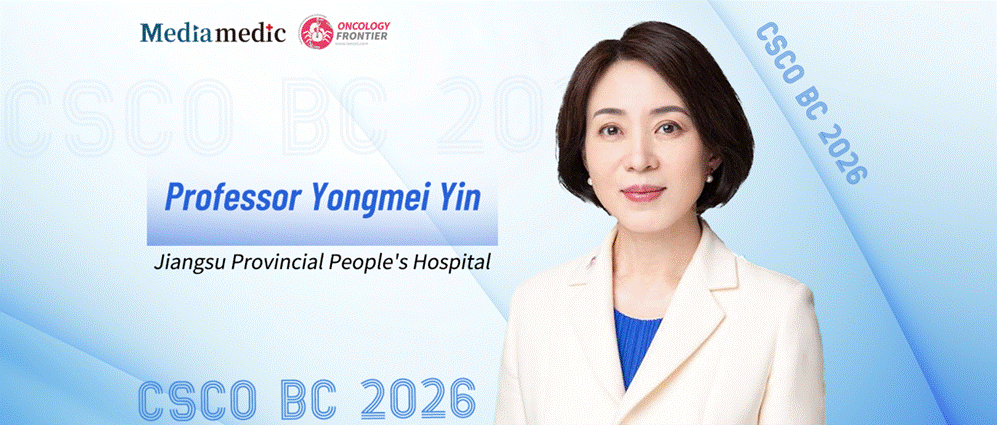
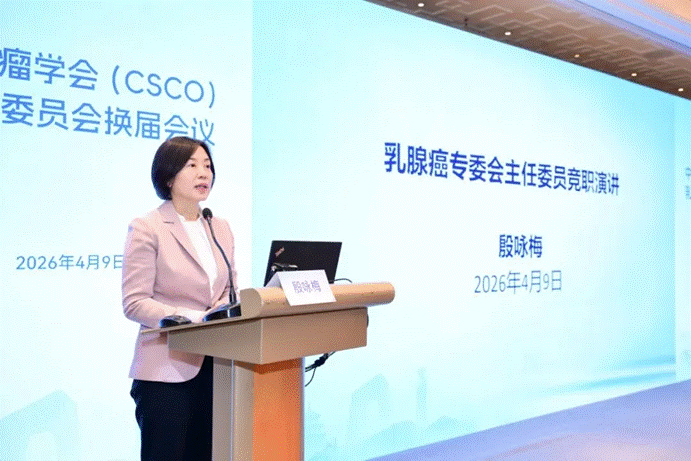
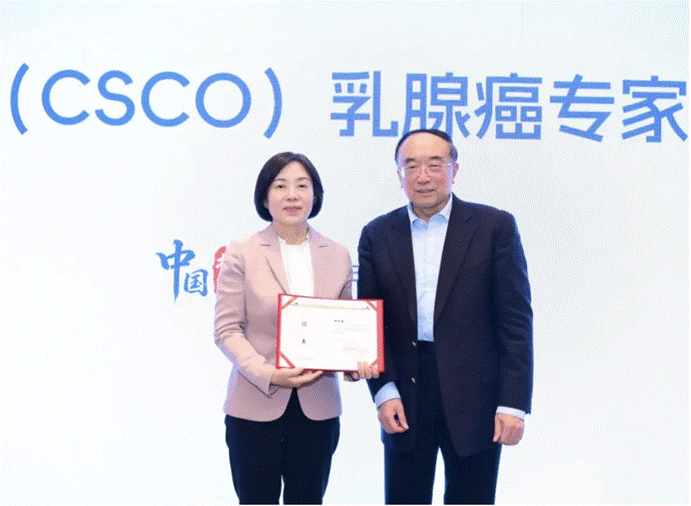
Editor’s Note: As the Breast Cancer Committee of the Chinese Society of Clinical Oncology (CSCO BC) marks its 10th anniversary, the 2026 National Breast Cancer Conference was grandly convened. More than an academic gathering, this conference served as a comprehensive review of CSCO BC’s decade-long journey and a blueprint for the future of breast cancer care in China.During the meeting, CSCO BC successfully completed its leadership transition, with Professor Yongmei Yin from Jiangsu Provincial People’s Hospital elected as the new Chair of CSCO BC. As part of its special “CSCO BC 10th Anniversary Tribute” series, Oncology Frontier invited Professor Yin to reflect on the organization’s achievements over the past decade and share the vision of the new committee for the future development of breast cancer care in China.
Oncology Frontier: Over the past decade, what do you believe has been CSCO BC’s most important contribution to the advancement of breast cancer care in China? How have the organization’s founding principles and accumulated experience laid the foundation for its long-term development?
Professor Yongmei Yin:
This year marks the 10th anniversary of CSCO BC. Under the leadership, guidance, and support of our founder Professor Zefei Jiang and the third Chair, Academician Erwei Song, CSCO BC has now developed into a multidisciplinary academic organization comprising more than 160 experts from breast surgery, medical oncology, radiation oncology, pathology, and related specialties.
Over the past decade, CSCO BC has made tremendous contributions to the development of breast cancer care in China.
First, it has played a pivotal role in advancing the standardization of breast cancer diagnosis and treatment nationwide. In 2017, CSCO BC released the inaugural CSCO BC Guidelines. Since then, the guidelines have been updated annually to incorporate the latest domestic and international research advances while reflecting the realities of Chinese clinical practice, thereby continuously guiding frontline clinical care.
Second, CSCO BC has accelerated innovative drug development and translational progress. Many CSCO BC experts—including Professor Zefei Jiang, Academician Erwei Song, Professor Shusen Wang, and Professor Qiang Liu—have served as leading principal investigators in major multicenter clinical trials both in China and internationally, substantially promoting the development and approval of novel therapies for breast cancer in China.
Third, CSCO BC has contributed significantly to talent development in China’s breast cancer field. Through collaborations with partner academic societies and industry, the organization has continuously strengthened the clinical and research capabilities of young and mid-career physicians.
At the same time, we are delighted to see CSCO BC receiving growing recognition from experts beyond the oncology community. Distinguished guests attending this year’s National Breast Cancer Conference—including Professor Ruilin Song from the China Pharmaceutical Innovation and Research Development Association and Academician Xuetao Cao from the Chinese Academy of Medical Sciences Immunotherapy Research Center—highly acknowledged the work of CSCO BC.
Looking ahead, with continued support from CSCO leadership and increasing attention from experts across multiple sectors, we hope CSCO BC will continue to flourish and grow even stronger in the future.
Oncology Frontier: As the newly elected Chair of CSCO BC, and standing at the beginning of the organization’s second decade, what key strategic priorities will the new committee focus on in response to the current landscape of breast cancer care in China?
Professor Yongmei Yin:
At this pivotal moment bridging the past and the future, I will remain committed to several core principles: balancing inheritance with innovation, integrating standardization with precision medicine, and aligning clinical progress with patient-centered care.
On one hand, we will continue to uphold the academic foundations and collaborative framework established by previous generations, maintaining CSCO BC’s leadership role in guideline development, academic promotion, and standardized diagnosis and treatment.
On the other hand, grounded in the realities of breast cancer care in China, we will focus on unmet clinical and patient needs, strengthen academic innovation, accelerate translational research, promote consistency in clinical practice, and comprehensively improve the overall standard of breast cancer care in China—so that Chinese achievements in breast cancer management can better serve patients both domestically and globally.
Looking to the future, CSCO BC will focus on five major strategic priorities:
First,
Building upon the “National Science and Technology Innovation 2030 Breast Cancer Collaborative Group” platform established by Professor Zefei Jiang and Academician Erwei Song, we will continue to unite breast cancer specialists and industry partners across China to address the major challenges and unmet needs in the field.
Second,
CSCO BC will deepen collaboration with colleagues from Europe, North America, and other regions to further enhance the organization’s international influence. For example, we plan to strengthen cooperation with Professor Michael Gnant, Chair of the St. Gallen International Breast Cancer Conference (SGBCC), in preparation for the 2027 SGBCC Asia meeting to be held in China.
Third,
We will actively promote early detection and early diagnosis of breast cancer. Through collaboration with partner academic organizations, CSCO BC aims to advance the management pathway upstream and establish comprehensive lifecycle management covering prevention, screening, early diagnosis, treatment, follow-up, and rehabilitation.
Fourth,
We will continue to strengthen the standardization and homogenization of breast cancer care at the grassroots level. Guideline lecture tours and multidisciplinary team (MDT) meetings play a crucial role in improving breast cancer management capabilities in primary and regional hospitals.
Fifth,
We will prioritize the development of young talent. With the support of Professor Zefei Jiang and Academician Erwei Song, CSCO BC will continue to implement programs designed to enhance the clinical research capabilities of young and mid-career physicians, with the goal of cultivating future clinician-scientists who possess both outstanding clinical expertise and strong research capabilities.
Oncology Frontier: The 2026 National Breast Cancer Conference represents another important milestone for the field. In your view, what mission does this conference carry for the industry, and what core value will it bring to the continued development of breast cancer care?
Professor Yongmei Yin:
Among the most influential components of this year’s conference were the sessions focused on “Scientific Frontiers” and “Innovative Drug Development,” during which attending academicians and distinguished experts delivered highly strategic and forward-looking presentations.
Academician Jinming Yu presented the latest cutting-edge advances in breast cancer radiotherapy. Academician Xuetao Cao shared important insights into the current landscape of immunology-related basic research in breast cancer. Academician Song discussed future prospects for translating basic scientific discoveries into clinical applications. Meanwhile, Professor Ruilin Song examined how to bridge the “last mile” between innovative drug development and real-world clinical implementation from the perspective of pharmaceutical innovation policy.
The valuable perspectives shared by these experts provided constructive guidance for strengthening collaboration among hospitals, pharmaceutical companies, and research institutes, thereby accelerating source innovation and advancing industry development.
On one hand, academic societies and hospitals must deepen cooperation with research institutes and industry partners, transforming clinical challenges into research questions and using scientific innovation to overcome clinical bottlenecks.
On the other hand, factors such as reimbursement coverage and patients’ financial burden can still limit access to innovative therapies. Expanding commercial insurance coverage may help better reflect the true value of innovative medicines and further contribute to industry development.
Personally, I believe the most important driving force for the future of breast cancer care in China lies in creating closer integration among hospitals, industry, and research institutions.
CSCO BC will continue to accelerate this process while upholding the CSCO philosophy of “unity, collaboration, pragmatism, and innovation.” We remain committed to contributing to scientific innovation, international cooperation, guideline dissemination, technology empowerment, and talent development.
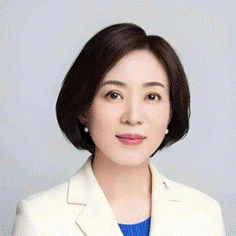
Professor Yongmei Yin
Jiangsu Provincial People’s Hospital