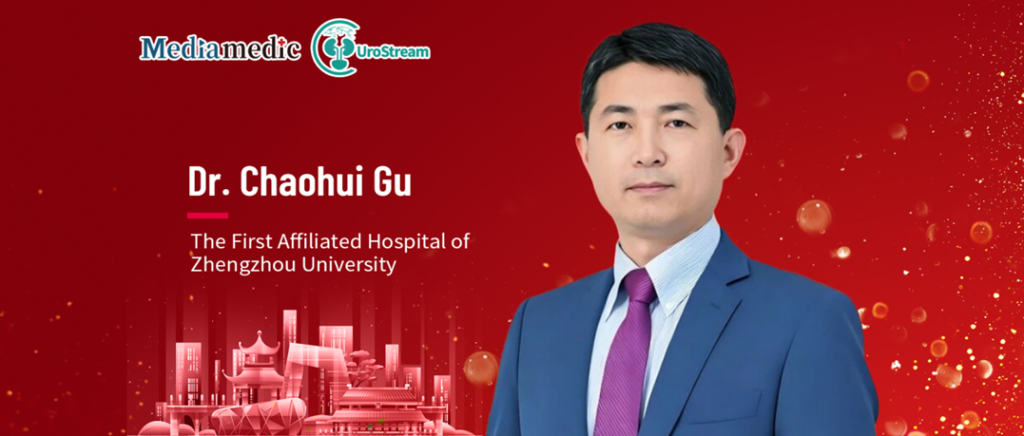
At the 2nd Peking University Urology Academic Forum and the 80th Anniversary Celebration of the Department of Urology at Peking University First Hospital, Oncology Frontier – UroStream interviewed Professor Chaohui Gu from the Department of Urology, The First Affiliated Hospital of Zhengzhou University.Professor Gu introduced a novel technique for immediate urinary continence recovery following radical prostatectomy. By utilizing autologous umbilical artery ligament suspension, the technique achieved a 90% continence rate within two weeks after catheter removal. This innovation has the potential to transform the management of postoperative urinary incontinence and substantially improve patients’ quality of life.
A New Approach to Address Post-Prostatectomy Urinary Incontinence
Oncology Frontier – UroStream :
Professor Gu, urinary incontinence after radical prostatectomy remains a major issue affecting patients’ quality of life. What originally motivated you to develop this new technique for immediate postoperative continence? Which limitations of conventional continence-preservation approaches does it address?
Professor Chaohui Gu:
Thank you to Oncology Frontier – UroStream and all our viewers.
The original motivation behind developing this technique came from witnessing how many patients around us suffered from urinary incontinence after radical prostatectomy. In the past, this complication was often considered almost unavoidable once such surgery was performed.
Conventional approaches mainly focus on preserving continence-related anatomical structures whenever possible and performing relatively simple reconstructive procedures.
Looking back over nearly 120 years of prostate cancer surgery, numerous surgical techniques have been proposed. As a younger surgeon, I carefully reviewed the strengths of previous methods and began considering whether meaningful innovation could be developed on top of existing experience.
Later, during my training in the United States, I combined concepts learned abroad with my own ideas and proposed several modifications. Specifically, we used the patient’s own umbilical artery ligament—located along the lateral side of the bladder—as a suspensory structure, functioning somewhat like an elastic band. The concept is similar to sling procedures used for female stress urinary incontinence.
We began exploring this approach in 2022, performing more than 20 cases in 2023. After reviewing the outcomes, we found the results very encouraging. We subsequently compiled the data and presented the technique at the 2024 American Urological Association (AUA) Annual Meeting, including detailed surgical videos demonstrating the resection and reconstruction procedures.
As of April this year, we have completed nearly 200 procedures, including approximately 40 cases performed using domestically developed multi-port and single-port robotic systems.
In our conventional surgeries, we already strive to preserve continence-related nerves, anatomical structures, and the bladder neck as much as possible while optimizing reconstruction. With this new approach, however, the continence rate two weeks after catheter removal has reached approximately 90%.
The motivation for this innovation is also deeply personal. A senior mentor and close family member of mine developed severe urinary incontinence after prostate cancer surgery and subsequently suffered from depression. He never truly regained continence before his passing.
As a urologist, witnessing a loved one endure such suffering was heartbreaking. Our goal from the beginning was to improve this situation and spare patients from the burden of postoperative incontinence.
Today, when patients come to me for surgery, after reviewing their imaging studies, I can generally assure them that they are unlikely to experience postoperative incontinence. Patient satisfaction and postoperative quality of life have improved dramatically.
Core Technical Principles and Clinical Advantages
Oncology Frontier – UroStream :
Could you briefly explain the technical principles behind this “immediate continence” approach? Compared with existing postoperative continence rehabilitation methods, what are its major advantages in terms of continence recovery, efficacy, and safety?
Professor Chaohui Gu:
At present, I primarily perform this technique robotically. Although I have attempted several laparoscopic cases, the outcomes were less satisfactory, so we have not promoted the laparoscopic approach for now.
Regardless of whether the procedure involves intrafascial, interfascial, or extrafascial dissection, there are two critical technical principles.
The first is adequate preservation and mobilization of the membranous urethra. It is essential to preserve sufficient membranous urethral length—ideally at least 8 mm to 1 cm or more. In my view, bladder neck preservation is relatively less important; the key lies in the membranous urethra.
The second is the autologous tissue suspension technique, which represents the core innovation of this procedure. The prepared umbilical artery ligament is positioned behind the membranous urethra and then suspended and fixed to the puboprostatic supporting structures using its natural elasticity. This effectively supports the urethra, increases urethral pressure, and improves postoperative continence.
The additional operative time is approximately 15 minutes, which is relatively modest.
Because the umbilical artery ligament retains natural elasticity, most patients do not experience significant postoperative voiding difficulties after suspension tightening.
However, there is one patient population that requires special caution: patients with long-standing diabetes mellitus, particularly those with disease duration exceeding 5–10 years. These patients are more prone to impaired bladder sensation. If postoperative urinary retention occurs, they may not perceive bladder fullness or discomfort, potentially increasing management risks. I previously attempted this technique in two diabetic patients and subsequently decided not to continue using it in such cases.
Patient selection is also important. Patients with very large prostates are not ideal surgical candidates initially. We generally begin with endocrine therapy or other medications to reduce prostate volume before proceeding with surgery after approximately 3–6 months.
This is because excessively large prostates are associated with shorter membranous urethral length and weaker periurethral support structures, which may compromise the effectiveness of the suspension.
Our technique has also received international recognition. The surgical video was officially included in the 2024 American Urological Association (AUA) Video Library, representing important acknowledgment from the international urological community.
Improving Quality of Life and Setting New Standards
Oncology Frontier – UroStream :
Following broader implementation, what practical changes do you believe this technique could bring to postoperative recovery after radical prostatectomy?
Professor Chaohui Gu:
Postoperative urinary incontinence after prostate cancer surgery is often referred to as a “social cancer.”
Many elderly patients avoid social interaction because of urinary odor, which severely undermines their confidence and quality of life.
With our modified technique, many patients have regained confidence and experienced minimal disruption to their daily lives and work after surgery.
Although urinary incontinence is considered a complication, it can profoundly diminish a patient’s motivation and enjoyment of life. Promoting this technique may not only improve postoperative quality of life, but could also establish a new benchmark for managing post-prostatectomy incontinence in the future.
In addition, we have now incorporated domestically developed single-port robotic systems—since imported single-port systems are not yet available in China—to perform nearly scarless minimally invasive suspension procedures in selected patients.
Many patients show almost no visible surgical scars postoperatively, which greatly enhances their self-confidence.
We continue to optimize the procedure and perioperative management in clinical practice and hope that more patients will benefit from this innovative technique in the future.
Expert Profile

Professor Chaohui Gu Department of Urology The First Affiliated Hospital of Zhengzhou University