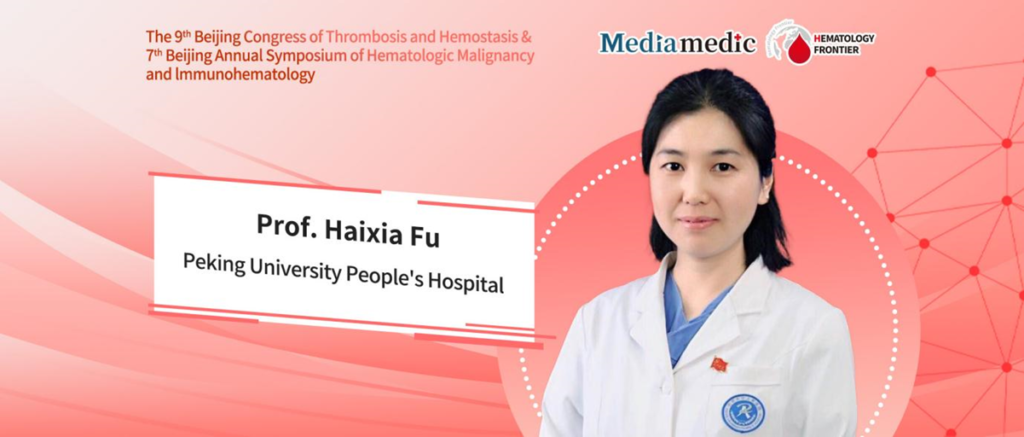
From March 27 to 28, 2026, the 9th Beijing Conference on Thrombosis and Hemostasis, hosted by the Hematologic Immunology Branch of the Chinese Society of Immunology, together with the 7th Beijing Summit Forum on Hematologic Malignancies and Immunology, was successfully held in Beijing. The meeting brought together leading international and domestic experts, clinicians, and industry leaders to explore cutting-edge developments in thrombosis and hemostasis, hematologic malignancies, and immunology, while advancing academic exchange and innovation in the field.At the conference, Professor Haixia Fu from Peking University People’s Hospital delivered an insightful presentation on the application and progress of thrombopoietin receptor agonists (TPO-RAs) and all-trans retinoic acid (ATRA) in ITP. Following the meeting, Oncology Frontier – Hematology Frontier conducted an exclusive interview with Professor Fu. A summary of the discussion is presented below.
ATRA in ITP: mechanistic insights and clinical potential
Oncology Frontier – Hematology Frontier: In your presentation, you discussed recent advances in ATRA for ITP treatment. What new insights have emerged regarding its mechanism of action and clinical efficacy? Could ATRA potentially reshape the current treatment landscape?
Professor Haixia Fu: Historically, research on all-trans retinoic acid (ATRA) in ITP has focused primarily on its demethylation effects. Our team has conducted extensive basic research in this area and found that ATRA can improve the function of mesenchymal stem cells within the bone marrow microenvironment.
Through this mechanism, ATRA helps regulate immune responses, promotes megakaryocyte differentiation and maturation, facilitates their migration toward the vascular niche, and enhances platelet production—thereby exerting therapeutic effects in ITP.
Building on these findings, we have combined ATRA with conventional ITP therapies (including first-line, second-line, and later-line treatments). Such combination strategies have improved long-term outcomes in ITP, aligning with the principles outlined in the latest treatment guidelines. The goal is to achieve durable remission through relatively short-term therapy.
Combination therapy can target and disrupt multiple pathogenic pathways in ITP, thereby enhancing overall therapeutic benefit. With the release of updated guidelines, this approach is expected to have broader applications and provide meaningful guidance for clinical practice.
TPO-RAs in the 2025 guidelines: key updates for clinical practice
Oncology Frontier – Hematology Frontier: In your interpretation of the 2025 ITP guidelines, you emphasized the role and evidence supporting thrombopoietin receptor agonists. Compared with previous versions, what are the most important changes for clinical decision-making?
Professor Haixia Fu: The updated guidelines reflect five years of accumulated evidence, including the approval and widespread clinical use of TPO receptor agonists (TPO-RAs) in China. During this period, a substantial body of prospective and real-world data has been generated, allowing for more refined clinical insights.
The new guidelines provide detailed recommendations on several key aspects of TPO-RA use, including timing of initiation, treatment duration, dose tapering, identification of loss of response, and strategies to enhance efficacy. These updates offer important practical guidance for clinicians managing ITP.
While TPO-RAs are highly effective in stimulating platelet production, monotherapy may not meet the needs of all patients. Therefore, future research will likely focus on combining TPO-RAs with agents targeting different mechanisms to achieve improved outcomes.
Additionally, strategies to minimize or avoid long-term dependence on TPO-RAs remain an important area for further investigation.
Individualized treatment in practice: balancing efficacy, safety, and patient needs
Oncology Frontier – Hematology Frontier: From a practical clinical perspective, how should physicians balance efficacy, safety, and individual patient needs when choosing between ATRA and TPO-RAs for different ITP subtypes or disease stages? What recommendations would you offer to help clinicians implement guidelines more effectively?
Professor Haixia Fu: At present, treatment options for ITP are diverse and not limited to ATRA and TPO-RAs. Importantly, there are currently no definitive clinical biomarkers to guide the selection between these therapies. In practice, treatment decisions are largely based on clinical characteristics and patient preferences.
For example, in patients with severely low platelet counts who require a rapid increase in platelet levels and wish to avoid the immunosuppressive effects of certain therapies, TPO-RAs are often recommended. These agents can quickly elevate platelet counts but generally require long-term administration, followed by gradual tapering once stability is achieved.
However, it is important to note that TPO-RAs may lose efficacy over time and may not be ideal for young women planning pregnancy. In addition, for patients with a history of thrombosis, excessive increases in platelet counts may elevate thrombotic risk, and thus are not desirable.
In such cases, therapies like ATRA—acting as immunomodulatory or immunosuppressive agents—may be more appropriate. Since ITP is fundamentally a disorder of immune dysregulation, agents like ATRA have the potential to address the underlying immune imbalance, achieving sustained benefit through short-term immunomodulation.
Expert profile

Professor Haixia Fu
Institute of Hematology, Peking University People’s Hospital
• MD, Chief Physician, Associate Professor
• Research interests: coagulation and bleeding disorders, hematologic malignancies, allogeneic hematopoietic stem cell transplantation
Academic Appointments: • Member, Thrombosis and Hemostasis Group, Hematology Branch, Chinese Medical Association • Member, Hemostasis and Thrombosis Committee, China Medical Education Association • Member, Platelet Disorders Group, Hematology Branch, Chinese Geriatrics Society • Member, National Health Science Popularization Expert Panel, Chinese Medical Association • Secretary-General, Hematology Committee, Beijing Anti-Cancer Association
Research and Awards: • Principal investigator of projects funded by the National Natural Science Foundation of China, the Ministry of Education, and the Beijing Natural Science Foundation • Recipient of the Second Prize of the Chinese Medical Science and Technology Award (2019) • Recipient of the First Prize of the Huaxia Medical Science and Technology Award (2019)