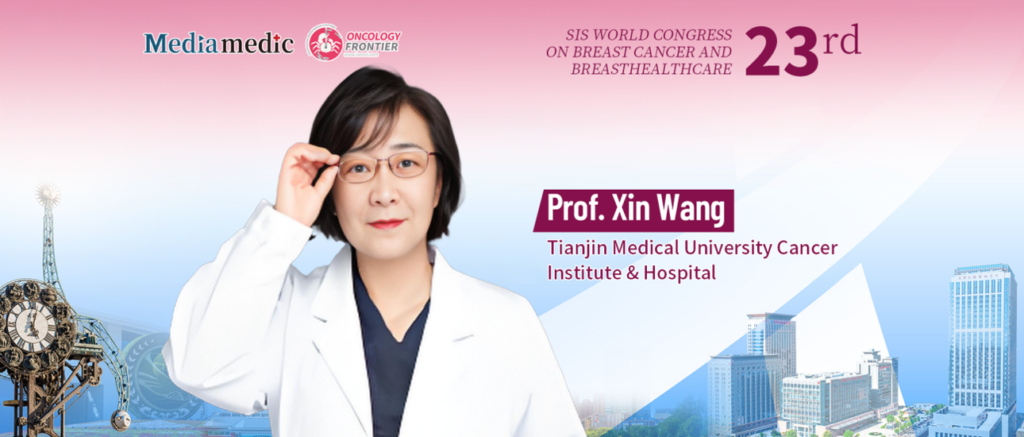
Breast cancer remains the most commonly diagnosed malignancy among women worldwide. With advances in early detection and multidisciplinary treatment, five-year survival rates have improved significantly. At the same time, increasing numbers of patients are seeking better postoperative quality of life and breast reconstruction options.During the 23rd World Congress on Breast Healthcare, Oncology Frontier spoke with Xin Wang from Tianjin Medical University Cancer Institute and Hospital about the clinical value of breast microsurgery, future technological developments, and the role of specialized training in advancing high-quality breast cancer care.
Oncology Frontier: You have extensive experience in breast microsurgery. Could you discuss its role in breast-conserving surgery and breast reconstruction?
Xin Wang:
One of the primary applications of breast microsurgery is free flap reconstruction, which is particularly valuable for patients with substantial tissue loss following surgery.
While breast-conserving surgery may require reconstruction of localized defects, the benefits of microsurgical techniques are most evident after mastectomy, where tissue loss is more extensive. In breast-conserving procedures, local tissue flaps are commonly used to restore breast contour and achieve favorable cosmetic outcomes.
Beyond ensuring complete oncologic treatment, reconstructive surgery plays an important role in restoring body image and self-confidence. Helping patients return to their families, careers, and daily lives with greater confidence is an essential component of improving postoperative quality of life.
Oncology Frontier: Breast microsurgery requires exceptional technical precision and multidisciplinary collaboration. What are the main challenges to its wider adoption, and where is the field heading?
Xin Wang:
Successful implementation of breast microsurgery depends on both advanced equipment and experienced multidisciplinary teams.
High-magnification operating microscopes are indispensable. Modern systems capable of 40-fold magnification have enabled the development of supermicrosurgery, allowing surgeons to perform highly delicate procedures such as vascular and lymphatic anastomoses. Intraoperative ultrasound further enhances surgical precision by accurately identifying target structures and helping optimize anastomosis sites.
However, equipment alone is not enough. Developing skilled microsurgeons remains the greatest challenge. Because these procedures have a steep learning curve, structured training programs are essential.
As a leading referral center, we have established a dedicated microsurgical training center that provides systematic education, enabling physicians to progress from beginners to experienced microsurgeons. As both technology and expertise continue to expand, we expect to offer increasingly personalized treatment strategies that further improve patient experience and long-term outcomes.
Oncology Frontier: What impact will hosting this year’s congress in Tianjin have on regional clinical research and the development of breast microsurgery?
Xin Wang:
This is the second time the World Congress on Breast Healthcare has been held in Tianjin, and it provides valuable momentum for advancing breast disease management throughout the region.
Our breast center, currently one of the world’s largest dedicated breast cancer centers, has established a comprehensive breast microsurgery program supported by an extensive training system.
Going forward, we hope to develop breast surgeons with broad expertise while supporting multicenter clinical research. Ultimately, clinical research should address real-world clinical questions.
One important example is breast cancer-related lymphedema, a serious postoperative complication whose incidence and timing remain incompletely understood. Our current research focuses on reducing lymphedema through two complementary strategies: minimizing the extent of axillary lymph node dissection whenever appropriate and evaluating lymphaticovenous anastomosis (LVA) as a preventive microsurgical approach.
Looking ahead, standardized training, wider dissemination of microsurgical techniques, and integration of multicenter clinical data will generate stronger evidence to support future clinical guidelines and standardized practice, ultimately benefiting more patients.
Professor

Xin Wang
Tianjin Medical University Cancer Institute and Hospital