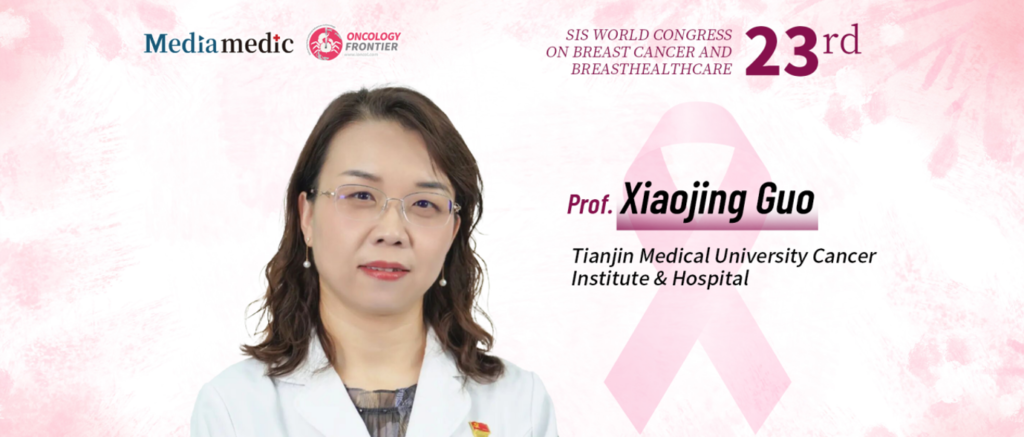
Breast cancer is the most commonly diagnosed malignancy among women worldwide, and its management has fully entered the era of precision medicine driven by molecular subtyping. Compared with Western populations, Chinese patients tend to develop breast cancer at a younger age and often present with higher-risk disease. Combined with China's large patient population, these characteristics place increasing demands on the efficiency, standardization, and precision of breast pathology.During the 23rd World Congress on Breast Healthcare, Oncology Frontier interviewed Xiaojing Guo from Tianjin Medical University Cancer Institute and Hospital. She discussed recent advances in artificial intelligence (AI)-powered breast pathology in China, the evolving role of pathology in the era of precision oncology, and how China’s experience in digital pathology is contributing to the refinement of global breast cancer diagnostic standards.
Oncology Frontier: Your team has been actively developing digital pathology and artificial intelligence for breast cancer. Last December, you introduced China’s first breast pathology large language model, BRIGHT. Could you tell us about its latest progress and key capabilities?
Xiaojing Guo:
The BRIGHT breast pathology model was developed under China’s national AI strategy with support from the Chinese Anti-Cancer Association and Tianjin Medical University Cancer Institute and Hospital. It was built using extensive clinical experience in breast pathology and officially launched at the Tianjin International Breast Cancer Conference in December 2025.
Since January 2026, BRIGHT has been integrated into our routine clinical workflow, where it continues to be refined and validated through real-world clinical practice, improving both diagnostic efficiency and accuracy.
The platform provides intelligent pathology support throughout the entire breast cancer care pathway. Its capabilities include morphologic diagnosis, molecular subtype prediction, prediction of pathological complete response (pCR) following neoadjuvant therapy, long-term survival prediction, and treatment-related drug screening and analysis.
Beyond clinical practice, BRIGHT also supports research and education. We are conducting multiple studies to evaluate its clinical applications while integrating the platform into pathology training programs. Our long-term goal is to extend its use to hospitals at all levels, helping improve the diagnostic capabilities of pathologists nationwide and ultimately supporting more precise diagnosis and personalized treatment for breast cancer patients.
Oncology Frontier: As molecular classification becomes increasingly refined, what new challenges are pathologists facing, and how do you see the future of breast pathology?
Xiaojing Guo:
Breast cancer was one of the first solid tumors to adopt molecular classification, with the goal of providing more precise diagnosis and treatment. Different molecular subtypes have distinct therapeutic strategies and prognoses, making accurate pathological classification essential.
Today, molecular classification continues to evolve. The identification of HER2-low and HER2-ultralow disease has introduced new challenges in standardizing testing procedures, interpreting results consistently, and ensuring uniform pathology reporting.
Our responsibility is to provide clinicians with increasingly accurate and clinically meaningful information. For example, accurately identifying patients with HER2-ultralow disease may expand access to emerging targeted therapies and improve patient outcomes.
Ultimately, the purpose of pathology is not simply to classify tumors, but to enable more precise treatment decisions and improve the care of breast cancer patients.
Oncology Frontier: This congress provided an important platform for international collaboration. From the perspective of pathology, how can China’s rapid progress in digital pathology contribute to global precision breast cancer care?
Xiaojing Guo:
The World Congress on Breast Healthcare is jointly organized by the World Society of Breast Health and the Chinese Anti-Cancer Association, with Tianjin Medical University Cancer Institute and Hospital, Tianjin Breast Cancer Prevention and Treatment Center, and the National Clinical Research Center for Cancer serving as co-hosts.
Under the leadership of Xishan Hao and Jihui Hao, our center has established a comprehensive breast cancer program that spans the entire continuum of care—from prevention and screening to diagnosis, treatment, and survivorship.
Artificial intelligence is rapidly becoming an integral part of modern medicine, supporting every stage of clinical care from diagnosis to treatment. With strong national support for AI development in healthcare, Chinese scientists and clinicians have made substantial progress in this field.
Today, breast cancer care in China is advancing alongside leading international centers. Institutions such as the Cancer Hospital of the Chinese Academy of Medical Sciences and Fudan University Shanghai Cancer Center are not only keeping pace with global developments but, in some areas, helping lead them.
China’s large breast cancer population and the distinct clinical characteristics of Asian patients—including younger age at diagnosis and higher-risk disease—provide unique opportunities to build comprehensive pathology databases and AI-driven clinical platforms. These resources can contribute valuable evidence from Asian populations to the international community.
Through exchanges at meetings such as this congress, we hope to strengthen collaboration with colleagues around the world while sharing China’s experience in digital breast pathology, ultimately contributing to more refined global standards for precision breast cancer diagnosis and treatment.
Professor
Xiaojing Guo
Tianjin Medical University Cancer Institute and Hospital