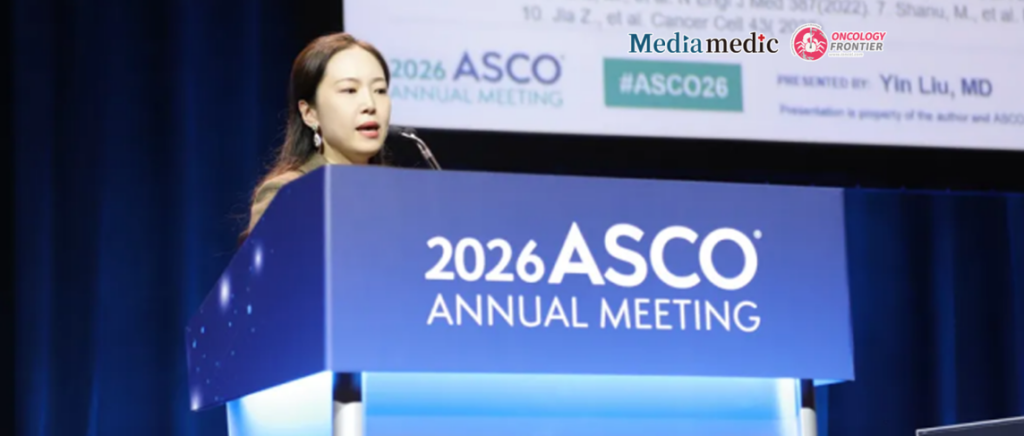
Triple-negative breast cancer (TNBC) remains one of the most aggressive breast cancer subtypes due to the absence of estrogen receptor (ER), progesterone receptor (PR), and HER2 expression, leaving patients without effective endocrine or anti-HER2 targeted therapies. Among its molecular subtypes, basal-like immune-suppressed (BLIS) TNBC is particularly challenging because of its highly invasive biology, immunosuppressive tumor microenvironment, poor response to immunotherapy, and limited treatment options after disease progression.Led by Zhimin Shao, Zhonghua Wang, Yizhou Jiang, and Keda Yu, the FUTURE research program has pioneered molecular subtyping and precision treatment strategies for TNBC. At the 2026 American Society of Clinical Oncology (ASCO) Annual Meeting, Yin Liu presented the latest results from the FUTURE2.0 study during the Rapid Oral Abstract session.
The study demonstrated that combining bevacizumab with antibody-drug conjugates (ADCs) produced remarkable synergy in previously treated BLIS TNBC. Compared with ADC monotherapy, the combination increased objective response rates from 40.0% to 83.3%–86.7% and extended median progression-free survival from 4.6 months to 9.2 months, while maintaining a manageable safety profile with no treatment-related deaths.
Oncology Frontier spoke with Yin Liu to discuss the scientific rationale, key findings, and future development of this China-led precision medicine strategy.
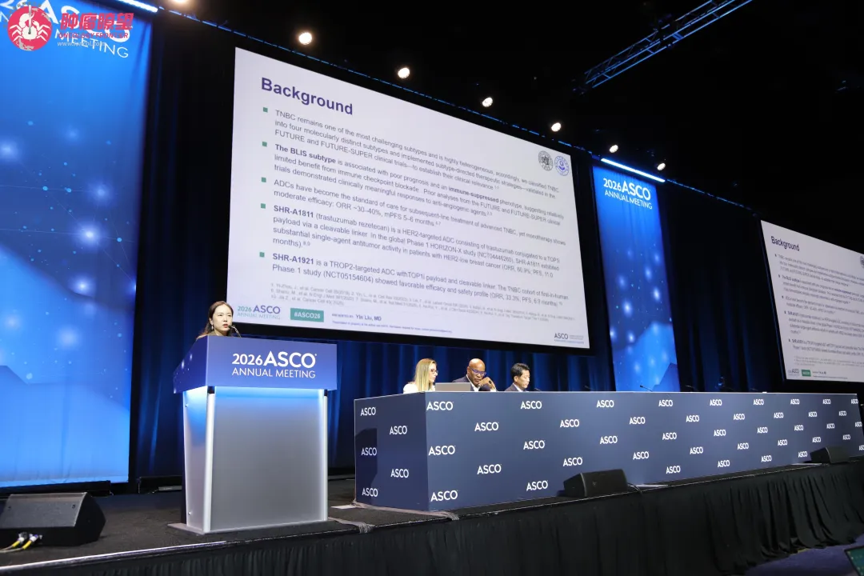
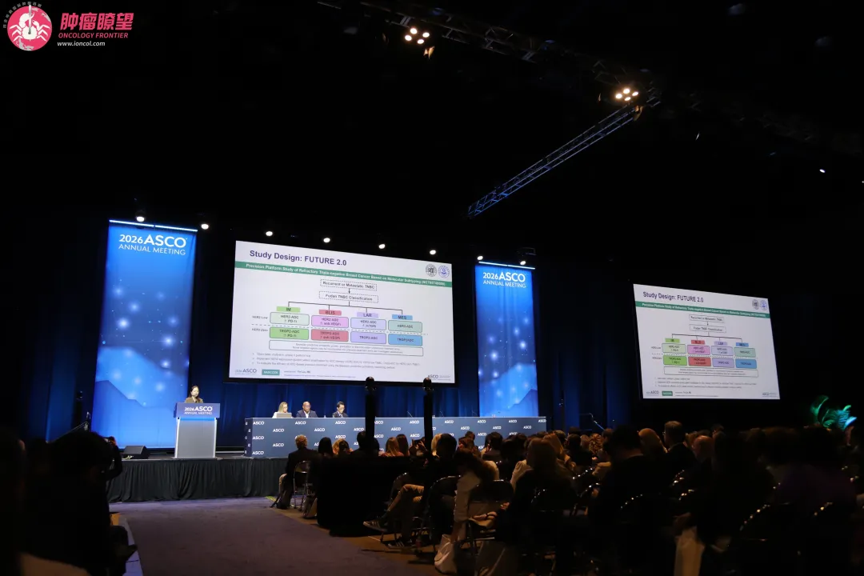
Oncology Frontier: Previous FUTURE studies suggested that BLIS TNBC is particularly responsive to anti-angiogenic therapy. What scientific rationale led your team to combine bevacizumab with ADCs?
Yin Liu:
This work is the result of many years of research.
In 2018, Professor Zhimin Shao and Professor Yizhou Jiang established China’s original four-subtype molecular classification system for TNBC, identifying the immune-modulatory (IM), basal-like immune-suppressed (BLIS), luminal androgen receptor (LAR), and mesenchymal (MES) subtypes.
Among these, IM and BLIS have the clearest biological characteristics, while effective therapeutic targets for LAR and MES remain less well defined.
Based on this classification, our team first launched the FUTURE umbrella trial, led by Professor Zhonghua Wang, which explored chemotherapy combined with subtype-specific targeted therapies. Building on those findings, we subsequently conducted the randomized FUTURE-SUPER study to generate stronger evidence for precision treatment.
As ADCs became the preferred option for later-line TNBC after 2020, Professor Zhimin Shao initiated the FUTURE2.0 multi-arm Phase II platform trial to evaluate ADC-based combination therapies across all TNBC molecular subtypes.
BLIS accounts for approximately half of all TNBC cases, making it the largest subtype and the first to complete enrollment.
From a biological perspective, BLIS tumors are highly invasive and characterized by profound immune suppression, resulting in limited responsiveness to immunotherapy. Importantly, this subtype also exhibits upregulation of the VEGF pathway, providing a strong mechanistic rationale for combining anti-angiogenic therapy with ADCs.
Oncology Frontier: Compared with ADC monotherapy, bevacizumab plus ADC nearly doubled response rates and prolonged median PFS from 4.6 to 9.2 months. Does this represent the beginning of a chemotherapy-free or efficacy-enhancing treatment strategy for BLIS TNBC?
Yin Liu:
I would not describe this strategy primarily as “enhancing efficacy while reducing toxicity.”
In my view, ADCs should be regarded as next-generation cytotoxic agents, rather than purely targeted therapies. Although they are directed against specific molecular targets, their antitumor activity ultimately depends on the cytotoxic payload they deliver. Consequently, ADCs still produce toxicities that are comparable to—or sometimes even more challenging than—those associated with conventional chemotherapy.
Therefore, the major advantage of this combination is its substantial improvement in efficacy, rather than a reduction in toxicity.
From a safety standpoint, the adverse event profile of the combination was very similar to that of ADC monotherapy, and no new safety signals were identified.
Another important finding from FUTURE2.0 is that the benefit appears to be broadly applicable across different ADC backbones.
During study design, we deliberately selected different ADCs according to HER2 status—for example, a Trop2-targeting ADC for HER2-zero disease—instead of using a single ADC for every patient. Regardless of which ADC was combined with bevacizumab, we consistently observed a comparable magnitude of efficacy improvement.
Oncology Frontier: A confirmatory Phase III study is already underway. How do you envision translating this precision treatment strategy into routine clinical practice? Could bevacizumab plus ADC eventually move into earlier treatment settings?
Yin Liu:
ADCs are already moving into first-line treatment for TNBC. Restricting investigation of this combination to later-line therapy would therefore limit its clinical value.
For this reason, our ongoing Phase III confirmatory trial continues to focus on the BLIS subtype, while expanding enrollment to patients across the full treatment continuum—from first-line through later-line therapy—provided they have not previously received ADCs with overlapping resistance mechanisms.
The translation from umbrella trials to clinical practice is also a defining feature of this research program.
Although the current results are highly encouraging, they come from a Phase II platform study, which evolved from our earlier umbrella trials. Both umbrella and platform studies are designed to rapidly identify promising treatment combinations that warrant definitive Phase III evaluation. Their findings should therefore be regarded as exploratory rather than practice-changing.
The ongoing Phase III trial will further evaluate efficacy, safety, subgroup benefit, and, importantly, determine whether adding bevacizumab translates into meaningful improvements in overall survival, which remains the key endpoint.
Study Overview
The FUTURE2.0 study is an ongoing open-label, multi-cohort Phase II platform trial evaluating bevacizumab plus ADCs in patients with recurrent or metastatic TNBC who progressed after first-line systemic therapy.
Patients with HER2-low disease received either SHR-A1811 alone or in combination with bevacizumab, while patients with HER2-zero disease received SHR-A1921 alone or combined with bevacizumab.
Between April 2022 and October 2025, 100 patients were enrolled.
The study demonstrated substantial efficacy improvements with combination therapy. Confirmed objective response rates increased from 40.0% with ADC monotherapy to 86.7% in the HER2-low cohort and 83.3% in the HER2-zero cohort. Median progression-free survival improved from 4.6 months with monotherapy to 9.2 months with combination treatment (HR 0.47).
Grade ≥3 treatment-related adverse events occurred in 27.5% of patients receiving ADC monotherapy and 33.3% of those receiving combination therapy. No treatment-related deaths were reported.
These findings provide the first clinical evidence supporting synergistic antitumor activity between bevacizumab and ADCs in BLIS TNBC and establish a strong rationale for the ongoing Phase III confirmatory trial.
Expert Profiles

Zhimin Shao
Fudan University Shanghai Cancer Center

Zhonghua Wang
Fudan University Shanghai Cancer Center

Yin Liu
Fudan University Shanghai Cancer Center