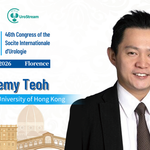

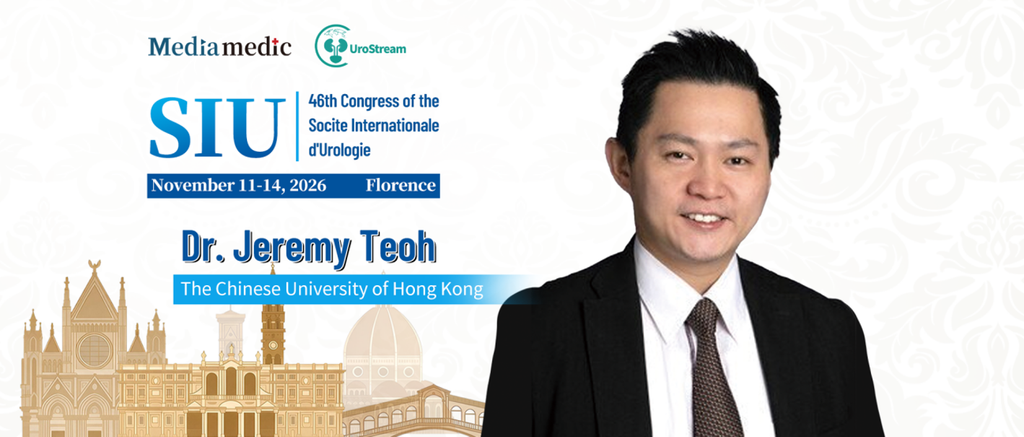

Editor's Note: The 46th Annual Congress of the Société Internationale d'Urologie (SIU) was held in Florence, Italy, from November 11 to 14, 2026. On this occasion, Oncology Frontier – UroStream invited Professor Jeremy Yuen Chun Teoh of the Faculty of Medicine, The Chinese University of Hong Kong, Chair of the Organizing Committee of this year's congress, to share his insights on the overall congress program, the development of Asian urology and its pathway toward greater international academic collaboration, as well as his motivation and vision for running for the position of SIU General Secretary-elect.01
Oncology Frontier – UroStream: As Chair of the Organizing Committee of the 2026 SIU Congress, could you introduce the overall planning of this year’s meeting, including its theme and key highlights, as well as the academic program and special sessions?
Professor Jeremy Teoh: The Société Internationale d’Urologie (SIU) is an international society with more than 14,000 members across over 100 countries and regions. We are delighted to hold this year’s congress in Florence, Italy, a wonderful venue for colleagues from around the world to come together and exchange professional knowledge. As you can see from the program, this year’s congress features a series of high-level sessions, including sessions organized by several national urological associations, a live surgery day, a B2B (Bench-to-Bedside) oncology program, and the SIU Innovators Program.
We have always wanted to bring cutting-edge technologies and new innovations to the congress, helping urologists learn about these developments and, more importantly, apply them in their clinical practice.
02
Oncology Frontier – UroStream: What is the current global academic standing of Asian urology, and what are its key characteristics? Compared with Europe and North America, what unique strengths does Asia have in three key areas: clinical diagnosis and treatment, innovation in basic and translational research, and the development of young talent?
Professor Jeremy Teoh: I think research from countries across Asia is gaining increasing international recognition. Of course, the first priority for urologists and academics in Asia is to come together and work in a truly united way. We need to conduct genuinely high-quality research, ideally research that can meaningfully change clinical practice.
Throughout the research process, it is always valuable to collaborate with key opinion leaders (KOLs) from different countries and regions, including colleagues in Europe and the United States. Ultimately, this will enable us to conduct global collaborative studies that can genuinely change clinical practice and improve patient outcomes in the long term.
I therefore believe that SIU is an excellent platform for this purpose, as it is an international society dedicated to bringing colleagues from around the world together. I hope we can use this opportunity to conduct higher-quality research in the future.
03
Oncology Frontier – UroStream: You have announced your candidacy for SIU General Secretary. What is the main motivation behind your decision to run for this position?
Professor Jeremy Teoh: I believe it is very important for Asian urologists to actively step onto the international stage and take on leadership roles within international societies. Ultimately, this is about more than research itself; it is about whether we can build an academic ecosystem that brings people together to accomplish impactful work collectively.
That is the fundamental reason why I am running for General Secretary-elect. In fact, I have already been nominated for the position. Tomorrow, at the General Assembly, we will find out whether I have the support of the SIU members present.
I genuinely believe that Asian urologists have both the talent and the capabilities to carry out impactful work. However, we need to be more proactive in stepping forward and building connections with colleagues around the world, so that the international community can gain a deeper understanding of what we are capable of achieving.
04
Oncology Frontier – UroStream: What do you think will be the major development trends in urology over the next five to ten years?
Professor Jeremy Teoh: I think we are already witnessing the rise of pharmaceutical companies in China, alongside advances in the development of medical devices and surgical robots in China and other parts of Asia. These developments are gradually gaining recognition among colleagues worldwide. The key is how we can conduct high-quality research that will be recognized by colleagues around the world.
I sincerely hope to contribute to the development of Asian urology by ensuring that our research maintains high standards while further expanding the dissemination and influence of our research findings, so that colleagues around the world can learn about them. I can genuinely see this trend: the center of gravity of global urology is gradually shifting toward Asia.
I also sincerely hope that young urologists across Asia will come together and work collectively to advance the field, demonstrating the true strength of Asian urology on the international stage.
05
Oncology Frontier – UroStream: What practical advice would you offer Chinese healthcare companies and clinical research institutions that hope to use the SIU platform to expand their international academic collaborations?
Professor Jeremy Teoh: From a practical standpoint, I believe the best approach is to embrace collaboration proactively from the very beginning and initiate it at a very early stage. For example, when a research project is first launched, KOLs from different countries should be invited to participate. They should be involved from the study design stage, so that everyone can jointly design the study and help shape its overall direction. As the study progresses to implementation, they can gain a better understanding of how we conduct the research and maintain its standards. This is what genuine collaboration looks like and how we can work together to advance research.
Therefore, I hope we can approach these global collaborations with a more open mindset and greater courage to take action.