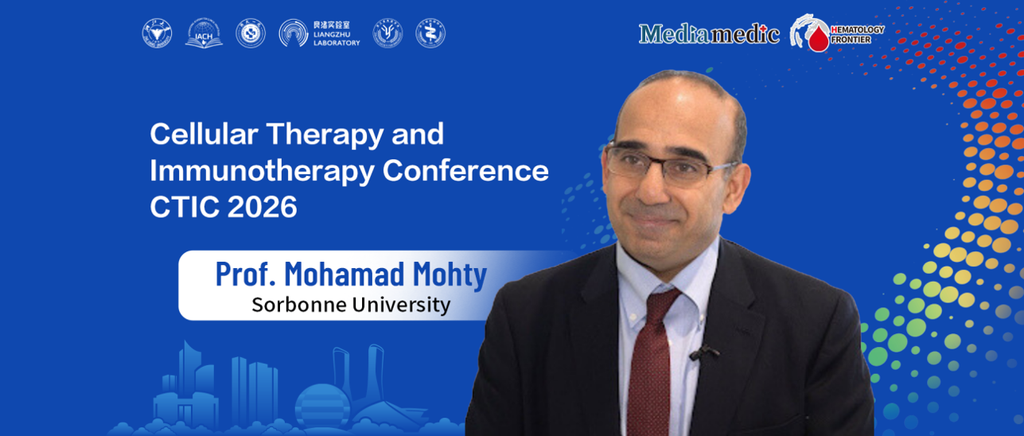
Qiantang Forum, Shaping the Future Through Innovation. From November 6 to 8, 2026, the 2026 Cellular Therapy and Immunotherapy Conference (CTIC 2026) was grandly held in Hangzhou. Taking a global perspective, the congress brought together leading experts and scholars from China and abroad to explore cutting-edge developments in cellular therapy, gene therapy, AI-enabled hematology, and translational research, addressing clinical challenges and charting a path toward high-quality development in the field. During the congress, Oncology Frontier – Hematology Frontier invited Professor Mohamad Mohty of Sorbonne University, France, who also served as the congress chair, to share his latest research findings and academic insights into mechanistic breakthroughs in chronic graft-versus-host disease (cGVHD) over the past decade, the immunological balance between GVHD and GVL, and the future role of cell therapy. The key points are presented below.Breaking Four Decades of Stagnation: Mechanistic Breakthroughs and Clinical Translation of Three Key Signaling Pathways
Oncology Frontier – Hematology Frontier: As chair of this year’s CTIC Congress, could you discuss the most significant advances in our understanding of the pathophysiological mechanisms of chronic graft-versus-host disease (cGVHD) in recent years? How have these basic research findings been translated into targeted therapies in clinical practice?
Professor Mohamad Mohty: cGVHD is one of the most serious long-term complications following allogeneic hematopoietic stem cell transplantation, with devastating effects on patients’ quality of life and organ function. Over the past decade, landmark breakthroughs have been achieved in research into the pathophysiological mechanisms of cGVHD, laying a solid foundation for the development of novel targeted therapies. These advances have primarily centered on the elucidation of three key signaling pathways.
First, the JAK signaling pathway plays a critical role in mediating inflammatory responses in cGVHD, directly leading to the clinical application of ruxolitinib. Second, the ROCK2 pathway is involved not only in inflammation but also plays a substantial role in tissue fibrosis. The ROCK2 inhibitor belumosudil has considerable therapeutic potential because it can target both inflammation and fibrosis, effectively achieving a “two birds with one stone” approach. Third, the recently identified CSF-1R pathway is a key driver of fibrosis, leading to the approval of axatilimab.
After nearly four decades during which treatment relied almost exclusively on corticosteroids, the precise elucidation of disease mechanisms has finally ushered in several highly effective targeted therapies for cGVHD. This marks the beginning of an entirely new era of precision intervention for this complication.
Balancing the Immunological Interplay: Precision Risk-Stratified cGVHD Treatment While Preserving GVL Effects
Oncology Frontier – Hematology Frontier: In clinical practice, cGVHD treatment often involves a difficult trade-off between suppressing GVHD and preserving the graft-versus-leukemia (GVL) effect. In your clinical experience, how can an integrated intervention strategy achieve precise risk-stratified treatment of cGVHD?
Professor Mohamad Mohty: In the field of allogeneic hematopoietic stem cell transplantation, separating graft-versus-host disease (GVHD) from the graft-versus-leukemia (GVL) effect has long been regarded as the “holy grail” of transplant immunology. Despite decades of investigation, completely separating GVHD from GVL remains extremely challenging. This dilemma is particularly pronounced today for two reasons. First, as an increasing proportion of high-risk patients and patients with advanced-stage disease undergo transplantation, the risk of post-transplant relapse is very high. Second, retrospective data suggest that mild-to-moderate cGVHD is often associated with prolonged survival.
Therefore, when intervening in cGVHD, clinicians must carefully assess the potential impact of treatment on the GVL effect. However, the challenge in clinical decision-making is that cGVHD itself is also an important cause of substantial morbidity and even transplant-related mortality.
Encouragingly, with the widespread clinical use of targeted agents such as ruxolitinib and belumosudil, neither prospective clinical trials nor real-world data have demonstrated a significant increase in relapse risk. This evidence indicates that these targeted agents can effectively control the pathological processes of cGVHD while preserving the GVL effect. They therefore provide clinicians with important therapeutic tools for achieving a more precise balance between risks and benefits.
Looking Ahead to Cell Therapy: The Role of CAR T Cells in cGVHD Intervention and International Collaboration
Oncology Frontier – Hematology Frontier: This year’s congress has brought together cell therapy and transplantation experts from around the world. As congress chair, what role do you think cell therapy will play in the prevention and treatment of cGVHD over the next five years? What are your expectations for promoting international collaboration in transplant immunology?
Professor Mohamad Mohty: The CTIC Congress held in Hangzhou has become a high-level academic platform connecting leading experts from China and around the world. The rapid development of cell therapy, particularly the outstanding contributions made by the Chinese academic community in this field, has attracted considerable attention.
Why discuss cGVHD at a cell therapy congress? In fact, the two fields are closely connected at the mechanistic level. Based on the pathophysiological characteristics of cGVHD, B cells—particularly CD19-positive B cells—and plasma cells play important roles in disease progression. Case reports have already demonstrated that CD19-targeted CAR T cells can effectively intervene in advanced cGVHD. This suggests that we may be able to develop specialized cellular therapy products in the future, not only to treat cGVHD but potentially even to prevent it at an early stage.
One unique advantage of cell therapy is its potential as a “one-shot treatment,” which may enable patients to achieve a cure or prolonged treatment-free remission. Discontinuing treatment and helping patients return to normal life is the ultimate goal of the hematologic oncology community. This is also consistent with the central vision advocated by this year’s Hangzhou congress: through in-depth international and interdisciplinary collaboration, accelerate the clinical translation of cutting-edge therapies and ultimately help patients “live long and well.”
Expert Profile
Professor Mohamad Mohty
Professor Mohamad Mohty is Professor of Hematology at Sorbonne University and Head of the Department of Clinical Hematology and Cellular Therapy at Saint-Antoine Hospital, Assistance Publique–Hôpitaux de Paris (AP-HP), France. He also leads a translational research team at the Saint-Antoine Research Centre (Inserm).
He is the founder and Chairman of the International Academy for Clinical Hematology (IACH) and Past President of the European Society for Blood and Marrow Transplantation (EBMT).
His scientific and clinical activities focus on hematopoietic stem cell transplantation, cellular immunotherapy, hematological malignancies, and the pathophysiology and treatment of graft-versus-host disease.
Professor Mohty served as a Chair of the 2026 Cellular Therapy and Immunotherapy Conference (CTIC) held in Hangzhou, China.