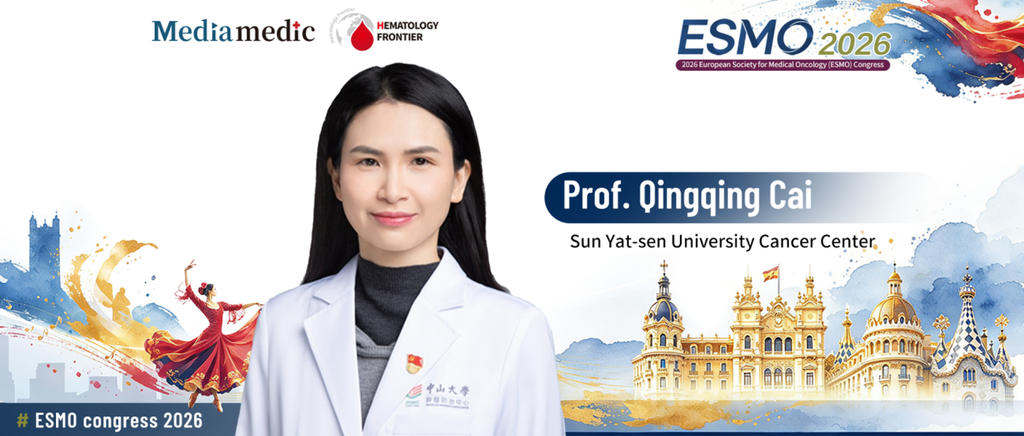
Non-germinal center B-cell-like (non-GCB) diffuse large B-cell lymphoma (DLBCL) is characterized by substantial molecular heterogeneity. Compared with the GCB subtype, it generally responds less favorably to conventional immunochemotherapy and is associated with poorer outcomes, making it a challenging subtype in clinical practice. At the 2026 European Society for Medical Oncology (ESMO) Congress, Professor Qingqing Cai's team from Sun Yat-sen University Cancer Center presented data from a multicenter Phase Ib study (1457O) evaluating the safety and preliminary efficacy of rocbrutinib, a novel fourth-generation Bruton tyrosine kinase (BTK) inhibitor, in combination with R-CHOP as first-line treatment for B-cell lymphoma. The study demonstrated an objective response rate (ORR) of 100% and a complete response (CR) rate of 86.7% among patients with newly diagnosed non-GCB DLBCL, with no cases of atrial fibrillation or severe bleeding observed. In this article, we invited Professor Qingqing Cai to provide an in-depth interpretation of the translational value and future research directions of this regimen, covering its pharmacological mechanisms, minimal residual disease (MRD)-guided strategies, and the future clinical development landscape.Oncology Frontier – Hematology Frontier: Rocbrutinib, a fourth-generation BTK inhibitor with both covalent and non-covalent binding properties, achieved an ORR of 100% and a CR rate of 86.7% when combined with R-CHOP as first-line treatment for newly diagnosed non-GCB DLBCL, with no cases of atrial fibrillation or severe bleeding observed. How do you assess the significance of this safety profile for the long-term use of BTK inhibitors?
Professor Qingqing Cai: For patients who require prolonged, continuous treatment with BTK inhibitors, atrial fibrillation and bleeding events are key dose-limiting toxicities that can lead to treatment discontinuation or dose reduction and ultimately compromise long-term quality of life. The absence of atrial fibrillation, atrial flutter, or major bleeding events in this study is an encouraging signal with clear clinical implications. It provides safety data supporting further investigations of long-term maintenance therapy.
When evaluating the long-term value of targeted agents, their tolerability must be considered alongside the intensity and completion of the overall combination regimen. Previous nonclinical studies and clinical experience have suggested that if the additional toxicity associated with a targeted agent leads to delays or dose reductions in the underlying immunochemotherapy regimen, such as R-CHOP, its anticipated curative benefit may be substantially compromised. Rocbrutinib is a highly selective fourth-generation BTK inhibitor. Its pharmacological design centers on optimizing its molecular structure to reduce off-target inhibition of kinases such as EGFR and TEC, thereby lowering the risk of bleeding and cardiovascular events at the mechanistic level. However, translating these pharmacological design advantages into definitive clinical benefits will require validation in larger patient populations with longer follow-up, particularly to establish its long-term safety and tolerability during maintenance therapy and its actual impact on adherence to the overall treatment regimen.
Oncology Frontier – Hematology Frontier: In the study, all eight patients who achieved CR and underwent circulating tumor DNA (ctDNA)-based MRD testing were reported to be MRD-negative. Is MRD negativity sufficient to support future exploration of chemotherapy-free approaches or shorter treatment durations in DLBCL? How far are we from implementing MRD-guided treatment modifications in DLBCL?
Professor Qingqing Cai: The current MRD data provide preliminary support for further exploration of chemotherapy-free or de-escalated treatment strategies. However, at this stage, they are insufficient to serve as a routine clinical decision-making standard for reducing chemotherapy intensity. The fundamental goal of first-line DLBCL treatment is to achieve a cure. Any effort to reduce the treatment burden must be based on the absolute prerequisite that patients’ chances of cure are not compromised.
In this study, among the eight patients who achieved CR and consented to testing, seven were MRD-negative, while one was unevaluable. These molecular response data provide highly valuable complementary information to conventional imaging assessments, suggesting that rocbrutinib plus R-CHOP may promote more thorough elimination of tumor clones. Nevertheless, validating the feasibility of shortening treatment duration will require rigorous prospective clinical studies with predefined time points for dynamic ctDNA monitoring and clearly quantified criteria for treatment de-escalation. We need not only to determine whether patients who maintain MRD negativity and achieve metabolic response on imaging can sustain disease control after chemotherapy reduction, but also to address the central clinical question of whether treatment de-escalation increases the risk of relapse.
Several studies worldwide are currently investigating shorter treatment durations or ctDNA-guided treatment strategies. The key challenge moving forward will be to achieve more precise risk stratification through dynamic MRD monitoring: accurately identifying which patients can safely receive less intensive treatment and which high-risk patients must continue to receive full-dose or even intensified therapy. These questions, which have direct implications for long-term survival, require answers from high-level evidence and prospective clinical trials.
Oncology Frontier – Hematology Frontier: Non-GCB DLBCL has historically responded poorly to conventional immunochemotherapy, yet rocbrutinib plus R-CHOP has demonstrated deep responses in this subtype. Do you believe this regimen has the potential to challenge the current first-line standard of care? Are there plans to include patients with the ABC subtype or high-risk populations, such as those with double-expressor or double-hit lymphoma, in subsequent studies?
Professor Qingqing Cai: The deep responses observed with this combination in non-GCB DLBCL are supported by a strong biological rationale and offer considerable potential for clinical translation. In non-GCB DLBCL, particularly the activated B-cell-like (ABC) subtype, a substantial proportion of patients have tumor cells that are highly dependent on B-cell receptor (BCR) signaling for survival. This provides a clear mechanistic rationale for targeted intervention with BTK inhibitors. The exceptionally high initial response rate, molecularly deep responses indicated by ctDNA testing, and manageable safety profile observed to date give us confidence in further investigating this regimen.
However, challenging and ultimately changing the current first-line treatment paradigm will require improvements in long-term survival outcomes. The present Phase Ib study has a single-arm design and a relatively small sample size (22 patients), with a short median follow-up of 5.46 months. Although no disease progression or deaths had been observed at the data cutoff, the current dataset is not yet sufficient to assess the regimen’s ultimate ability to reduce long-term relapse risk or improve cure rates.
Future research must therefore advance toward larger studies and randomized controlled trials (RCTs) directly comparing this regimen with current first-line standards, such as Pola-R-CHP or R-CHOP, to establish its statistical and clinical superiority in progression-free survival (PFS) and overall survival (OS). In subsequent clinical trial designs and translational research, we will further focus on high-risk molecular subgroups, including patients with the ABC subtype, double-expressor lymphoma (DEL), or double-hit lymphoma. Through more refined biomarker-based selection, we aim to explore whether this targeted combination can achieve greater survival benefits in specific high-risk populations, thereby advancing first-line DLBCL treatment toward a more precise, molecular subtype-driven approach.
Expert Profile

Professor Qingqing Cai
Sun Yat-sen University Cancer Center
- Deputy Director of the Department of Medical Oncology and Principal Investigator of the Lymphoma Research Program, Sun Yat-sen University Cancer Center
- Distinguished Professor under the Changjiang Scholars Program, Ministry of Education
- Chair of the Lymphoma Committee of the China Anti-Cancer Association Committee on Integrated Chinese and Western Medicine
- Chair of the Lymphoma Committee of the Guangdong Anti-Cancer Association
- Chair of the Lymphoma Committee of the Guangdong Precision Medicine Application Association
- Vice Chair of the Lymphoma Committee of the Chinese Society of Clinical Oncology (CSCO)
- Member of the 12th Committee of the Hematology Branch of the Chinese Medical Association
Over the past five years, Professor Cai has published more than 30 SCI-indexed papers in leading international journals, including JAMA, The Lancet Oncology, The Lancet Haematology, Blood, Signal Transduction and Targeted Therapy, Clinical Cancer Research, and Leukemia. She has led major national science and technology projects, key projects funded by the National Natural Science Foundation of China, and key research and development projects of the Ministry of Science and Technology. As the first award recipient, she received the First Prize of the 2023 Guangdong Provincial Science and Technology Progress Award. She was also named one of the “Top 10 Medical Elite Experts” at the 7th Annual Conference of Medical Scientists in 2022.