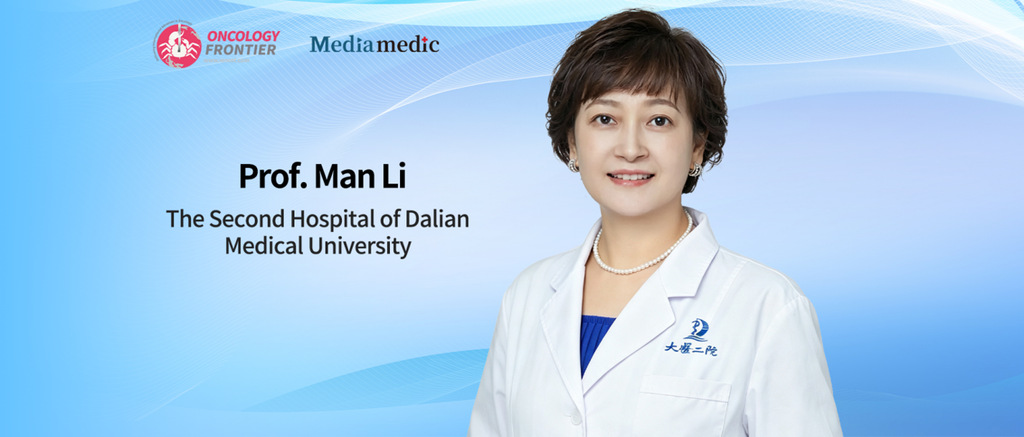
Editor's Note: To further promote standardized and precision-based cancer treatment, the 7th Dalian Xinghai Medical Forum Academic Conference on Comprehensive Cancer Treatment was jointly organized by the Beijing Cancer Prevention and Control Society and the Beijing Breast Cancer Prevention and Control Society, co-organized by the Oncology Branch of the Dalian Medical Association, and hosted by the Second Affiliated Hospital of Dalian Medical University. The conference was held in Dalian from November 6 to 8, 2026, in a hybrid online and in-person format. Under the theme "Focus on Precision, Collaborate for Innovation," the meeting brought together leading experts from across China in liver cancer, lung cancer, gastrointestinal tumors, breast cancer, lymphoma, gynecologic oncology, immunotherapy, and other fields. Participants delivered presentations on the latest clinical applications and research advances in cancer care. Oncology Frontier invited Professor Man Li of the Second Affiliated Hospital of Dalian Medical University, Chair of the Conference, to introduce the program and highlights of the meeting and share her perspectives on patient education and the research development of young physicians.01
Oncology Frontier: As Chair of the 7th Dalian Xinghai Medical Forum Academic Conference on Comprehensive Cancer Treatment, could you first introduce the program and key highlights of this year’s meeting?
Professor Man Li: Thank you for your interest. This year’s conference continues to uphold the theme of “Focus on Precision, Collaborate for Innovation.” From November 6 to 8, we have prepared a comprehensive academic program in a hybrid format, covering a wide range of tumor types, including liver cancer, lung cancer, gastrointestinal tumors, breast cancer, lymphoma, and gynecologic cancers.
This year’s conference has several notable highlights:
Highlight 1: Broad coverage of tumor types, with the main session setting the direction. The main session fully demonstrates the breadth and depth of “comprehensive cancer treatment.” On November 7, the main session will bring together leading experts from across China, with presentations spanning multiple solid tumors, including pancreatic cancer, gastric cancer, and cervical cancer. Professor Shukui Qin and Professor Zefei Jiang will deliver on-site presentations entitled “RAS-Mutant Inhibitors in Pancreatic Cancer: Therapeutic Applications and Clinical Research Progress” and “The 2026 Chinese Guidelines for Breast Cancer Diagnosis and Treatment: China’s Contributions,” respectively. In addition, Professor Jun Liang and Professor Baocheng Wang will address broader interdisciplinary topics, including “Safety Management of Anticancer Drugs” and “Toxicity Management of Immune Checkpoint Inhibitors.” This progression from precision treatment for specific tumor types to overarching strategies for medication safety and toxicity management across cancer disciplines fully reflects the conference’s broad vision of “Focus on Precision, Collaborate for Innovation.”
Highlight 2: A comprehensive and internationalized breast cancer program. For breast cancer, we have arranged highly specialized sessions. The program includes practical surgical topics, such as surgical de-escalation and oncoplastic breast-conserving surgery, alongside precision medical treatment for different subtypes, including HR+/HER2-negative, HER2-positive, and triple-negative breast cancer. It also features practical discussions of multidisciplinary team (MDT) cases and a post-ESMO session providing updates on the latest advances. From early to advanced disease, local to systemic treatment, and standardized care to cutting-edge developments, the program forms a comprehensive and integrated framework.
Highlight 3: Integration of patient education and guideline outreach. In addition to in-depth academic discussions, we have also arranged activities focusing on patient education and guideline dissemination. On the afternoon of November 6, we will hold the launch ceremony for the Breast Health Public Welfare Initiative and the publication ceremony for the new book An Introduction to Breast Cancer. On November 7, we will organize a CSCO BC guideline outreach session, followed by a clinical research roundtable on November 8.
This conference combines forward-looking guideline interpretation and exploration of cutting-edge advances with practical real-world research and patient-centered care. We hope all participants will gain valuable knowledge and insights from the Xinghai Forum.
02
Oncology Frontier: We noticed that the standardized treatment session on the afternoon of November 6 will include the launch of the Breast Health Patient Education and Care Initiative and the publication ceremony for An Introduction to Breast Cancer. What motivated you to publish this book? Given the demanding nature of clinical practice, where do you believe the greatest value lies in physicians’ involvement in patient education and public health communication?
Professor Man Li: Our primary motivation for publishing An Introduction to Breast Cancer was to alleviate patients’ fears and break down information barriers. In our outpatient clinics, we often see patients who experience extreme anxiety after receiving a breast cancer diagnosis. Faced with pathology reports and informed consent documents full of technical terminology, they may feel overwhelmed and helpless. Some even take the wrong path or refuse treatment because of misleading information online. Through this book, we hope to explain the entire breast cancer care journey—from prevention and diagnosis to surgery, chemotherapy, radiotherapy, endocrine therapy, and psychological recovery—in language that the general public can easily understand.
Treating the disease also means caring for the patient’s emotional well-being. Clinical work is indeed extremely demanding. Surgeons operate, and medical oncologists prescribe treatments; these are our core responsibilities. However, patients’ understanding of their disease and their willingness to participate in treatment directly determine the ultimate outcomes. I believe that effective patient education must be built on a foundation of trust between physicians and patients. When we translate professional medical knowledge into practical tools that empower patients to protect their own health, they become less anxious and are better able to participate in standardized, comprehensive care throughout the treatment process.
Therefore, although patient education takes up some of our personal time, it represents an extension of medical care—from treating existing disease to preventing disease and addressing both physical and psychological well-being. The publication of this book and the launch of the patient education initiative are also part of the breast cancer team’s commitment to implementing standardized treatment at the Second Affiliated Hospital of Dalian Medical University.
03
Oncology Frontier: This year’s forum includes the CSCO BC guideline outreach session, a post-ESMO session, and a clinical research roundtable, among other forward-looking activities. As Conference Chair, how do you view the balance between guideline-based standardized care and exploration of emerging advances in clinical practice? What advice would you offer young physicians attending the meeting, particularly regarding their research development?
Professor Man Li: Guidelines represent the “baseline” for clinical treatment, while emerging advances define its “potential.” If we compare clinical practice to navigation, guidelines are our “navigation charts,” helping ensure medical safety and basic treatment efficacy. For example, the CSCO BC guideline outreach session aims to equip physicians at primary and community hospitals with the most standardized treatment approaches and help them avoid errors.
Emerging advances, such as the latest ESMO data and the development of ADCs, are like “lighthouses,” guiding us toward better treatment strategies. Neither can be neglected. Pursuing cutting-edge advances without adhering to guidelines is like “taking risks blindly,” while following guidelines without keeping up with new developments means falling behind. In clinical practice, we must continuously seek a balance between the two.
I have several suggestions for young physicians:
1. Research topics should originate from unmet clinical needs. Do not conduct research simply for the sake of publishing papers. During ward rounds, surgery, and MDT discussions, make a habit of asking “why” more often. For example, why does this patient develop treatment resistance? Why does the disease recur after surgery? Turning these clinical questions into research topics gives your work genuine purpose and relevance.
2. Pay attention to clinical translation and real-world data. The clinical research roundtable scheduled for November 8, for example, will focus on real-world research. Young physicians should make good use of existing hospital data and actively participate in multicenter clinical trials, transforming the patient cases and clinical resources available to them into high-quality research evidence.
3. Listen, observe, and engage across disciplines. The Xinghai Forum covers multiple disciplines, including medical and surgical oncology. I hope participants will use the opportunity to break down professional barriers through communication and exchange. Young physicians should develop a mindset of comprehensive, full-course patient management and use this platform to connect with like-minded colleagues and build collaborative partnerships.