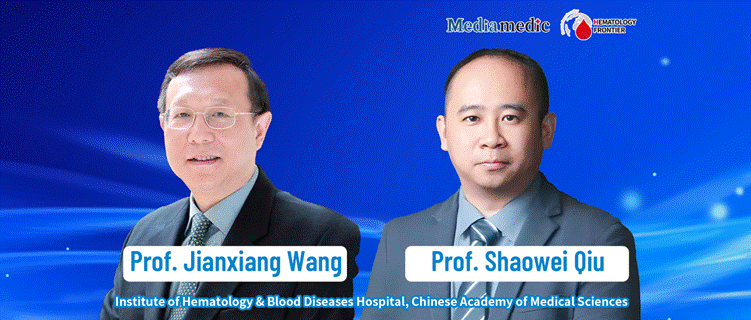
Acute myeloid leukemia (AML) is a highly heterogeneous hematologic malignancy. Approximately 20–30% of AML patients harbor FLT3 internal tandem duplication (FLT3-ITD) mutations. FLT3-ITD is a major driver mutation in AML and typically arises as a late genetic event during leukemogenesis, often coexisting with mutations in NPM1, DNMT3A, WT1, and others. Although FLT3-ITD is generally associated with poor prognosis, substantial variability in clinical outcomes has been observed among FLT3-ITD–positive patients. Previous studies have largely focused on the molecular characteristics of FLT3-ITD itself, while the impact of its clonal origin on prognosis has been underexplored. Moreover, the key genetic evolutionary mechanisms driving resistance during progression from newly diagnosed disease to relapsed/refractory (R/R) AML remain incompletely understood.In December 2025, a research team led by Professor Jianxiang Wang and Professor Shaowei Qiu from the Blood Diseases Hospital, Chinese Academy of Medical Sciences (Institute of Hematology, CAMS) published an original research article online in Neoplasia (impact factor 7.7), entitled “Clonal architecture of FLT3-ITD and acquired 13q uniparental disomy define prognostic heterogeneity and therapeutic vulnerabilities in acute myeloid leukemia.” This study elucidates the critical roles of FLT3-ITD clonal origin and 13q uniparental disomy (UPD) in precision risk stratification and treatment of AML.
The investigators retrospectively analyzed clinical data from 149 AML patients with FLT3-ITD mutations treated at their institution between April 2020 and July 2023. By integrating genomic and transcriptomic data, they classified patients for the first time into four distinct subtypes based on clonal origin: DNMT3A/NPM1-mutated origin, IDH/NPM1-mutated origin, transcription factor (TF) gene mutation or fusion gene origin, and an “other” clonal origin group.
The study demonstrated that prognosis differed markedly across these clonal subtypes, providing a novel framework for precision stratification. Among the four subtypes, patients with a DNMT3A/NPM1 clonal origin exhibited the poorest outcomes, consistent with prior reports. However, this group itself showed significant internal heterogeneity. Based on differentiation status, these patients could be further divided into hematopoietic stem cell (HSC)–like and monocyte-like subgroups. Patients with HSC-like expression signatures had a higher tumor burden at diagnosis and significantly shorter event-free survival.
Longitudinal whole-exome sequencing revealed that 13q UPD represents a central driver of disease progression. Notably, among DNMT3A/NPM1-origin patients who developed relapsed or refractory disease, the detection rate of 13q UPD reached 100% (8/8). The study further identified two distinct patterns by which 13q UPD contributes to chemotherapy resistance and relapse. In the therapy-induced model, 13q UPD is acquired during treatment, conferring a survival and proliferative advantage to initially heterozygous FLT3-ITD clones, which subsequently expand at disease progression (50%, 4/8). In the pre-existing escape model, small subclones harboring 13q UPD are already present at diagnosis, successfully evade treatment pressure, persist, and ultimately drive relapse (50%, 4/8).
Single-cell analyses revealed significantly enhanced activity of the DNA homologous recombination repair (HRR) pathway in tumor cells of DNMT3A/NPM1-origin AML, suggesting a potential therapeutic vulnerability. Based on these findings, the authors propose that PARP inhibitors, either alone or in combination with existing therapies such as venetoclax and FLT3 inhibitors, may represent a promising strategy for this high-risk subgroup. Targeting DNA repair pathways in a precision manner may therefore offer more effective treatment options for patients with refractory FLT3-ITD–mutated AML.
Professor Jianxiang Wang and Professor Shaowei Qiu are co–corresponding authors of the study. Dr. Anli Lai (currently a resident physician at the Blood Diseases Hospital, CAMS) and Dr. Wenbing Liu (currently an assistant researcher at the Tianjin Institute of Medical and Health Research) are co–first authors. This work was supported by the National Natural Science Foundation of China, the CAMS Innovation Fund for Medical Sciences, the Natural Science Foundation of Tianjin, and other funding programs.
Author and Expert Profiles

Jianxiang Wang, MD, PhD
Blood Diseases Hospital, Chinese Academy of Medical Sciences
Chief Clinical Expert; Director, National Clinical Research Center for Hematologic Diseases
Professor, Chief Physician, and Doctoral Supervisor
Professor Wang is among the first tenured professors at Peking Union Medical College and a nationally recognized expert under the “Hundreds, Thousands, and Tens of Thousands Talent Program.” He has served as Chair of the 10th Committee of the Chinese Society of Hematology and holds multiple leadership roles in national medical associations. With decades of experience in both clinical practice and basic research, his work focuses primarily on leukemia and hematologic malignancies.
Shaowei Qiu, MD, PhD
Blood Diseases Hospital, Chinese Academy of Medical Sciences
Director, Leukemia Diagnosis and Treatment Center Ward
Master’s Supervisor, Peking Union Medical College
Professor Qiu received his MD from Peking Union Medical College and was a visiting scholar at the University of Alabama at Birmingham. He is recognized as an Outstanding Young Scientific Talent in Tianjin. His research focuses on mechanisms of drug resistance and immunotherapeutic strategies in acute leukemia. He has published more than 20 SCI-indexed papers in leading journals such as Blood, Cancer Research, Leukemia, Journal of Clinical Investigation, Haematologica, and British Journal of Haematology, and has led multiple national and provincial research grants.