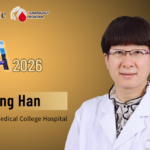
At the 2026 Congress of the European Hematology Association (EHA), Prof. Liang Wang from Beijing Tongren Hospital, Capital Medical University, delivered an oral presentation unveiling the latest follow-up results of CAR2219, a CD19/CD22 dual-target CAR-T cell therapy for patients with relapsed/refractory large B-cell lymphoma (R/R LBCL). The study reported an impressive 12-month progression-free survival (PFS) rate of 59.8%.Beyond its innovative dual-target design, the study also incorporated a comprehensive treatment strategy featuring bridging therapy and post-CAR-T maintenance/consolidation therapy, representing a paradigm shift from a single-treatment approach to full-course disease management.
At the EHA meeting, Oncology Frontier – Hematology Frontier invited Prof. Wang to discuss the clinical significance of this strategy in overcoming barriers to durable remission and to share his perspectives on future clinical development and implementation under China’s evolving regulatory framework.
Oncology Frontier – Hematology Frontier
At last year’s ASH Annual Meeting, your team first reported preliminary results of CAR2219 in R/R LBCL. Updated data presented at EHA now show a 12-month PFS rate of 59.8% and an overall survival (OS) rate of 72.8%. Compared with the earlier analysis, what do you consider the most important breakthrough and clinical implication of this longer follow-up?
Prof. Liang Wang
It is a great honor to share our latest findings on CD19/CD22 dual-target CAR-T cell therapy for relapsed/refractory large B-cell lymphoma at the 2026 EHA Congress.
Compared with the preliminary results presented at the ASH Annual Meeting last year—which included 31 patients with a median follow-up of approximately six months—the current analysis is considerably more mature. Patient enrollment has now been completed, with a total of 74 patients successfully receiving dual-target CAR-T infusion, and the median follow-up duration has extended to nearly one year.
The updated results are highly encouraging. Among these 74 patients, the best overall response rate (ORR) within three months reached 95.9%, while the best complete response rate (CRR) approached 60%. Most importantly, the 12-month PFS rate reached 59.8%.
Compared with previously reported outcomes from conventional CD19-directed CAR-T therapies, this dual-target approach appears to offer meaningful efficacy advantages. We believe this innovative strategy has the potential to provide improved long-term survival outcomes for patients with relapsed/refractory and other high-risk forms of diffuse large B-cell lymphoma.
Oncology Frontier – Hematology Frontier
CD19-directed CAR-T therapy has become an important treatment option for R/R LBCL, but there remains room for improvement in durable remission rates. Based on your findings, how do you evaluate the advantages of dual-target CD19/CD22 CAR-T therapy in overcoming antigen escape and improving long-term remission? Which patient populations may benefit most from this approach?
Prof. Liang Wang
This study differs from many previous CAR-T trials in two important aspects.
First, we broadened the eligibility criteria by allowing patients to receive bridging therapy. Traditional CAR-T studies often require patients to have an ECOG performance status of 0–1 and relatively stable disease. In contrast, our study allowed enrollment of patients with rapidly progressing disease or a high tumor burden. Through the use of bridging therapy, the vast majority of patients were ultimately able to proceed to CAR-T infusion.
Second, and perhaps more importantly, we introduced a maintenance and consolidation strategy following CAR-T infusion.
After the first efficacy assessment at Day 28, patients became eligible for maintenance treatment consisting primarily of PD-1 inhibitors, either alone or in combination with targeted agents such as XPO1 inhibitors or BTK inhibitors.
Previous studies have shown that conventional CD19-directed CAR-T therapy can induce responses in approximately 70–80% of patients. However, median progression-free survival often remains less than six months because relapse rates are relatively high. One major reason is that CAR-T cells frequently have limited persistence or may rapidly enter a state of functional exhaustion.
The goal of maintenance therapy is therefore to prolong CAR-T cell persistence and maximize their antitumor activity. Earlier research has already demonstrated favorable synergy between PD-1 blockade and CAR-T therapy.
As a result, CAR-T cells in our treatment model are not used as a standalone intervention. Instead, they are integrated into a broader therapeutic framework that combines multiple treatment modalities. This comprehensive strategy aims to achieve deeper and more durable remissions, ultimately maximizing patient survival.
Therefore, the key message from this study extends beyond the CD19/CD22 dual-target CAR-T product itself. It highlights the importance of rethinking the overall treatment strategy for patients with relapsed or refractory LBCL.
Oncology Frontier – Hematology Frontier
As a Phase II study, CAR2219 has demonstrated encouraging efficacy and safety. What will be the primary focus of future clinical development? Are there plans to validate its clinical value through multicenter or registration-directed studies and ultimately broaden access to this therapy?
Prof. Liang Wang
First, we are very encouraged by the clinical outcomes achieved with this CD19/CD22 dual-target CAR-T therapy.
Our hope is that the sponsoring company will formally initiate an Investigational New Drug (IND) application and proceed with registration-directed clinical development. Through larger and more rigorous regulatory studies, we can further validate the therapy’s efficacy and safety profile and hopefully accelerate its path toward regulatory approval. Achieving this goal will require collaboration among investigators, industry partners, and regulatory authorities.
Second, the regulatory landscape for cell therapy in China has undergone substantial changes following the implementation of Order No. 818 and Order No. 828, which have significantly reshaped the framework governing cellular therapies.
Under the current regulations, we can no longer continue this program as an investigator-initiated trial (IIT). Instead, future development must proceed through officially recognized translational research pathways involving biomedical new technologies.
At present, we are actively seeking registration and filing approval for this technology through the National Health Commission. Once this process is completed, we hope to continue clinical development in a fully compliant manner, accelerate patient access to this innovative therapy, and potentially reduce treatment costs so that a broader patient population can benefit.