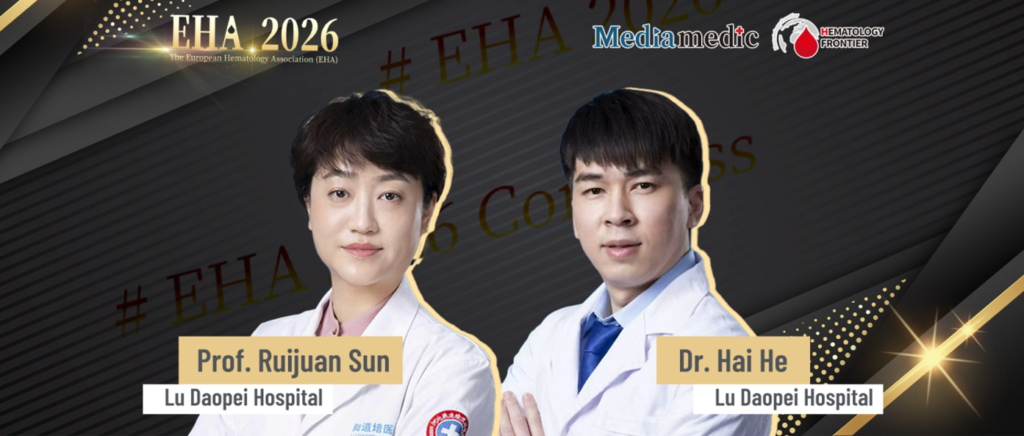
The 2026 Congress of the European Hematology Association (EHA 2026) was held from June 11 to 14 in Stockholm, Sweden. As one of the most influential international meetings in hematology, EHA brings together leading experts from around the world to showcase the latest advances in basic science, translational research, and clinical practice.At this year’s meeting, a study conducted by the team led by Professor Ruijuan Sun and Dr. Hai He from Lu Daopei Hospital was selected for poster presentation. The research focused on NUP98::NSD1-positive acute myeloid leukemia (AML), a rare but highly aggressive molecular subtype characterized by poor response to conventional chemotherapy and extremely unfavorable outcomes. By evaluating the role of allogeneic hematopoietic stem cell transplantation (allo-HSCT), the investigators provide important evidence supporting improved treatment strategies for this challenging patient population.
Study Overview
Title: Allo-HSCT Overcomes Poor Prognosis in Patients with NUP98::NSD1-Positive AML
First Author: Hai He Corresponding Author: Ruijuan Sun
Background
NUP98::NSD1 is a well-recognized adverse prognostic marker in AML. Although relatively uncommon, it is associated with resistance to conventional chemotherapy and poor survival outcomes. The coexistence of NUP98::NSD1 and FLT3-ITD mutations has been shown to further worsen prognosis.
Previous studies have suggested that allogeneic hematopoietic stem cell transplantation may help overcome the adverse impact of this molecular abnormality. However, clinical data remain limited, and the optimal management of these patients continues to be an area of active investigation.
Methods
This study included patients with NUP98::NSD1-positive AML who underwent allogeneic HSCT between June 2019 and November 2025.
The primary clinical endpoints included overall survival (OS), disease-free survival (DFS), cumulative incidence of relapse (CIR), non-relapse mortality (NRM), and the cumulative incidence of both acute and chronic graft-versus-host disease (GVHD). All outcome measures were calculated from the date of stem cell infusion.
Results
A total of 56 patients with NUP98::NSD1-positive AML were included in the analysis. The cohort consisted of 31 males and 25 females, with a median age of 30 years (range, 14–70 years).
At diagnosis, 21 patients (37.5%) presented with a white blood cell count exceeding 100 × 10⁹/L. The most common co-occurring mutation was FLT3-ITD, detected in 50 patients (89.3%), followed by WT1 (48.2%), RAS (14.3%), CEBPA (14.3%), RUNX1 (8.9%), and TET2 (8.9%).
The complete remission rate after the first induction cycle was 26.8% (15/56), increasing to 28.2% (11/39) after a second induction cycle, highlighting the chemoresistant nature of this disease subtype.
Most patients underwent haploidentical transplantation, accounting for 67.9% of the study population.
Before transplantation, 29 patients (51.8%) were in first complete remission (CR1), six patients (10.7%) were in second complete remission (CR2), and 21 patients (37.5%) had active disease without remission.
Myeloablative conditioning regimens included busulfan/cyclophosphamide (BU/Cy) in 53.6% of patients, busulfan/fludarabine (BU/Flu) in 42.9%, and total body irradiation/cyclophosphamide (TBI/Cy) in 3.6%.
Importantly, all patients achieved successful hematopoietic engraftment following transplantation. By Day 30 after HSCT, the complete remission rate reached 100%, and 82% of patients achieved molecular measurable residual disease (MRD) negativity.
After a median follow-up of 32 months (range, 2–79 months), the outcomes were highly encouraging.
The 3-year overall survival and disease-free survival rates were 78.4% and 77.6%, respectively. The cumulative incidence of relapse at three years was only 10.7%, while non-relapse mortality was 11.7%.
Regarding transplant-related complications, the cumulative incidence of Grade II–IV acute GVHD within 100 days was 25.0%, while Grade III–IV acute GVHD occurred in 12.5% of patients. The 3-year cumulative incidence of chronic GVHD was 44.8%, with extensive chronic GVHD occurring in 9.9% of patients.
Subgroup analyses demonstrated that outcomes remained favorable regardless of disease status at the time of transplantation. No statistically significant differences were observed between patients transplanted in complete remission and those with active disease in terms of either overall survival or disease-free survival.
Similarly, the presence or absence of FLT3-ITD mutations did not significantly affect post-transplant outcomes. Three-year overall survival was comparable between FLT3-ITD-positive and FLT3-ITD-negative patients, as was disease-free survival.
A total of nine patients died during follow-up. Causes of death included infection (n=2), acute GVHD (n=1), chronic GVHD (n=1), disease relapse (n=4), and unknown causes (n=1).
Study Conclusions
The findings suggest that allogeneic HSCT can effectively overcome the historically poor prognosis associated with NUP98::NSD1-positive AML.
Notably, post-transplant survival outcomes appeared independent of both pre-transplant disease status and the presence of coexisting FLT3-ITD mutations, indicating that transplantation may mitigate the adverse prognostic impact of these high-risk features.
Investigator Perspective
NUP98::NSD1 fusion is increasingly recognized as a distinct high-risk subtype of AML with unique biological and clinical characteristics. The fusion results from the chromosomal translocation t(5;11)(q35;p15.5), involving rearrangement of the nucleoporin gene NUP98 and the histone methyltransferase gene NSD1.
Although rare, this subtype carries substantial clinical significance because of its strong association with treatment resistance and poor outcomes.
The disease tends to occur in younger patients. Pediatric studies have reported a median age at diagnosis of approximately nine years, while a recent large adult cohort published in Leukemia reported a median age of 41 years for patients with NUP98::NSD1-positive AML, significantly younger than other NUP98-rearranged AML subtypes.
Male predominance has also been observed. Emerging preclinical evidence suggests that altered estrogen signaling in leukemic stem cells may partially contribute to this gender distribution.
Clinically, patients often present with marked leukocytosis and are most commonly classified as FAB M2, M4, or M5 subtypes. Cytogenetically, approximately one-third of patients harbor trisomy 8, while the characteristic t(5;11) translocation is frequently cryptic and may require FISH or molecular testing for detection.
Historically, outcomes with chemotherapy alone have been extremely poor. Previous studies have shown high rates of treatment resistance and relapse, particularly among patients with concurrent FLT3-ITD mutations.
In contrast, transplantation has emerged as the most effective consolidation strategy currently available. Earlier studies reported 3-year overall survival rates of approximately 60–70% in adults and 70–80% in pediatric patients undergoing HSCT. The present study further strengthens the evidence supporting transplantation in this high-risk population.
Another promising development is the increasing use of FLT3 inhibitors. Recent data published in Leukemia in 2026 demonstrated that FLT3 inhibitor therapy significantly improves outcomes in patients with NUP98::NSD1-positive AML. Among treated patients, the 5-year overall survival rate reached 53.3%, approaching outcomes seen in intermediate-risk AML populations.
Given that approximately 70–80% of NUP98::NSD1-positive patients also harbor FLT3-ITD mutations, broader incorporation of FLT3 inhibitors may further improve outcomes.
Looking ahead, several novel therapeutic strategies are under investigation, including PRDM16-targeted approaches, Menin inhibitors, and selective estrogen receptor modulators such as tamoxifen. These emerging therapies aim to target the unique biology of NUP98::NSD1-driven leukemia and may ultimately complement transplantation-based approaches.
Key Clinical Takeaways
- Allogeneic HSCT currently represents the most effective potentially curative treatment for patients with NUP98::NSD1-positive AML.
- Post-transplant outcomes appear favorable regardless of remission status at transplantation or coexisting FLT3-ITD mutations.
- FLT3 inhibitor–based therapy should be strongly considered whenever appropriate, given its demonstrated ability to improve survival.
- Regular molecular monitoring of NUP98 rearrangements after transplantation is essential for early detection of relapse and timely intervention.
Expert Profiles

Professor Ruijuan Sun
Lu Daopei Hospital
Director, Department of Hematopoietic Stem Cell Transplantation
Professor Sun graduated from Xi’an Jiaotong University School of Medicine in 2000 and joined the Lu Daopei team in 2003. She has more than two decades of experience in hematopoietic stem cell transplantation and has successfully performed over one thousand allogeneic transplant procedures in patients ranging in age from seven months to 69 years.
Her clinical expertise includes the management of hematologic malignancies, acute and chronic GVHD, severe infections, and post-transplant complications, with particular focus on immunotherapy-based strategies for preventing and treating post-transplant relapse.
Professor Sun has contributed to several landmark transplantation procedures in China, including the country’s first autologous cord blood transplantation for severe aplastic anemia in a child and the first transplantation performed for XIAP-associated hemophagocytic syndrome. She has also successfully treated multiple patients with dyskeratosis congenita through stem cell transplantation.
She has presented her work at numerous international meetings, including APBMT, EBMT, TCT, and ASH.
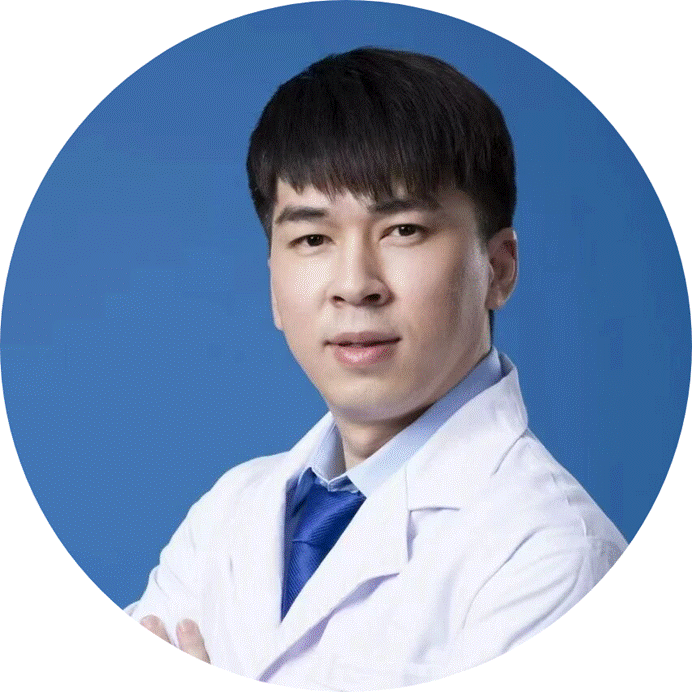
Hai He, MD
Lu Daopei Hospital
Associate Chief Physician
Dr. Hai He graduated from Hebei University School of Medicine in 2011 and joined the Lu Daopei Medical Group in 2012. He currently serves as Associate Chief Physician in the Bone Marrow Transplantation Department.
His clinical and research interests focus on chemotherapy, hematopoietic stem cell transplantation, and the management of transplantation-related complications in patients with hematologic diseases. He has extensive experience in stem cell transplantation and post-transplant care across a wide range of hematologic disorders.