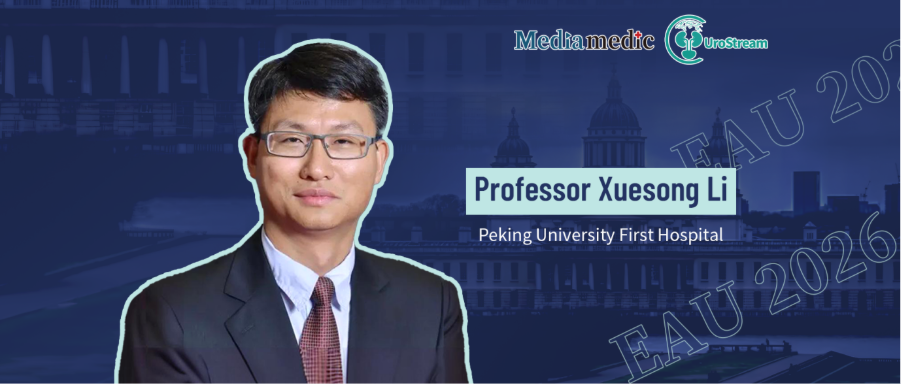
At the 2026 European Association of Urology Congress (EAU26), held in London, major advances in urologic oncology were presented. Among them, the work of Professor Xuesong Li’s team from Peking University First Hospital attracted considerable attention. The team not only contributed important achievements in upper urinary tract reconstruction but also presented a phase II clinical study of disitamab vedotin combined with radiotherapy for upper tract urothelial carcinoma (UTUC), offering a promising new treatment option. In this interview, Professor Xuesong Li provides insights into the highlights of the genitourinary reconstruction session, discusses the latest progress of disitamab vedotin in UTUC, and shares perspectives on future research directions.
01
Could you introduce the key highlights of the Genitourinary Reconstruction session at EAU2026?
Professor Xuesong Li: It was a great honor to represent Chinese clinicians at the 41st EAU Annual Congress and to co-chair the Genitourinary Reconstruction session alongside Dr. Neuville and Dr. Spinoit. This session, held on the afternoon of the second day, was a major platform focusing on upper urinary tract reconstruction.
The session consisted of two parts, featuring a total of 18 presentations. The first half included nine talks addressing core techniques and recent clinical advances in upper urinary tract reconstruction. The second half covered nine additional topics, including gender-affirming surgery and the reconstruction of complex urinary fistulas.
These fistulas, often resulting from pelvic malignancies such as prostate, rectal, or cervical cancer after radiotherapy, are frequently accompanied by ureteral strictures and represent some of the most challenging conditions in reconstructive urology worldwide.
Notably, four Chinese experts presented their work, covering areas such as pelvic floor fistula repair, reconstruction of complex ureteral strictures, and surgical management of urethral diverticula. These presentations demonstrated the growing global impact of Chinese research in this field.
One highlight was a presentation by Dr. Yang Jiyu from our team, reporting the largest single-center study worldwide on bilateral ileal ureter replacement for complex ureteral strictures. These cases were predominantly radiation-induced strictures following pelvic cancers, which are known for their high complexity and recurrence risk.
To address these challenges, our team developed standardized anastomotic techniques—referred to as the reverse “7”, “7”, and “Y” configurations—transforming a previously complex and technically demanding procedure into a more standardized and reproducible approach. Clinical results showed a surgical success rate of 98%, with over 80% success in preserving renal function and restoring urinary tract function.
This means that patients with end-stage complex ureteral strictures, once considered untreatable, can now achieve clinical cure, significantly improving both physiological function and long-term quality of life. It also reflects that China has reached a leading international level in complex upper urinary tract reconstruction.
02
What important advances of disitamab vedotin in UTUC were presented at this EAU meeting, and how might they change clinical practice?
Professor Xuesong Li: Several important studies on disitamab vedotin were presented at this congress, including a phase II study led by our team focusing on adjuvant therapy for high-risk UTUC patients.
Although the current results are preliminary, they demonstrate promising efficacy and safety. The study enrolled patients who had undergone radical nephroureterectomy with bladder cuff excision and were at high risk of recurrence, but were ineligible for cisplatin due to impaired renal function. All patients had HER2 expression of IHC 2+ to 3+.
As we know, cisplatin-based chemotherapy is the standard adjuvant treatment for high-risk UTUC, but many patients cannot tolerate it after surgery due to renal insufficiency. This represents a major unmet clinical need.
Our study explored a novel approach combining disitamab vedotin with radiotherapy in the adjuvant setting. After a median follow-up of 12 months, only 1 out of 25 patients in the combination group experienced recurrence, compared to 8 out of 22 patients in the control group. The one-year disease control rate was 93% versus 73%, showing a statistically significant difference.
In terms of safety, the regimen was well tolerated, with less than 10% of patients experiencing grade 3 or higher treatment-related adverse events, and no unexpected safety signals were observed.
This study has several important implications. It provides an effective and low-toxicity adjuvant treatment option for cisplatin-ineligible patients, addressing a long-standing clinical gap. It also expands the role of HER2-targeted ADC therapy from metastatic disease into the postoperative setting, potentially enabling more patients to reduce recurrence risk and achieve cure.
Importantly, UTUC has a higher incidence in China than in Western countries, making this research highly relevant both locally and globally. These findings represent high-quality evidence generated from a Chinese population and contribute to the global advancement of UTUC management.
Future efforts will include larger multicenter randomized trials and longer follow-up to further validate the long-term efficacy and safety of this strategy.
03
Given the strong potential of disitamab vedotin, what future directions should be explored?
Professor Xuesong Li: Disitamab vedotin still has significant potential across the entire treatment course of UTUC.
One key direction is expanding its role in the perioperative setting, including both neoadjuvant and adjuvant therapy. Our current study focuses on postoperative treatment, addressing the unmet need in cisplatin-ineligible patients while balancing efficacy and renal safety.
Another important area is combination strategies. Beyond radiotherapy, future studies should explore combinations with immune checkpoint inhibitors or minimally invasive local therapies such as laser ablation. These multimodal approaches may further enhance efficacy and broaden the patient population that can benefit.
Biomarker-driven patient selection is also crucial. HER2 is the primary target of disitamab vedotin, but its expression in urothelial carcinoma is heterogeneous both spatially and temporally. Our team has explored the use of 68Ga-HER2 PET/CT imaging to dynamically assess HER2 expression across the whole body, highlighting the need to move beyond single biopsy-based evaluation toward real-time, whole-body precision assessment.
Finally, generating real-world data in Chinese populations will be essential. Given the unique epidemiology and clinical characteristics of UTUC in Asia, large-scale real-world evidence can help refine treatment strategies and create a continuous cycle of clinical observation, research validation, and clinical application.
Overall, we anticipate that more high-quality data on disitamab vedotin will emerge, helping to establish a comprehensive, precise, and patient-centered treatment system for UTUC, ultimately benefiting more patients worldwide.
Expert Profile
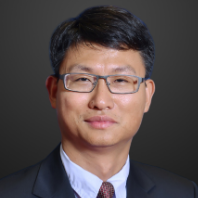
Xuesong Li Peking University First Hospital
Professor Xuesong Li is a leading expert in urologic oncology and reconstructive surgery, with significant contributions to upper urinary tract reconstruction and precision treatment strategies in urothelial carcinoma.