On June 9, 2026, the 16th Peking University Gastrointestinal Oncology Forum and CGOG Annual Meeting officially opened. The first day featured three dedicated ASCO Highlights sessions showcasing the latest advances in gastrointestinal oncology.During the ASCO Esophageal Cancer Updates Session, leading experts provided in-depth reviews of the most recent global developments in esophageal cancer research and clinical practice. The session was livestreamed across multiple platforms and attracted more than 21,000 online viewers, reflecting strong interest from the oncology community.
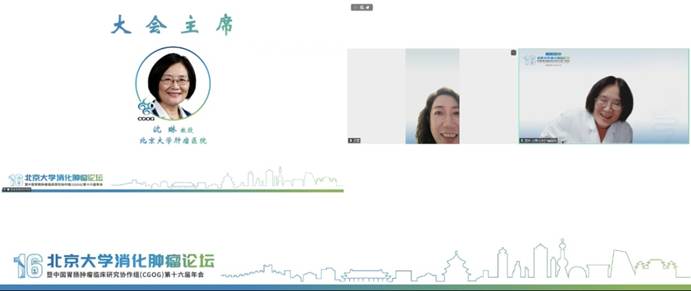
Figure: Conference Chair Prof. Lin Shen; Session Chair Prof. Xue Meng
In her opening remarks, Lin Shen from Peking University Cancer Hospital noted that China has emerged as a global leader in the comprehensive management of esophageal cancer and the development of innovative therapies. She highlighted that Chinese patients account for more than half of all esophageal cancer cases worldwide, underscoring the importance of large-scale, multicenter research conducted within China.
Prof. Shen also pointed out that meaningful differences exist between Chinese and Western patient populations in terms of tumor biology and pathological subtypes. As a result, she emphasized the need for stronger international collaboration to advance understanding of the disease and optimize treatment strategies across diverse populations.
She explained that this special session was designed to provide a multidisciplinary perspective on the latest developments in esophageal cancer research, incorporating insights from medical oncology, radiation oncology, and surgical oncology. The goal, she noted, was to help participants rapidly grasp both the most important recent advances and the key unresolved challenges in the field of esophageal cancer.
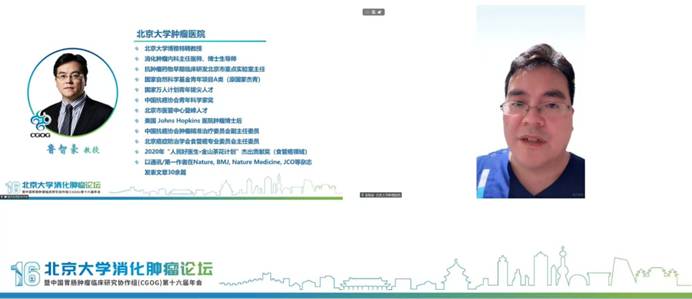
Figure: Session Chair Prof. Zhihao Lu
Following the opening remarks, the scientific program officially commenced under the moderation of Zhihao Lu from Peking University Cancer Hospital and Xue Meng from Shandong Cancer Hospital.
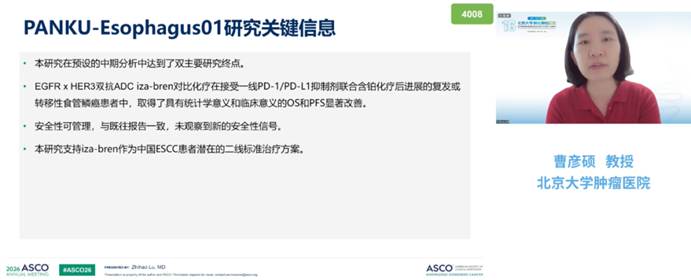
Figure: Speaker Prof. Yanshuo Cao
First, Yanshuo Cao from Peking University Cancer Hospital presented an overview of the major advances in medical oncology for esophageal cancer reported at the 2026 ASCO Annual Meeting.
Prof. Cao highlighted that antibody-drug conjugates (ADCs) emerged as one of the most important areas of progress in esophageal cancer treatment this year. Among them, iza-bren, an EGFR × HER3 bispecific ADC, demonstrated particularly promising efficacy as second-line therapy for patients with recurrent or metastatic esophageal squamous cell carcinoma (ESCC). The agent significantly improved clinical outcomes while maintaining a manageable safety profile, positioning it as a potential new standard in the second-line treatment setting.
Another notable development was SKB500, a B7-H3-targeted ADC currently being evaluated across multiple tumor types, including ESCC. Early clinical data have shown encouraging antitumor activity and an acceptable safety profile, highlighting the considerable therapeutic potential of the B7-H3 target.
Prof. Cao also noted the rapid emergence of other innovative therapeutic platforms, including PD-L1-targeted ADCs and degrader-antibody conjugates (DACs), reflecting the continued expansion of treatment options for solid tumors.
Beyond ADCs, he reviewed data showing that nimotuzumab combined with a TP regimen (taxane plus platinum chemotherapy) provided a clear survival benefit in patients with EGFR-amplified esophageal squamous cell carcinoma. In addition, neoadjuvant studies evaluating a BTLA inhibitor in combination with a PD-1 antibody and chemotherapy demonstrated improvements in pathological complete response (pCR) rates, although further data will be required to confirm the long-term clinical benefit of this strategy.
Overall, these findings underscore the rapid evolution of the therapeutic landscape for esophageal cancer and highlight the growing role of biomarker-driven and next-generation targeted treatment approaches.
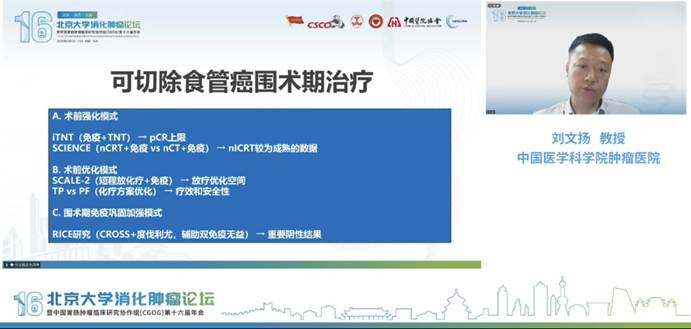
Figure: Speaker Prof. Wenyang Liu
Next, Wenyang Liu from the Cancer Hospital, Chinese Academy of Medical Sciences, provided a comprehensive review of the key radiation oncology advances in esophageal cancer presented at the 2026 ASCO Annual Meeting, while also sharing his perspectives on the evolving treatment landscape.
In the neoadjuvant setting, Prof. Liu highlighted the growing promise of total neoadjuvant therapy (TNT) combined with immunotherapy. This approach achieved pathological complete response (pCR) rates of up to 70% while maintaining an acceptable safety profile, suggesting the potential to reshape the current paradigm of neoadjuvant treatment for esophageal cancer.
He also reviewed the latest findings from the SCIENCE study, which demonstrated that neoadjuvant chemoradiotherapy plus immunotherapy significantly improved pCR rates compared with neoadjuvant chemotherapy plus immunotherapy. Importantly, preoperative ctDNA clearance was found to be closely associated with pathological response, highlighting its potential value as a predictive biomarker.
In addition, results from the SCALE study showed that short-course neoadjuvant radiotherapy combined with chemoimmunotherapy possesses substantial antitumor activity and may improve long-term patient outcomes.
For patients with unresectable or locally advanced esophageal cancer, several innovative treatment strategies were presented. The SCENIC study investigated a response-adapted approach for cervical esophageal cancer, in which patients underwent treatment stratification following induction chemotherapy. Those achieving a favorable response received definitive chemoradiotherapy followed by maintenance immunotherapy, resulting in two-year survival outcomes that compared favorably with historical benchmarks.
Another study evaluated induction chemotherapy plus immunotherapy followed by concurrent chemoradiotherapy, demonstrating encouraging survival outcomes beyond historical expectations while maintaining acceptable toxicity levels. Similarly, a “sandwich” treatment strategy—consisting of induction chemotherapy, followed by concurrent chemoradiotherapy and subsequent consolidation immunotherapy—produced high objective response and disease control rates with manageable toxicity.
Prof. Liu also discussed treatment advances for special patient populations. In elderly patients with esophageal cancer, the combination of radiotherapy, S-1, and nimotuzumab achieved a high objective response rate, favorable safety profile, and satisfactory quality-of-life outcomes, offering a promising therapeutic option for this often challenging patient group.
Finally, for patients with oligometastatic esophageal cancer, the addition of radiotherapy to first-line chemoimmunotherapy demonstrated encouraging long-term survival benefits, further supporting the role of local treatment intensification in selected patients.
Overall, these studies reflect the growing integration of radiotherapy, immunotherapy, and biomarker-guided treatment approaches in esophageal cancer, with the potential to further improve outcomes across multiple disease settings.
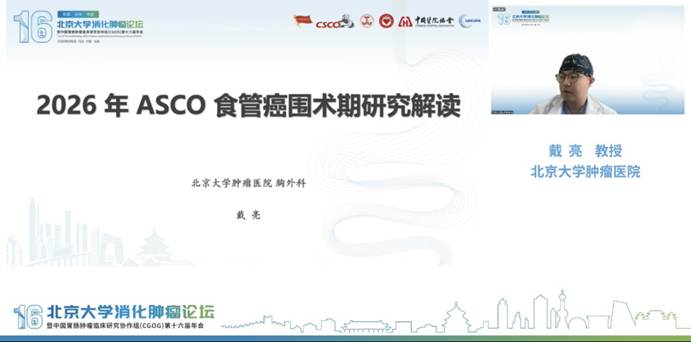
Figure: Speaker Prof. Liang Dai
In the session on advances in surgical management of esophageal cancer, Liang Dai from Peking University Cancer Hospital reviewed several important developments in perioperative treatment and personalized therapeutic strategies.
Regarding neoadjuvant treatment, Prof. Dai discussed findings from the ESOPEC trial, which compared the impact of the FLOT regimen and the CROSS regimen on patients’ quality of life. The study demonstrated that FLOT was associated with better preoperative quality-of-life outcomes than CROSS. However, FLOT was also linked to more persistent and severe neurotoxicity, providing clinicians with additional factors to consider when selecting the most appropriate treatment approach for individual patients.
In the area of personalized therapy, Prof. Dai highlighted the promising results of iNeo-Vac-P01, an individualized neoantigen vaccine evaluated as adjuvant treatment in patients at high risk of recurrence following esophageal cancer surgery. The vaccine was capable of inducing robust antitumor immune responses and was associated with significant and durable survival benefits while maintaining a favorable safety profile. These findings further support the view that personalized immunotherapy may become an important future direction in esophageal cancer treatment.
Prof. Dai also emphasized the growing potential of circulating tumor DNA (ctDNA) as a tool for perioperative risk stratification, prognostic assessment, and selection of patients for adjuvant therapy. Although ctDNA has shown considerable promise in clinical research, he noted that further work is needed to establish standardized methodologies for testing, interpretation, and clinical implementation.
Overall, these advances underscore the movement toward more individualized treatment strategies in esophageal cancer, integrating patient-centered outcomes, precision immunotherapy, and molecular monitoring to optimize long-term disease management.
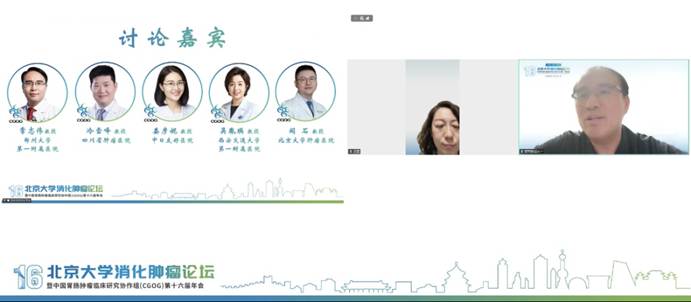
Figure: Panelists
Following the insightful presentations by the three speakers, the meeting moved into a panel discussion session.
The discussion was moderated by Xue Meng and featured a distinguished panel comprising Zhiwei Chang from the First Affiliated Hospital of Zhengzhou University, Xuefeng Leng from Sichuan Cancer Hospital, Yanni Lou from China-Japan Friendship Hospital, Yinying Wu from the First Affiliated Hospital of Xi’an Jiaotong University, and Shi Yan from Peking University Cancer Hospital.
Drawing on perspectives from medical oncology, surgical oncology, and radiation oncology, the panel engaged in a comprehensive discussion of the most significant advances presented at ASCO 2026. Topics included the transformative potential of antibody-drug conjugates (ADCs), the future of precision and personalized treatment strategies for esophageal cancer, optimal approaches for combining immunotherapy and radiotherapy, clinical research in special patient populations, and the evolving role of dynamic ctDNA monitoring in disease management.
The experts agreed that this year’s ASCO Annual Meeting delivered a wealth of important findings in the esophageal cancer field. They noted that the therapeutic landscape is undergoing rapid transformation, driven by innovative drug development and increasingly sophisticated treatment strategies. Looking forward, multidisciplinary collaboration and precision patient stratification were identified as key priorities for future research and clinical practice.
At the conclusion of the meeting, Lin Shen delivered the closing remarks. She highlighted the growing number of first-in-class therapies led by Chinese investigators that were presented this year, underscoring China’s expanding contribution to global innovation in esophageal cancer treatment. She also emphasized the important progress achieved through multidisciplinary collaboration in optimizing comprehensive treatment strategies.
Prof. Shen expressed her hope that, through the CGOG platform, experts from across China will continue to work together to advance esophageal cancer research, accelerate clinical innovation, and further improve outcomes for patients with this disease.
Original article: Department of Gastrointestinal Oncology, Peking University Cancer Hospital
Author: Hao Jiao
Reviewer: Yanshuo Cao