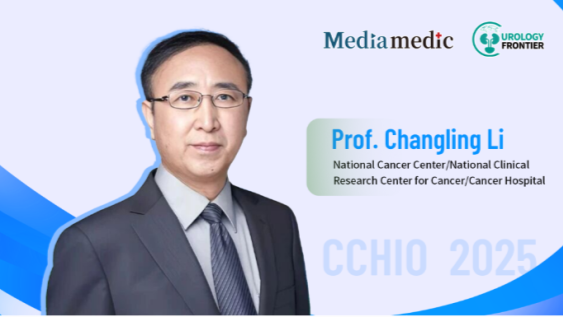
Editor’s Note: From November 6–9, 2025, the China Congress of Holistic Integrative Oncology (CCHIO 2025) was held in Kunming. The conference was hosted by the China Anti-Cancer Association (CACA) and the Tengchong Scientist Forum Organizing Committee, co-organized by the World Association of Integrative Oncology (WAIO) and the China Academy of Integrative Medicine, and jointly undertaken by Yunnan Cancer Hospital, Kunming Medical University, and the Yunnan Anti-Cancer Association. As urologic cancers remain among the most common malignancies worldwide, advances in this field drew substantial attention at CCHIO 2025. Oncolgy Frontier– Urology Frontier invited Prof. Changling Li, Executive Chair of the CACA Committee on Integrative Urologic Oncology and Chair of the CACA Urologic Oncology Committee, to share insights on integrative oncology, China’s recent breakthroughs, and future directions. 01 — Interview with Oncology Frontier – Urology Frontier
You previously proposed that medical development should progress from “truth” (scientific foundation) to “virtue” (ethical orientation) to “beauty” (humanistic care). In urologic oncology practice, how can we implement multidisciplinary integration across the continuum of prevention, screening, diagnosis, treatment, and rehabilitation, and avoid over-reliance on single technologies or specialty silos?
Prof. Changling Li: When discussing cancer treatment, we must go beyond techniques alone and consider philosophical and humanistic dimensions. This is the essence of “truth, virtue, and beauty.”
“Truth” has two meanings. For physicians, it means mastering clinical guidelines, tumor biology, and therapeutic skills—professional excellence. For patients, it means trust: only when patients truly trust their physicians can they actively engage in treatment, enabling better outcomes.
“Virtue” refers to guiding patients psychologically and emotionally. Throughout hospitalization and treatment, physicians and patients must work together to maintain positive direction.
“Beauty” is the ultimate humanistic goal: the purpose of oncology care is not only to treat disease but to care for people, to offer compassion and support.
This year, Academician Fadiming Fan, President of CACA, proposed the strategy of “Anti-cancer – Tumor Control – Life Support.”
- “Anti-cancer” focuses on direct tumor treatment;
- “Tumor control” aims for host–tumor coexistence when cure is unlikely;
- “Life support” places human wellbeing at the center.
This aligns with the philosophy of “truth, virtue, beauty,” elevating oncology to a new conceptual level. Historically, cancer treatment suffered from fragmentation, but integrative oncology seeks to unify efforts. For example, CACA’s strategy of coordinated, cross-disciplinary collaboration aims to truly extend survival and improve quality of life.
In urologic oncology, we must also embrace integrative medicine and strengthen MDT cooperation. The establishment of the CACA Committee on Integrative Urologic Oncology, covering surgery, medical oncology, organ preservation, and integrative approaches, has created a comprehensive, multi-dimensional cancer-care system. The ultimate goal is to improve survival while delivering humane, patient-centered care.
02 — Interview with Oncology Frontier – Urology Frontier
The 2025 ESMO meeting presented the RC48-C016 study, and other ADC–immunotherapy combinations in renal cancer have also appeared at ASCO. How do you view the impact of China-developed ADC+IO regimens on clinical practice?
Prof. Changling Li: In urologic oncology, Chinese scientists and clinicians have moved from following to running alongside, and now to leading. A hallmark of this progress is the RC48-C016 study, published in The New England Journal of Medicine. Led by Prof. Xinan Sheng and Prof. Jun Guo from Peking University Cancer Hospital, the study compared disitamab vedotin + toripalimab versus platinum-based chemotherapy as first-line treatment for HER2-expressing advanced urothelial carcinoma.
Key results include:
- Progression-free survival: 13.1 vs 6.5 months; 64% reduction in progression/death risk
- Overall survival: 31.5 vs 16.9 months; 46% reduction in mortality risk
- Fewer adverse events than chemotherapy
These results represent a new era for HER2-positive urothelial carcinoma and are expected to influence clinical guidelines internationally.
In renal cancer, two major areas have gained attention:
- Neoadjuvant targeted-immunotherapy for tumor thrombus, and
- Targeted-immunotherapy combinations improving survival in advanced disease
Venous tumor thrombus occurs in 4–10% of renal cancer cases. Once tumor thrombus reaches the inferior vena cava, the 1-year cancer-specific survival drops to ~29%. Surgical removal, however, can increase 5-year survival to 40–60%.
Research by Chinese teams shows that axitinib + toripalimab can successfully downgrade tumor thrombi.
- In the NEOTAX trial, 44% of patients experienced thrombus downgrading, and 61.9% underwent a change in surgical strategy enabling resection.
In the RENOTORCH study, for previously untreated intermediate/high-risk or metastatic renal cancer:
- Median PFS improved to 18.0 months
- Risk of progression/death reduced by 35%
- ORR increased to 56.7%
These breakthroughs demonstrate significant progress and expand treatment options for patients.
03 — Interview with Oncology Frontier – Urology Frontier
Looking ahead, beyond known targets such as PSMA and HER2, which emerging therapeutic strategies or platforms hold the greatest promise for the next wave of breakthroughs?
Prof. Changling Li: Whether from the perspective of specific molecular targets or broader treatment paradigms, remarkable innovations are emerging.
In prostate cancer, PSMA remains a key target. By attaching ligand “navigation systems,” radionuclide therapies such as PSMA–Lu-177 can precisely deliver radiation to tumor cells, showing encouraging clinical efficacy. This concept may extend to other urologic tumors.
In urothelial carcinoma, HER2-targeted and Nectin-4-targeted ADCs (disitamab vedotin and enfortumab vedotin) have already reshaped treatment standards with strong clinical evidence, signaling continued evolution in precision medicine.
In renal cancer, carbonic anhydrase IX (CA IX) is gaining attention as a potential target. CA IX-based theranostic ligands, similar to PSMA strategies, have already entered early clinical application, advancing precision therapy in kidney cancer.
More broadly, we must embrace the philosophy that “Cancer control succeeds through integration.” Only by combining multidisciplinary expertise and forming a coordinated, large-scale therapeutic system can we significantly improve outcomes and quality of life for patients.
Expert Profile
Prof. Changling Li Chair, CACA Urologic Oncology Committee Executive Chair, CACA Committee on Integrative Urologic Oncology Renowned expert in urologic oncology and integrative cancer care