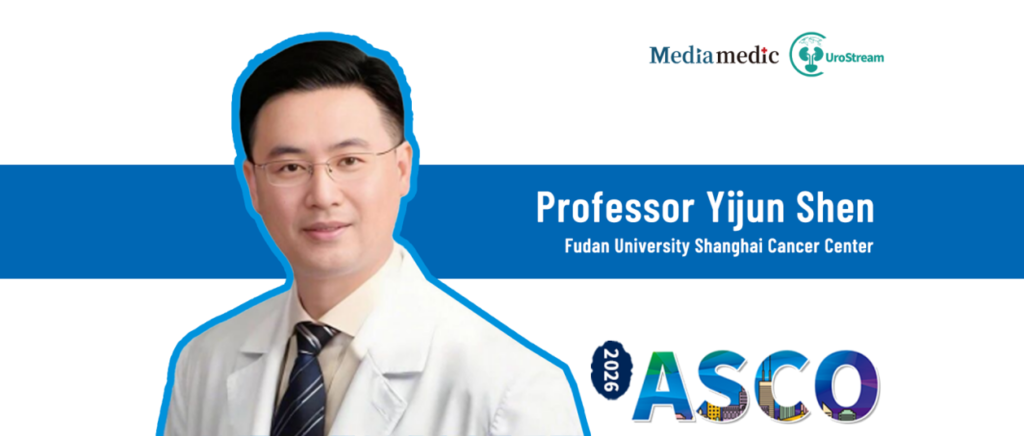
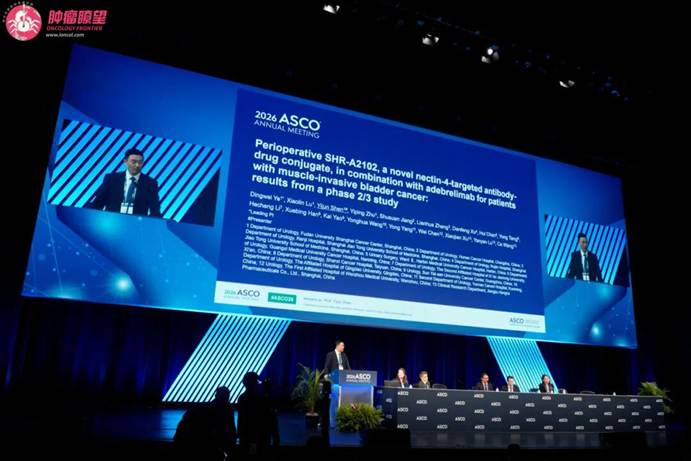
The 2026 American Society of Clinical Oncology (ASCO) Annual Meeting has once again brought together the latest breakthroughs in cancer research and drug development from around the world. As the largest and most influential oncology conference globally, every oral presentation represents a major advance in clinical practice and translational research.At this year’s meeting, the team led by Prof. Dingwei Ye and Prof. Yijun Shen from Fudan University Shanghai Cancer Center presented a Phase II/III study of SHR-A2102 combined with adebrelimab for the perioperative treatment of muscle-invasive bladder cancer (MIBC) (Abstract 4506). Selected for oral presentation, the study emerged as one of the notable “Voices of China” at ASCO 2026.
At the ASCO meeting, Oncology Frontier – UroStream interviewed Prof. Yijun Shen to discuss the innovative features and clinical significance of this combination regimen, as well as future directions for Phase III development, biomarker-driven patient selection, and bladder-preservation strategies.
The following are highlights from the interview.
01
Oncology Frontier – UroStream
The EV-303 and EV-304 studies have established the role of Nectin-4-targeted ADCs combined with PD-1 inhibition in the perioperative management of MIBC. What distinguishes SHR-A2102 in terms of molecular design, payload, and mechanism of action?
Prof. Yijun Shen
In recent years, Nectin-4 has emerged as one of the most important therapeutic targets in bladder cancer. Landmark studies such as EV-303 and EV-304 have demonstrated that Nectin-4-targeted ADCs combined with immunotherapy can significantly improve both pathologic complete response (pCR) and event-free survival (EFS). Benefits have been observed in both cisplatin-eligible and cisplatin-ineligible populations, establishing this strategy as an important component of perioperative treatment for MIBC.
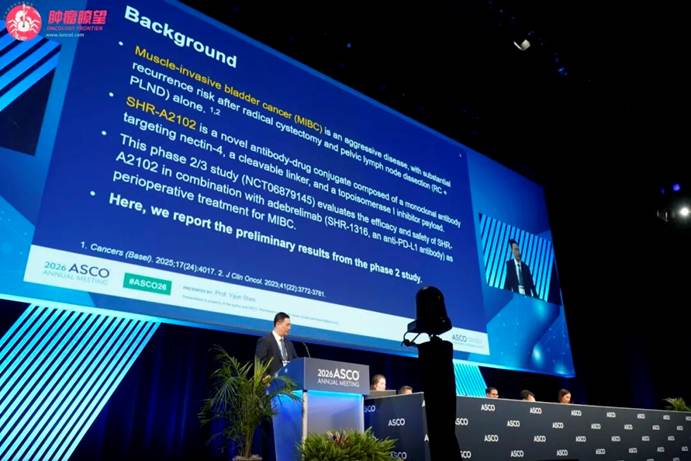
The SHR-A2102 regimen that we presented at ASCO also targets Nectin-4. While several Chinese pharmaceutical companies are currently developing Nectin-4 ADCs, most utilize conventional MMAE payloads. SHR-A2102 incorporates several important innovations.
First, it employs a next-generation topoisomerase I (Topo1) inhibitor payload, differentiating it from EV and many other ADCs that rely on MMAE. This provides a distinct mechanism of action.
Second, the molecule incorporates a newly optimized linker technology with greater structural stability than traditional linkers, allowing for more precise and consistent payload release.
Most importantly, the drug was specifically engineered to address one of the major challenges associated with ADC therapy—drug resistance. Through molecular optimization, SHR-A2102 effectively reduces P-glycoprotein (P-gp)-mediated drug efflux, thereby lowering the risk of resistance to Nectin-4-targeted treatment and potentially improving long-term clinical efficacy.
02
Oncology Frontier – UroStream
This Phase II study produced very encouraging preliminary results, with an overall pCR rate of 48.1% and a pathological downstaging rate of 59.3%. Notably, patients with impaired renal function (creatinine clearance <60 mL/min) achieved comparable pCR benefits. How do you interpret the clinical significance of these findings?
Prof. Yijun Shen
This exploratory Phase II study evaluated SHR-A2102 plus adebrelimab as perioperative therapy in 37 patients with MIBC.
It is important to recognize that our study population differed substantially from those enrolled in landmark studies such as EV-103 Cohort H, EV-303, and EV-304. Patients in our trial generally had a higher disease burden, with a larger proportion of T3 and T4 tumors, as well as nearly 20% lymph node-positive (N1) disease. Overall, the baseline clinical characteristics reflected a more advanced population.
Despite these challenges, the study achieved excellent efficacy outcomes. The overall pCR rate reached 48.1%, while the pathological downstaging rate approached 60%.
Perhaps even more clinically meaningful was the subgroup analysis showing that patients benefited regardless of renal function or cisplatin eligibility. This finding addresses an important unmet need in MIBC, as many patients with impaired renal function are unable to receive standard cisplatin-based chemotherapy.
There is also an important nuance in interpreting these data. Of the 37 enrolled patients, only 27 ultimately underwent radical surgery. Among the ten patients who did not proceed to surgery, nine had T3 or T4 disease.
In most cases, these patients experienced such substantial tumor regression following neoadjuvant therapy that they chose not to undergo radical cystectomy, largely because they wished to preserve their bladder and maintain quality of life.
As a result, the available efficacy data for T3/T4 N0 patients are somewhat limited, and this consideration should be taken into account when interpreting the strong efficacy outcomes observed in the study.
03
Oncology Frontier – UroStream
Regarding safety, Grade 3 or higher treatment-related adverse events occurred in 40.5% of patients, primarily neutropenia and lymphopenia, and no patient lost the opportunity to undergo surgery because of toxicity. Compared with traditional cisplatin-based chemoimmunotherapy, what advantages do you see in the safety profile of this regimen?
Prof. Yijun Shen
The fundamental principle of neoadjuvant treatment in the perioperative setting is to improve outcomes without delaying or compromising potentially curative surgery. This remains our most important benchmark when evaluating safety.
Based on the data from this study, the combination of SHR-A2102 and adebrelimab demonstrated a manageable safety profile and was generally well tolerated.
Because the regimen utilizes a novel Topo1 payload, treatment-related toxicities were primarily limited to mild bone marrow suppression, including leukopenia, thrombocytopenia, and anemia, together with common but generally manageable adverse events such as mild nausea and alopecia.
Of particular interest, the incidence of Grade 3 treatment-related adverse events during the neoadjuvant and adjuvant phases was only 27%, indicating a favorable therapeutic window.
Compared with conventional cisplatin-based chemoimmunotherapy, the regimen avoids many of the most concerning toxicities, including severe nephrotoxicity and significant gastrointestinal adverse events.
Most importantly, treatment did not interfere with surgical management. No patient experienced treatment-related delays or missed the opportunity for surgery because of toxicity, making the regimen particularly well suited for perioperative use.
We also recognize that successful perioperative treatment requires close multidisciplinary collaboration. Management of adverse events, prevention of perioperative complications, postoperative recovery, and coordination of adjuvant therapy all depend on effective cooperation among medical oncologists, surgeons, nurses, and supportive care teams.
Additionally, the study evaluated multiple dose levels. Both dosing cohorts demonstrated encouraging efficacy and manageable safety, providing a strong foundation for dose selection in future Phase III development.
04
Oncology Frontier – UroStream
What are the key priorities for the upcoming Phase III study? Will you further explore biomarkers for patient selection or expand the regimen into bladder-preservation strategies?
Prof. Yijun Shen
Building upon the promising results of this Phase II study, our future research program will focus on three major directions.
First, we plan to conduct a large-scale Phase III confirmatory trial to validate the efficacy and safety of this domestically developed Nectin-4-targeted ADC with a novel Topo1 payload combined with immunotherapy in Chinese patients with MIBC. The goal is to determine whether the regimen can deliver meaningful survival benefits and establish high-level clinical evidence supporting broader adoption of this innovative therapy.
Second, we intend to advance precision medicine approaches through biomarker research.
As pCR rates continue to improve with ADC-immunotherapy combinations, clinicians increasingly face important questions regarding which patients may safely omit adjuvant therapy and which patients might even avoid radical cystectomy altogether.
Inspired by the recent FDA approval of ctDNA-based companion diagnostics in bladder cancer, we plan to investigate biomarkers such as ctDNA and urinary tumor DNA (utDNA) to identify patients at high risk of recurrence and guide individualized adjuvant treatment decisions, thereby reducing overtreatment while maximizing clinical benefit.
Third, we aim to expand the role of this regimen in bladder-preservation strategies.
Preserving bladder function while maintaining long-term oncologic outcomes has become one of the most important goals in contemporary bladder cancer management. Future studies will evaluate SHR-A2102 combined with immunotherapy, potentially alongside radiotherapy and other multimodal approaches, to improve bladder-preservation rates while minimizing treatment-related toxicity.
Ultimately, our objective is to leverage innovations in Chinese-developed therapeutics to overcome the limitations of traditional treatment approaches. Beyond improving survival outcomes, we hope to preserve organ function, enhance quality of life, and usher in a new era of precision and individualized bladder cancer treatment driven by next-generation ADC technologies.
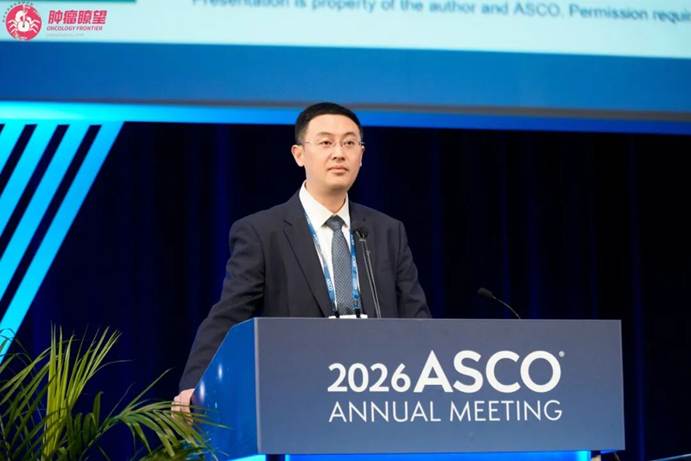
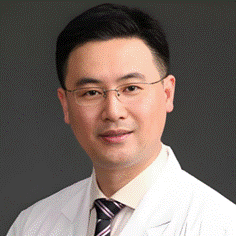
Prof. Yijun Shen