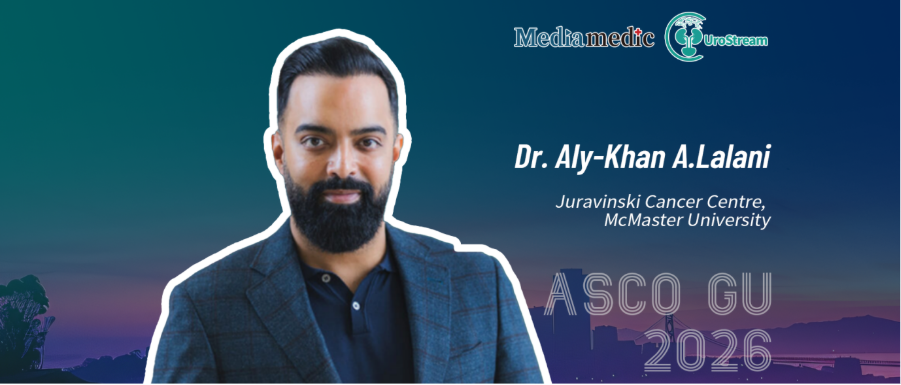
Editor’s Note: The 2026 American Society of Clinical Oncology Genitourinary Cancers Symposium (ASCO GU 2026) has successfully concluded. Numerous landmark studies in genitourinary oncology were presented, providing key evidence to inform and refine clinical practice. Among them, the phase II randomized CYTOSHRINK trial, focusing on treatment-naïve advanced renal cell carcinoma, reported its latest findings, offering important insights into the integration of immunotherapy with radiotherapy. We invited Professor Aly-Khan A. Lalani from the Juravinski Cancer Centre at McMaster University, Canada, to discuss the study design, clinical implications, and future directions in the field. 01
Oncology Frontier: Could you briefly introduce the core research you presented at this ASCO GU congress?
Dr. Aly-Khan A. Lalani: At this congress, I presented the first results from the CYTOSHRINK trial—an investigator-initiated, multicenter, open-label, randomized phase II study launched in 2019. The primary objective is to evaluate the efficacy and safety of adding early stereotactic body radiation therapy (SBRT) to standard immune checkpoint inhibitor (ICI) therapy in patients with treatment-naïve, de novo advanced renal cell carcinoma.
The study used a 2:1 stratified randomization design. Patients were stratified according to the International Metastatic Renal Cell Carcinoma Database Consortium (IMDC) risk categories (intermediate vs. high risk), and then randomized to either the intervention or control group.
- Control group: Received standard first-line dual immunotherapy with nivolumab plus ipilimumab.
- Intervention group: Received one cycle of induction dual immunotherapy, followed by SBRT to the primary tumor (30–40 Gy delivered in five fractions). After radiotherapy, patients continued dual immunotherapy and subsequently transitioned to nivolumab monotherapy as maintenance.
The primary endpoint was the 1-year progression-free survival (PFS) rate. Secondary endpoints included objective response rate (ORR), overall survival (OS), and quality of life (QoL). The study also included pre-specified exploratory biomarker analyses, with results to be reported in future updates.
02
Oncology Frontier: What key clinical insights can be drawn from this study, and how would you describe the safety profile of the regimen?
Dr. Aly-Khan A. Lalani: Several important findings emerged from our analysis that are highly relevant to clinical practice.
First, patient enrollment and adherence were excellent. Recruitment began in February 2020, just before the COVID-19 pandemic. Although enrollment was temporarily paused due to public health measures, we successfully reached our target sample size.
Second, enrolled patients generally had advanced disease at diagnosis, and there were notable baseline imbalances between the two groups. Patients in the intervention arm had a higher tumor burden, including significantly larger primary renal tumors, and a higher incidence of bone and liver metastases—indicating a worse baseline prognosis compared to the control group.
Despite these unfavorable baseline characteristics, the primary endpoint—1-year PFS—was broadly comparable between the two groups. In a per-protocol analysis of patients who completed four cycles of nivolumab plus ipilimumab, outcomes were generally more favorable, with a hazard ratio (HR) for progression or death of approximately 1.07 between groups.
Subgroup analyses suggested that patients with intermediate IMDC risk derived greater benefit from the intervention compared to high-risk patients, although the difference did not reach statistical significance. This was likely due to the small number of high-risk patients, resulting in wide confidence intervals and limited statistical power.
At present, overall survival data remain immature and are still under follow-up. However, a particularly noteworthy signal emerged in terms of tumor response: while overall ORR was similar between the groups, the proportion of patients achieving durable responses was significantly higher in the intervention arm—50% versus 10% in the control group.
This finding suggests that early integration of dual immunotherapy with SBRT may lead to deeper and more sustained tumor responses in selected patients.
03
Oncology Frontier: Which other studies presented at ASCO GU do you believe deserve attention, and what future directions may shape the field?
Dr. Aly-Khan A. Lalani: For the CYTOSHRINK trial, we will continue long-term follow-up, focusing on key endpoints such as overall survival, quality of life, post-progression treatment patterns, and outcomes in patients undergoing cytoreductive nephrectomy after progression.
Importantly, the planned biomarker analyses are ongoing and highly anticipated. These results are expected to help identify the patient populations most likely to benefit from this treatment strategy.
ASCO GU 2026 also showcased numerous important advances across genitourinary oncology. Notably, progress in urothelial carcinoma has been particularly impressive, especially in optimizing perioperative treatment for muscle-invasive bladder cancer (MIBC).
For example, the chemotherapy-free perioperative regimen combining enfortumab vedotin (EV) with pembrolizumab demonstrated promising efficacy and manageable safety, offering a new option for patients who are ineligible for cisplatin-based chemotherapy.
In renal cancer, we anticipate that more innovative combination strategies will move into clinical practice. Future research will focus on:
- Dual-agent combinations in the adjuvant setting
- Combination strategies after first-line treatment failure
- Real-world effectiveness and long-term survival benefits

Professor Aly-Khan A. Lalani