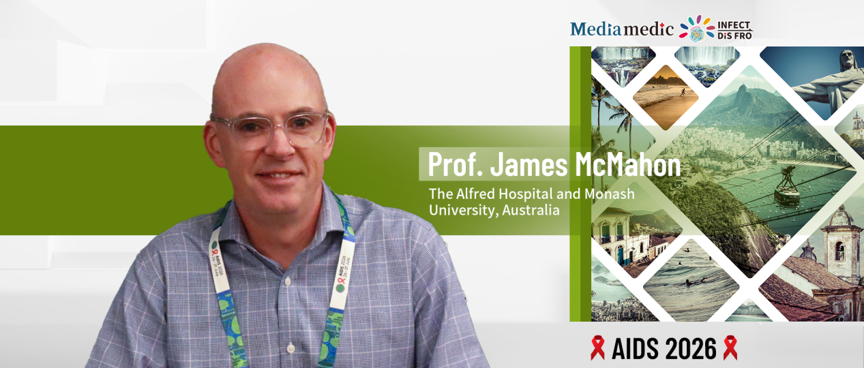

Editorial Note: The 2026 International AIDS Conference (AIDS 2026) was successfully held in Rio de Janeiro, Brazil. The conference covered multi-dimensional topics including HIV prevention, diagnosis and treatment, and long-term disease management, bringing together scholars from the global infectious disease field for academic exchanges. Professor James McMahon from the Alfred Hospital and Monash University, Australia presented data from a 104-week Phase II clinical trial at the conference, focusing on evaluating the efficacy and safety of a half-yearly long-acting triple regimen combining lenacapavir, teropavimab and zinlirvimab. Long-acting administration represents a key developmental direction for current HIV therapy, drastically alleviating the daily pill-taking burden on patients and offering new insights for optimized long-term disease management. Infectious Disease Frontier conducted an exclusive interview with Professor McMahon to discuss the sustained viral suppression effects, tolerability profiles and target patient populations of this innovative long-acting triple regimen based on core primary clinical trial data, for reference by frontline clinical practitioners.Infectious Disease Frontier: This 104-week follow-up study evaluated the semi-annually administered long-acting regimen of lenacapavir combined with teropavimab and zinlirvimab. What was the durability of viral suppression observed over long-term treatment? Compared with existing long-acting two-drug regimens, what unique advantages does this long-acting triple combination demonstrate?
Prof. McMahon: The regimen we evaluated was lenacapavir and two broadly neutralizing anti-HIV antibodies: teropavimab and zinlirvimab. This complete therapeutic regimen only requires administration once every six months to treat HIV. The data presented here are Phase II clinical trial results officially released at this academic conference, with a two-year follow-up period for trial participants receiving this long-acting therapy. Some participants initially received oral medication before fully switching to this injectable long-acting regimen. Trial outcomes confirmed that the regimen achieves an excellent viral suppression rate exceeding 95%.
Supported by these robust efficacy data coupled with favorable safety profiles, the trial has advanced to two Phase III clinical trials, which have just officially launched to collect definitive clinical evidence about the efficacy of this regeimn in a larger number of study participants. Based on existing trial findings, we hold high expectations that this long-acting triple combination will ultimately gain regulatory approval for clinical use.
Infectious Disease Frontier: This novel regimen combines long-acting monoclonal antibodies with a capsid inhibitor featuring an innovative mechanism of action. Long-term use raises concerns over immune-related adverse events, local injection reactions and the risk of drug resistance. In light of the 104-week safety data, what are the overall tolerability profiles of this regimen, and have any distinctive safety signals requiring heightened vigilance been identified?
Prof. McMahon: No unanticipated major safety signals were identified throughout the trial; there were no drug-related serious adverse events, nor any participant discontinuing treatment due to systemic adverse reactions. Lenacapavir is a small-molecule agent delivered via two low-dose subcutaneous injections. Prior research has confirmed that while lenacapavir triggers injection-site reactions in most recipients, overall tolerability remains satisfactory—a conclusion validated by our 104-week long-term trial.
Trial data indicated that 70% to 80% of participants experienced mild local reactions such as injection-site nodules and pain. Only one participant discontinued therapy due to subcutaneous nodule formation, marking the sole treatment withdrawal linked to injection-site adverse events in the entire study.
Multiple previous clinical trials have verified the favorable safety profile of these monoclonal antibodies among people living with HIV. Consistent with all monoclonal antibody therapeutics, mild infusion reactions may occur, yet no treatment discontinuations stemming from infusion reactions were recorded in our trial. Collectively, this regimen’s excellent safety profile is a core factor enabling its progression to Phase III investigation.
Infectious Disease Frontier: Based on the two-year findings from this study, which subgroups of people living with HIV do you believe should be prioritized to receive this semi-annually dosed long-acting triple regimen in the future?
Prof. McMahon: This trial was designed to benefit all people living with HIV, particularly those burdened by pill-taking routines and adherence barriers. Constrained by clinical trial design criteria, participants enrolled in the ongoing large-scale Phase III trial primarily consist of patients able to attend regular hospital follow-up visits required for the clinical trial.
Nevertheless, clinical experience with existing shorter-interval injectable long-acting antiretrovirals suggests that the regimen’s core strengths could be most pronounced among patients with poor treatment adherence, those unable to maintain daily oral dosing, or individuals struggling with consistent clinic attendance.
In my view, this half-yearly long-acting triple regimen carries immense clinical potential for all people living with HIV. It delivers stable viral suppression for patients without adherence difficulties who wish to simplify treatment and cut dosing frequency, as well as those unable to sustain daily oral therapy and facing persistent medication-taking challenges, freeing them from the need for daily oral pills. Given the unprecedented six-month dosing interval validated in this trial, the field holds highly optimistic outlooks for the clinical application of this triple long-acting combination.