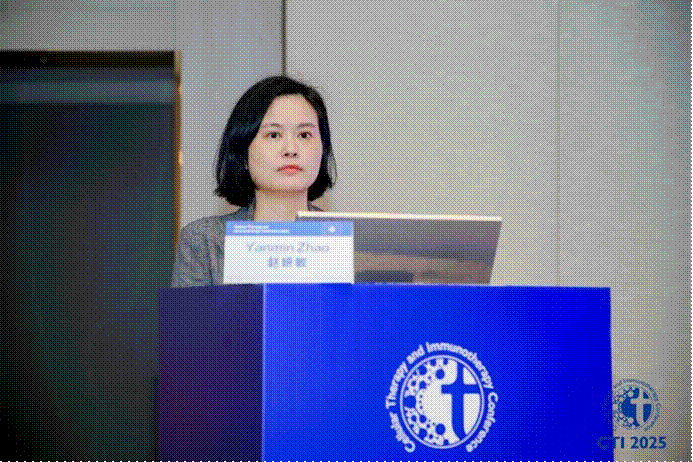
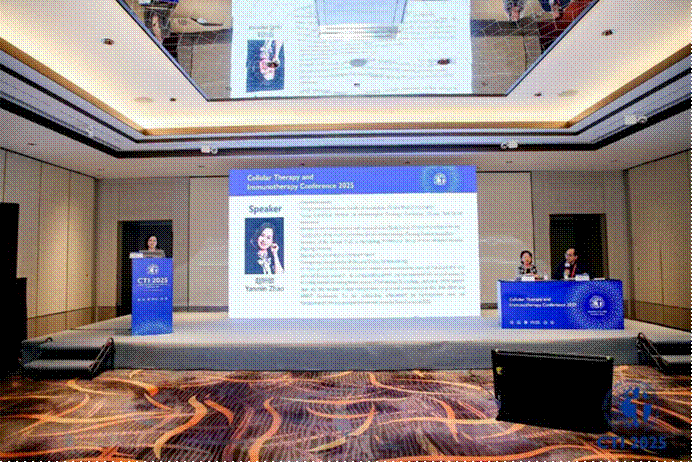
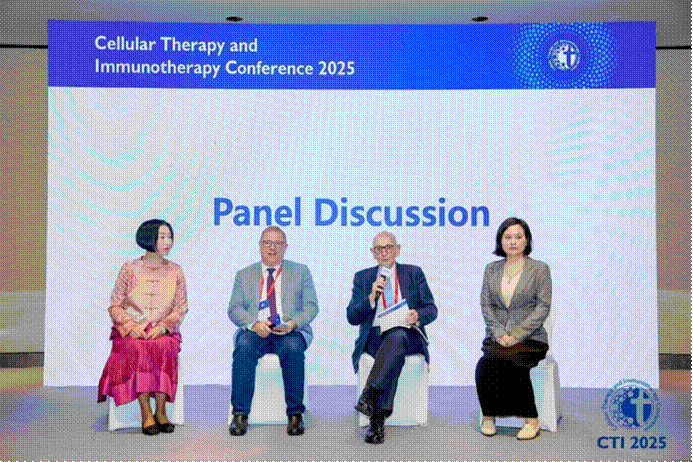
To promote innovation in China’s cell and immunotherapy field, enhance communication on key scientific issues, share the latest clinical advances, and foster global collaboration and translational progress, the 2025 International Cell & Immunotherapy Congress (CTI 2025)—jointly organized by Zhejiang University, the International Academy for Clinical Hematology (IACH), Zhejiang Immunological Society and Zhejiang Anti-Cancer Association—was held on November 13–16, 2025 in Hangzhou, China, and co-hosted by the First Affiliated Hospital of Zhejiang University School of Medicine and the Liangzhu Laboratory.
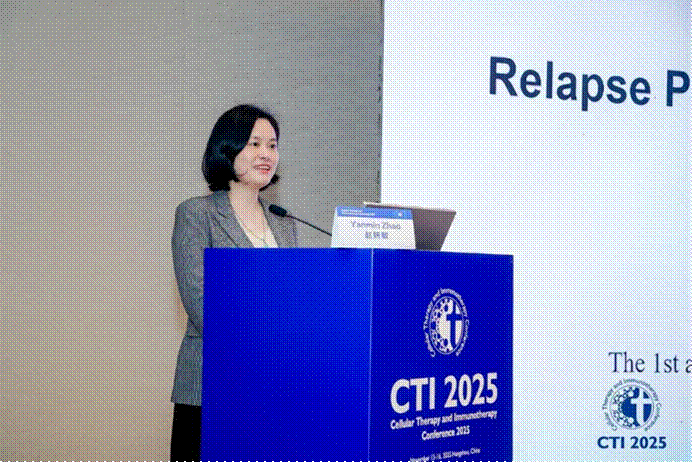
During the conference, Oncology Frontier – Hematology Frontier invited Professor Yanmin Zhao, First Affiliated Hospital of Zhejiang University School of Medicine, to conduct an in-depth discussion on TP53-mutated disease: MRD monitoring, transplant timing, and future therapeutic strategies, offering valuable insights for clinical and translational development.
Q1
TP53 mutations often coexist with complex karyotypes and may present with different variant allele frequencies (VAF). Based on your team’s research, are there factors that impact the prognostic value of ddPCR-based MRD monitoring? For high-risk patients, what is the recommended post-transplant monitoring frequency and intervention threshold?
Professor Zhao Yanmin:
Digital PCR (ddPCR) has strong advantages in MRD assessment—ultrasensitive detection (theoretical sensitivity up to 10⁻⁶), rapid turnaround time, relatively low cost, and absolute quantification. It can be used together with qPCR as an important MRD monitoring tool.
Although current guideline-level evidence remains limited regarding TP53 mutation as an MRD marker, our research—across both internal and external cohorts—supports its potential feasibility. However, when selecting TP53 mutation sites for MRD monitoring, germline mutations and SNPs must be excluded, as they are not suitable MRD markers.
Recommended MRD monitoring after allogeneic transplantation
- 0–3 months post-transplant:
Monthly ddPCR-based MRD monitoring - 0–12 months for TP53-mutant patients:
Higher relapse risk → every 2 months - Year 2–3 post-transplant:
Every 3 months - After year 3:
Frequency individualized based on clinical risk
Q2
You mentioned that combining dPCR with MFC improves prognostic stratification. How should clinicians adjust transplant timing or conditioning intensity based on combined MRD results?
Professor Zhao Yanmin:
For MRD-guided transplant decision-making, combining multi-parameter flow cytometry (MFC) and ddPCR optimizes assessment:
- MFC → widely available, detects immunophenotypic MRD
- ddPCR → highly sensitive molecular detection, ideal for TP53 MRD
Using both allows more accurate assessment of residual disease burden.
Transplant Timing Strategy
Lower tumor burden MDS (e.g., MDS-IB1 with <10% blasts):
- Do not delay transplant while trying to reach MRD negativity
- Multiple chemotherapy cycles may cause marrow suppression, infection, or disease progression
- Earlier transplant improves outcomes
Higher tumor burden AML or MDS with blasts ≥10%:
- Key goal: reduce tumor burden before transplant
- Use chemotherapy, hypomethylating agents, or targeted/immune therapy
- Aim to achieve:
- Molecular MRD clearance, or
- Significant reduction before proceeding
- This can lower relapse risk and improve post-transplant survival
Q3
What future research directions will your team pursue in MRD monitoring or novel therapies?
Professor Zhao Yanmin:
1. Advancement in MRD Monitoring Technologies
Targeted NGS (tNGS) may become a powerful tool for TP53 MRD because it can simultaneously detect:
- TP53 mutation burden
- Loss of heterozygosity (LOH)
- Dynamic evolution from single-hit → double-hit TP53 status
This helps guide more precise disease evaluation and treatment decisions.
2. New Therapeutic Strategies for TP53-Mutated Myeloid Malignancies
Current backbone therapy remains hypomethylating agents (e.g., decitabine). Although they can reduce TP53-mutated tumor burden, responses are often short-lived, so patients must proceed to transplant promptly once remission is achieved.
Promising emerging therapies:
• p53 reactivators
- Eprenetapopt (APR-246)
Shows potential efficacy in TP53-mutant disease by restoring wild-type–like p53 function.
• MDM2 inhibitors
For patients still retaining partial wild-type p53 activity → stabilizes p53 protein and enhances anticancer activity.
Future outlook
Combining these agents with hypomethylating therapy may:
- Achieve deeper remissions
- Create better pre-transplant conditions
- Improve long-term cure rates for TP53-mutant patients

Expert Profile
Professor Zhao Yanmin
First Affiliated Hospital, Zhejiang University School of Medicine
- MD, Chief Physician, Doctoral Advisor
- Deputy Director, Bone Marrow Transplant Center
- Zhejiang Provincial High-Level Talent (551 Talent Program)
- Member, Youth Committee of the Chinese Society of Hematology
- Member, China Medical Education Association HSCT & Cell Therapy Committee
- Deputy Chair, Youth Committee of Zhejiang Hematology Society
- Editorial Board Member: Cell Transplantation
- Published 40+ SCI papers as first/corresponding author in Blood, JHO, JAMA Network Open, Leukemia, etc.
- Oral presenter at ASH, EHA, EBMT, APBMT
- Recipient of:
- Zhejiang Provincial Science & Technology Progress First Prize
- National Science & Technology Progress Second Prize