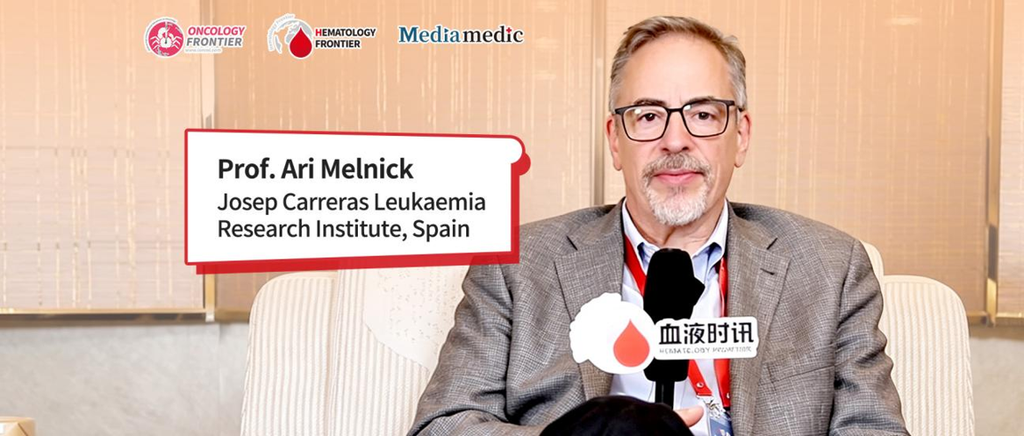
Basic stem cell research, regenerative medicine, cell therapy, and the clinical application of research guidelines are among the most closely watched frontiers in hematology and translational medicine worldwide. With these topics at its core, The 10th International Forum on Stem Cells (IFSC) brought together leading experts and scholars from around the world to explore scientific discoveries and technological innovations, showcase the latest advances in basic, clinical, and translational hematopoietic stem cell research, and promote collaborative innovation across the global stem cell field. During the conference, Oncology Frontier – Hematology Frontier invited Professor Ari Melnick, Director of the Josep Carreras Leukaemia Research Institute in Spain, to share his latest research findings and academic insights into the mechanisms underlying the acquisition of stem-like plasticity in B-cell lymphomas and emerging targeted therapeutic strategies. The key points are presented below for our readers.Oncology Frontier – Hematology Frontier: Traditional theories hold that the self-renewal capacity of stem cells is a core factor driving treatment resistance and relapse in hematologic malignancies. However, the vast majority of B-cell lymphomas originate from fully differentiated mature B cells. In your presentation, you revealed how mature B cells transiently regain “stem-like plasticity” during adaptive immune responses, and how somatic mutations can lead to the aberrant persistence of this plasticity. Could you elaborate on the key cellular interactions and molecular mechanisms driving this process? Furthermore, what progress has your team made in developing targeted interventions against this aberrant plasticity that may have potential for clinical translation?
Professor Ari Melnick: Our research has shown that although stem-like functions fade as B cells mature, they transiently re-emerge when B cells participate in adaptive immune responses. More importantly, the restoration of these stem-like functions depends on the ability of a specific B-cell subset—germinal center B cells—to establish strong intercellular contacts with T cells. This means that, with T-cell help, B cells can acquire the ability to express certain stem-like characteristics, particularly a high degree of plasticity. In the context of cancer treatment, plasticity is a key factor contributing to treatment failure because it provides the basis for tumor cells to evade immunotherapy and chemotherapy.
Notably, our team found that this normal, T-cell help-induced plasticity in B cells becomes aberrantly sustained in B-cell-derived lymphomas. This provides a mechanistic explanation for how fully differentiated mature cells can transform into tumor cells. We further demonstrated that specific somatic mutations—for example, mutations in Histone H1, which are among the most common mutations in diffuse large B-cell lymphoma (DLBCL)—can enable B cells to overcome their dependence on T-cell help and autonomously acquire and maintain stem-like plasticity.
At the molecular level, one of the key pathways driving this stem-like phenotype in normal B cells is the non-canonical NF-κB signaling pathway. Selective inhibitors of non-canonical NF-κB targeting IKKα can effectively block this effect in laboratory experiments. From a clinical translation perspective, there are currently no effective approaches for directly targeting tumor cell plasticity. However, these inhibitors have demonstrated the potential to deprive lymphoma cells of their plasticity. Based on these findings, our team has proposed that specifically targeting IKKα could serve as a therapeutic strategy to eliminate lymphoma cell plasticity, thereby blocking the mechanisms through which these cells evade immunotherapy and chemotherapy and potentially improving the cure rate with frontline treatment.
In addition, the aberrant plasticity induced by histone mutations is associated with other signaling mechanisms, and we believe that targeted drugs against these mechanisms are already available. This discovery has opened up an entirely new field: “plasticity-targeted therapy.” The central concept is not to kill cancer cells directly, but rather to “freeze” them in their existing state, depriving them of their ability to evade treatment. Our team is working to advance this concept and hopes to move into clinical trials soon to evaluate its clinical feasibility.
02. International Collaboration: Advancing Translational Research in Hematologic Malignancies Through China–Spain Cooperation
Oncology Frontier – Hematology Frontier: As Director of the Josep Carreras Leukaemia Research Institute, how do you assess the remarkable progress China has made in recent years in “bench-to-bedside” translational research in hematologic malignancies? Looking ahead, what are your institute’s priorities and expectations for international collaboration and joint research initiatives with leading Chinese research institutions, such as the Institute of Hematology & Blood Diseases Hospital, Chinese Academy of Medical Sciences (IH CAMS)?
Professor Ari Melnick: This year’s forum, held in Tianjin, has brought together leading stem cell experts from around the world. In recent years, China’s capabilities in translational research on hematologic malignancies have grown significantly. World-class research institutions, represented by the Institute of Hematology & Blood Diseases Hospital, Chinese Academy of Medical Sciences (IH CAMS), have emerged as leaders in scientific and therapeutic innovation, delivering tangible benefits to patients with hematologic malignancies.
The Josep Carreras Leukaemia Research Institute and IH CAMS share a closely aligned academic mission: to conduct cutting-edge scientific research with the goal of bringing innovative diagnostic and therapeutic approaches to patients with hematologic malignancies. Our institute believes that in-depth exchanges with Chinese colleagues are of fundamental strategic importance. They provide an essential foundation for establishing high-quality research collaborations, advancing scientific progress, and improving patient outcomes.
China is a key strategic partner for our institute. The two sides have already undertaken numerous academic exchanges and joint projects, demonstrating that these collaborations are both highly effective and academically impactful. We greatly appreciate the outstanding academic expertise of our Chinese colleagues and look forward to achieving further breakthroughs and making more original discoveries together in the future.
Professor Ari Melnick
Josep Carreras Leukaemia Research Institute, Spain
Professor Melnick is currently Director of the Josep Carreras Leukaemia Research Institute in Spain and also serves as an Adjunct Professor at Weill Cornell Medicine in the United States. He received his M.D. from the University of Buenos Aires, Argentina, in 1990. He previously served as the Gebroe Family Professor of Hematology and Medical Oncology at Weill Cornell Medicine and as Head of the Hematologic Malignancies Program.
His research focuses on cancer epigenetics and hematologic malignancies. He is a pioneer in the development of transcription factor inhibitors and large-scale studies of the human epigenome. He has published more than 380 scientific papers and has an h-index of over 130. Several therapeutic strategies developed through his research have received FDA approval or advanced into Phase III clinical trials.
His honors include the American Society of Hematology (ASH) Ernest Beutler Translational Research Award and the National Cancer Institute (NCI) Outstanding Investigator Award. In 2025, he was elected a Fellow of the American Association for Cancer Research (AACR).