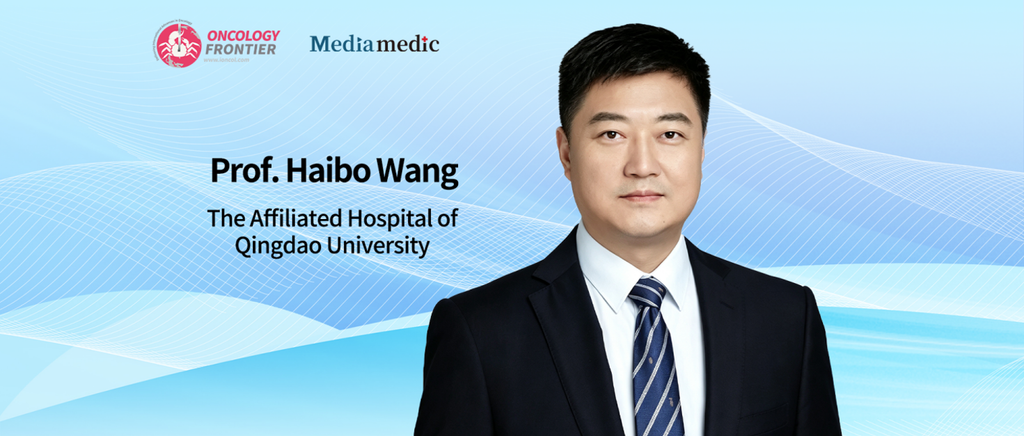
Editor's Note: From November 6 to 8, 2026, the 7th Dalian Xinghai Medical Forum Academic Conference on Comprehensive Cancer Treatment was held with great fanfare. After seven years of development, the Xinghai Forum has grown into an academic platform that brings together multiple disciplines and showcases cutting-edge advances in oncology. During the conference, Professor Haibo Wang of the Affiliated Hospital of Qingdao University shared the “Qingdao experience” in breast specialty development. Professor Wang emphasized the importance of remaining patient-centered and integrating multidisciplinary resources to provide patients with one-stop, precision multidisciplinary team (MDT) diagnosis and treatment services. Breast cancer treatment is not a matter of “fighting alone”; rather, it requires both continuous advancement in surgical techniques and the development of comprehensive systemic medical treatment capabilities to jointly improve the quality of care throughout the breast cancer journey. Professor Wang stressed that the development of specialized disease centers must avoid a department-centered approach and instead maintain a patient-centered focus and multidisciplinary balance. This article summarizes the key points from the interview for our readers.01
Oncology Frontier: At this conference, you shared the “Qingdao experience” in the development of breast specialties. What were the most important strategic drivers behind the remarkable progress of your hospital’s breast specialty, and what representative practices have come to characterize the Qingdao experience?
Professor Haibo Wang: The most fundamental principle behind the development of the Qingdao Breast Disease Diagnosis and Treatment Center is putting patients first. This is also consistent with the national vision of patient-centered care, multidisciplinary collaboration, and one-stop services for patients. This philosophy has guided the center throughout its development. The center brings together relevant specialties, including breast surgical oncology, breast medical oncology, breast plastic and reconstructive surgery, and breast imaging, while also coordinating closely with pathology, radiation oncology, nuclear medicine, rehabilitation, and other departments.
While allowing each specialty to retain its distinctive strengths, the center provides patients with one-stop services through the MDT model. This patient-centered approach enables patients to experience care, compassion, and precision treatment at the center. One-stop services and multidisciplinary integration allow physicians from different specialties to maintain their respective expertise while developing numerous integrated techniques. This is essential to the development of the specialties themselves.
02
Oncology Frontier: As a surgical expert, how do you balance the advancement of surgical techniques with the development of medical oncology capabilities in systemic treatment during specialty development?
Professor Haibo Wang: We focus not only on the development of the specialty as a whole, but also on the expertise, specialization, and advanced technical capabilities of each individual discipline. Surgeons must possess truly sophisticated surgical skills, while medical oncologists are responsible for systemic treatment. Plastic and reconstructive surgery should be organically integrated with surgical oncology. For example, breast surgical oncology and plastic surgery can jointly develop breast-conserving oncoplastic techniques and various reconstructive approaches.
The imaging department is responsible for diagnosis and assessment. Systemic treatment plans require joint decision-making by medical oncology, surgery, and other relevant disciplines. Surgery involves tumor resection by breast surgical oncologists, followed by reconstruction in collaboration with the relevant departments. Radiation oncology and pathology must also provide guidance during subsequent care, while patients need both physical and psychological rehabilitation.
Therefore, the center cannot solve every problem through technical expertise alone. Each specialty must continuously bring its own strengths into play. Ultimately, through multidisciplinary collaboration, we can provide patients with a comprehensive system of diagnosis, treatment, and rehabilitation management.
03
Oncology Frontier: At this conference, Professor Qiang Zhang also shared the “Liaoning experience” in the development of breast specialties. In your view, what aspects of the Liaoning experience are similar to or different from the Qingdao experience?
Professor Haibo Wang: The development of breast disease centers is a philosophy that can be implemented through different approaches and models. Professor Qiang Zhang introduced their highly developed and advanced experience. I believe the common ground is that we are all patient-centered and committed to providing patients with integrated services that are precise and compassionate.
Each center has its own distinctive strengths, and there is much we can learn from Liaoning Cancer Hospital. First, its management is highly refined, with clearly defined responsibilities among personnel in translational research, comprehensive and systematic management, and surgery. Their contributions to improving work performance are also reflected through the departmental performance evaluation system.
Professor Zhang places great emphasis on regional collaboration through relevant alliances, as well as cooperation with major centers across China. These collaborations help connect different institutions, establish a shared platform, and ensure that their work remains aligned with that of leading centers nationwide.
Another important aspect is their strong emphasis on identifying problems in clinical practice, validating them through clinical research, and then translating the findings back into clinical care. I believe these are valuable practices that we can all learn from.
04
Oncology Frontier: As specialties transition from the development of individual departments to the establishment of fully integrated specialized disease centers, what pitfalls should specialty leaders be particularly alert to or avoid?
Professor Haibo Wang: As a specialized disease center, we need multidisciplinary collaboration. There is one particularly important point that everyone must keep in mind: we must put patients at the center, rather than place any single department at the center. This issue was also emphasized during this conference.
We must be clear that patients are the core of a specialized disease center. All disciplines work together through multidisciplinary collaboration to serve patients. The center should not become department-centered simply because one specialty happens to have a greater workload at a particular time. Therefore, maintaining balance is essential to bringing everyone together, fostering collaboration, and advancing the center’s development collectively.