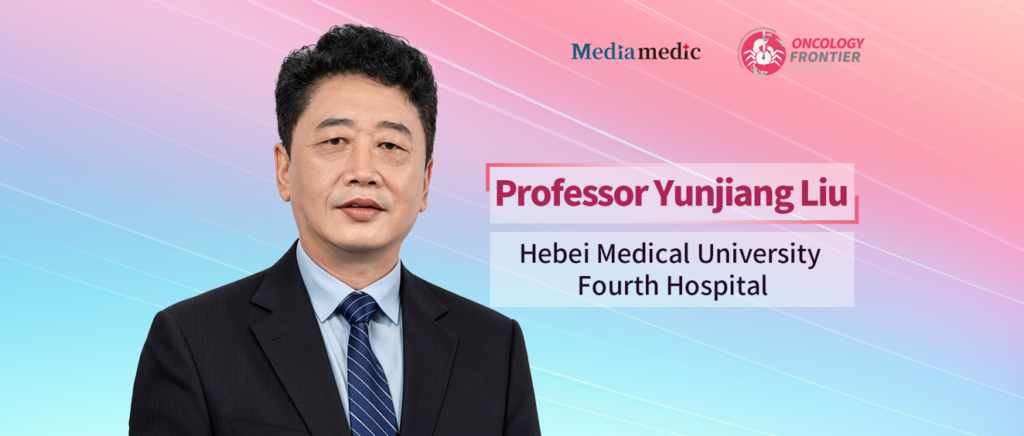
Editor's Note: The 17th Yanzhao Breast Cancer Forum was held in Shijiazhuang from August 26 to 30, 2026. Jointly organized by the Beijing Breast Disease Prevention and Treatment Society and the Hebei Clinical Oncology Society, and hosted by the Hebei Provincial Breast Disease Diagnosis and Treatment Center and the Breast Center of the Fourth Hospital of Hebei Medical University, the forum adhered to its guiding principles of “pragmatism, standardization, and development.” It brought together leading breast cancer experts from across China for in-depth discussions on key topics, including surgery, systemic therapy, pathological diagnosis, and multidisciplinary collaboration. During the meeting, Oncology Frontier invited Professor Yunjiang Liu of the Fourth Hospital of Hebei Medical University for an exclusive interview. He shared his insights into breast surgery practices in Hebei Province, the design of training programs in oncoplastic and reconstructive techniques, and strategies for extending these techniques to primary-level hospitals.Oncology Frontier: At this year’s forum, you will share practical experience in breast cancer surgery and treatment in Hebei Province. What major progress has been made in standardizing breast cancer surgery in recent years? What common challenges still warrant attention?
Professor Yunjiang Liu: This year marks the 17th Yanzhao Breast Cancer Forum. Although the meeting is held in Hebei, it has effectively become a high-level national academic platform. Each year, it brings together academicians and renowned breast cancer experts and scholars from across China to discuss the latest developments in the field. Thanks to years of academic exchange and the collective efforts of colleagues throughout the province, Hebei has made remarkable progress in standardizing breast surgery and clinical care.
At present, provincial breast centers have mastered a full range of advanced oncoplastic and reconstructive procedures. Deep inferior epigastric perforator (DIEP) flap reconstruction, regarded as one of the most advanced forms of breast reconstruction, is a particularly notable example. A single center performed nearly 70 DIEP flap reconstruction procedures in the first half of 2026, placing its surgical volume among the highest in China. The center’s overall breast-conserving surgery rate is approximately 40%, while its breast reconstruction rate is around 20%. Approximately 60% of breast cancer patients treated at the center are able to preserve their breasts.
Breast cancer has profound physical and psychological effects on women. Mastectomy can adversely affect patients’ family lives, social interactions, psychological well-being, and body image. Breast-conserving surgery and reconstructive procedures, by contrast, can preserve breast appearance while maintaining—and in some cases potentially improving—oncological outcomes. Their clinical value is substantial, and they are well received by patients.
In terms of specialty development, a mature talent-development system has been established across the province. On the one hand, young physicians are regularly sent to other institutions for advanced training in complex surgical techniques. On the other, experienced experts provide mentorship and hands-on guidance, strengthening the local surgical workforce and ensuring the continued development of technical expertise. In addition, through national academic platforms such as the Breast Surgery Group of the Chinese Society of Surgery under the Chinese Medical Association and the Committee of Oncoplastic Surgery of the Chinese Anti-Cancer Association, we have actively promoted more than 30 clinical practice guidelines on breast surgery, helping standardize clinical practice throughout the province.
At the same time, we recognize that the quality of breast cancer care remains uneven across the province, with greater needs for improvement in primary-level hospitals. Breast-conserving surgery and oncoplastic and reconstructive procedures, which address both tumor control and quality of life, have become increasingly established at leading hospitals, where procedure volumes continue to rise. However, these techniques remain rarely available in county-level hospitals, meaning that many patients can receive only mastectomy. Although some prefecture- and city-level hospitals offer these procedures, their adoption remains far from adequate. Technical limitations are a major bottleneck to the development of breast surgery at the grassroots level and will be a key focus of our future efforts. Through the work of our center’s expert team, we hope to bring advanced treatment concepts to primary-level institutions and make established techniques accessible to more physicians working there.
To support this goal, this year’s forum continued its longstanding tradition of holding the “Shaping Miracles” Oncoplastic and Reconstructive Surgery Training Course on the Wednesday and Thursday before the opening ceremony. This year, more than 100 participants from across China registered for the course. Those who complete the full training program will receive a standardized certificate of completion.
The course offers a comprehensive and well-structured curriculum, with live surgical demonstrations as a central component. Real-time broadcasting allows surgeons and trainees to communicate promptly, while expert-led discussions help explain technical details that are difficult to fully demonstrate during an operation. The participating surgical teams include not only key physicians from our center but also renowned experts from other institutions across China, who perform procedures alongside our team.
The course also dedicates an afternoon to theoretical lectures, followed by discussion and interactive sessions to reinforce learning and ensure that participants benefit fully from the training. The continued delivery of the “Shaping Miracles” course is helping improve breast surgery and treatment in Hebei Province and is also making a contribution to the broader advancement of breast cancer care across China.
Oncology Frontier: The training course in breast oncoplastic and reconstructive techniques is an important part of this year’s forum. How was the curriculum designed? As the principles of breast surgery continue to evolve, which technical aspects and clinical challenges are the main focus of the course?
Professor Yunjiang Liu: The oncoplastic and reconstructive surgery training course aims to promote two fundamental shifts.
The first is a shift in the philosophy of care—from a disease-centered approach to a patient-centered one. In the past, breast cancer treatment focused primarily on whether the tumor could be completely removed. However, truly high-quality care must do more than control the disease: it should also support patients’ physical and psychological recovery while minimizing postoperative sequelae and anxiety.
The second is the development of a systematic approach to surgical decision-making. Oncoplastic and reconstructive breast surgery requires a clear clinical rationale for choosing among autologous tissue reconstruction, implants, or a combination of the two. When autologous tissue is selected, surgeons must also determine which donor site and flap are most appropriate. These decisions require a well-established technical framework.
The course covers a complete spectrum of techniques, from basic to advanced procedures. Relatively straightforward techniques include tissue rearrangement, which is suitable for smaller defects. When defects are larger and tissue rearrangement alone cannot achieve a satisfactory contour, volume replacement techniques are needed. These include fat-fascial flaps, perforator flaps, and axial-pattern flaps, which can fill defects and restore an optimal breast shape.
The curriculum also covers procedures to improve the appearance of the contralateral breast. For example, mastopexy can address excessive breast ptosis, while reduction mammoplasty combined with mastopexy can be used for excessively large breasts. These procedures help optimize overall body symmetry and aesthetic outcomes. Among the most advanced approaches is autologous breast reconstruction, which relies on supermicrosurgical vascular anastomosis and requires exceptional precision.
Beyond surgical techniques themselves, the course also addresses the prevention and management of postoperative complications. For example, following lymph node dissection for breast cancer, approximately 20%–30% of patients develop upper-limb lymphedema. This can cause substantial heaviness and restricted movement, affect appearance and everyday clothing choices, and create considerable distress. By assessing the lymphatic system through preoperative lymphangiography and performing supermicrosurgical lymphatic anastomosis when appropriate, alongside manual and physical therapies, we can effectively alleviate lymphedema.
Overall, the course offers a rich program of surgical demonstrations that integrates clinical principles, practical techniques, and systematic theoretical learning. We hope it will provide young physicians with valuable knowledge and skills that they can apply in their own practice to better serve their patients.
Oncology Frontier: The standardized dissemination of oncoplastic and reconstructive breast surgery is an important current priority. In your view, what are the greatest challenges to introducing these techniques in primary-level and prefecture- or city-level hospitals? What has this year’s forum done to help translate these techniques into clinical practice?
Professor Yunjiang Liu: The challenges of promoting oncoplastic and reconstructive techniques at the grassroots level mainly involve two aspects: clinical concepts and technical capabilities.
At the conceptual level, the primary challenge is the difference in treatment philosophies. Some primary-level institutions still focus mainly on removing the tumor, rather than taking a broader view of the patient’s overall benefit. The principle should be to preserve the breast whenever oncologically appropriate. If the cosmetic outcome after breast-conserving surgery is unsatisfactory, oncoplastic techniques should be used to improve the appearance and achieve a more desirable breast contour, helping patients recover both physically and psychologically and regain their confidence and well-being.
At the technical level, procedures can be divided into two broad categories. The first comprises relatively straightforward volume-displacement techniques, in which surrounding tissues are mobilized and released to fill the defect. The second comprises volume-replacement techniques, which are required when local tissues are insufficient to achieve satisfactory reconstruction. In such cases, surgeons may use local random-pattern flaps, perforator flaps, axial-pattern flaps, or even tissue from more distant sites, such as latissimus dorsi myocutaneous flaps or the greater omentum, to fill the defect and achieve an optimal contour.
Oncoplastic and reconstructive techniques do not compromise the effectiveness of oncological treatment; their principal value lies in improving appearance and reducing the physical and psychological impact of surgery. The most advanced autologous reconstruction procedures, however, involve vascular anastomosis and have a long learning curve. Surgeons need systematic training under experienced mentors to master vascular anastomosis and the key principles of postoperative management. Thrombosis can also occur after surgery, potentially resulting in flap necrosis. Therefore, successful reconstruction requires not only meticulous surgical technique but also comprehensive management throughout the postoperative period.
In essence, breast oncoplastic and reconstructive surgery is an integrated system of care that encompasses preoperative preparation and vascular assessment, precise intraoperative techniques, postoperative management, and coordination with the nursing team.
The central purpose of this year’s “Shaping Miracles” training course is to address these challenges directly. We want young physicians to understand the direction in which breast surgery is evolving and to acquire stronger technical knowledge and practical skills, enabling them to return to their institutions and provide better care for their patients.
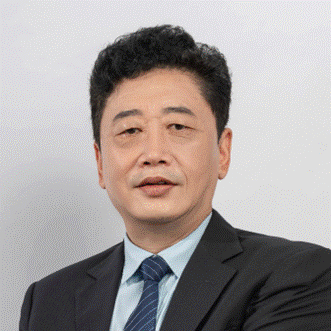
Professor Yunjiang Liu