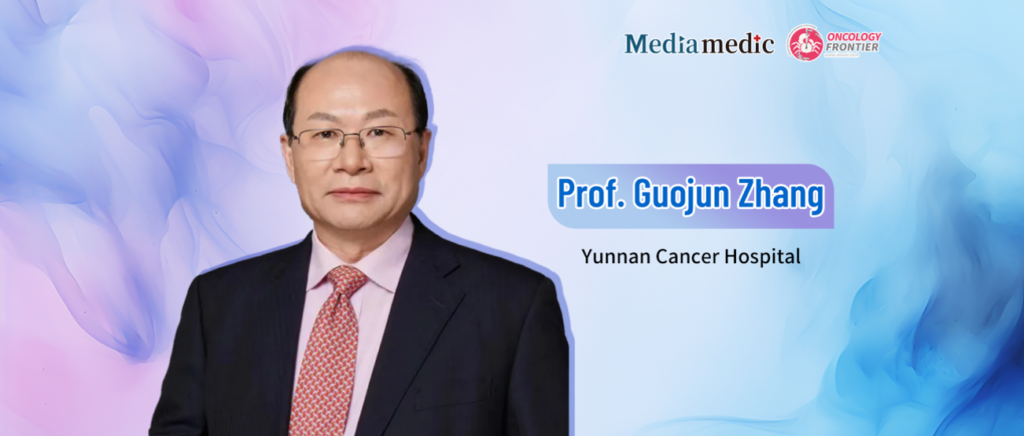
Editor's Note: The 10th Yunling Breast Cancer Conference was held in Kunming from August 21–22, 2026. After a decade of development, the Yunling Breast Cancer Conference has evolved from a regional academic exchange platform into a widely influential breast cancer academic brand. With the theme “Inheritance, Innovation, and Vision,” this year's conference not only brought together leading experts in breast cancer from across China, but also actively incorporated cutting-edge developments from interdisciplinary fields including molecular medicine, artificial intelligence, and materials science, showcasing new advances in breast cancer basic research and clinical practice.On the occasion of the conference, Oncology Frontier invited Professor Guojun Zhang, Chair of the 10th Yunling Breast Cancer Conference and Professor at Yunnan Cancer Hospital, for an in-depth discussion on the conference’s distinctive features and highlights, the innovative translation of molecular imaging navigation technology, and future directions for precision assessment in breast-conserving surgery.
A Decade of Perseverance
The Yunling Breast Cancer Conference Enters a New Stage of Higher-Level Development
Discussing the distinctive features and innovations of the 10th Yunling Breast Cancer Conference compared with previous editions, Professor Zhang Guojun noted that this year’s meeting represents both a summary of the conference’s achievements over the past decade and a new starting point for the future.
“From the perspective of attendance, when the conference was first established, there were only several dozen to one or two hundred participants. Beginning with the eighth edition, attendance exceeded 300, while this year’s conference has attracted more than 500 participants,” Professor Zhang Guojun explained.
The theme of this year’s conference is “Inheritance, Innovation, and Vision.” “Inheritance” represents the continuation of successful experiences and valuable academic traditions from the past; “Innovation” emphasizes breaking through established models and actively introducing cutting-edge concepts and technologies; while “Vision” reflects the aspiration to develop the Yunling Breast Cancer Conference into an important academic brand in Southwest China and to continuously expand its influence.
The academic program has also further strengthened its interdisciplinary focus.
Professor Zhang Guojun explained that the conference specially invited Academician Tan Weihong of the Chinese Academy of Sciences and Director of the Hangzhou Institute of Medicine to deliver a keynote presentation on advances in molecular research in cancer diagnosis and treatment. With the rapid development of molecular medicine, precision diagnosis and treatment based on molecular classification are continuously driving innovations in breast cancer treatment. Even for highly aggressive subtypes such as triple-negative breast cancer, more refined stratification and management may enable increasingly precise treatment.
The conference also invited Professor Zhang Jin, Chair of the Breast Cancer Professional Committee of the Chinese Anti-Cancer Association, to present the latest advances in breast cancer, while Professor Tian Jie of Beihang University shared cutting-edge research on combining artificial intelligence with molecular imaging to drive innovation in breast cancer diagnosis and treatment.
Professor Zhang Guojun noted that the conference not only covers the latest advances in medicine, but also incorporates multidisciplinary perspectives from engineering, materials science, and other fields, providing participants with a broader academic perspective.
In addition to the main forum, the conference featured eight parallel sessions covering precision diagnosis and treatment, medical treatment of breast cancer, molecular imaging-guided surgical navigation, a young investigators forum, basic research, and other topics, aiming to comprehensively showcase the latest achievements in breast cancer diagnosis, treatment, and basic research.
“Whether in the main forum or the parallel sessions, we hope to present the most cutting-edge and valuable academic content to everyone. This is also an important manifestation of the innovative spirit of this year’s conference,” Professor Zhang Guojun said.
From Basic Research to Clinical Translation
Molecular Imaging Navigation Technology Moves Toward Patient Benefit
In recent years, Professor Zhang Guojun’s team has made continuous breakthroughs in molecular imaging-guided precision surgery. Their “Molecular Imaging Technology for Precise Intraoperative Assessment of Breast Cancer Surgical Margins” was selected as one of the Top Ten Original Research Achievements in Breast Cancer in 2024. Their research on the novel fluorescent tracer TTP-ICG was also published in the internationally renowned journal PNAS.
Discussing the challenges involved in bringing innovative technologies from the laboratory into clinical practice, Professor Zhang Guojun explained that his team has conducted systematic research on molecular imaging navigation for many years and has established a diverse range of molecular probe platforms.
“Over the years, we have developed multiple technological approaches, including nanoprobes, ICG-based molecular imaging probes, rare-earth nanoprobes, as well as small-molecule, peptide, antibody, and ADC-related probes,” Professor Zhang Guojun said.
These probes can specifically recognize tumor tissue and help surgeons determine tumor boundaries more accurately.
“Tumors actually have boundaries, but it is difficult to accurately determine their true extent through visual inspection or surgical palpation alone. Molecular imaging technology enables us to display tumor boundaries in real time, dynamically, and visually. This represents an important breakthrough for precision surgery.”
According to Professor Zhang Guojun, the greatest challenge at present remains how to safely and effectively translate these innovative biomaterials and molecular probes into human applications.
To promote translational research, the team has established a bridge between basic research and clinical application through approaches such as staining of ex vivo tumor tissues, continuously narrowing the gap between laboratory discoveries and clinical practice.
“Some of our probes already have the potential for clinical application, while others are approaching the stage of clinical translation,” Professor Zhang Guojun said.
The team’s research has been published in major international journals including Science Translational Medicine, PNAS, and Cancer Research. Related clinical studies have also been initiated, with trials registered on ClinicalTrials.gov.
“In the future, we hope to bring promising molecular probes into clinical practice as quickly as possible, so that they can ultimately benefit patients,” he said.
Precisely Defining Surgical Margins
Molecular Imaging and AI Reshaping Decision-Making in Breast-Conserving Surgery
The key to breast-conserving surgery lies in balancing “complete tumor removal” with “optimal cosmetic preservation.” The fundamental goal is to ensure complete tumor resection while preserving the appearance and function of the breast as much as possible.
Regarding how molecular imaging technology may change surgeons’ intraoperative decision-making in the future, Professor Zhang Guojun emphasized that surgical experience and technical expertise will always remain indispensable, but traditional visual and tactile assessment has inherent limitations.
“No matter how experienced a surgeon is, visual observation and tactile assessment during surgery have certain limitations. Molecular imaging probes can identify tumors at the molecular level and help us overcome these limitations,” he said.
Particularly in the context of the rapid development of artificial intelligence, the deep integration of molecular imaging and AI has the potential to further improve the accuracy of tumor boundary identification and provide surgeons with more objective and precise evidence for intraoperative decision-making.
Professor Zhang Guojun pointed out that breast-conserving surgery essentially seeks the optimal balance between oncologic control and breast aesthetics.
“If the resection is too extensive, it may cause breast deformity or distortion, and may even result in a bird’s-beak-like appearance. If the resection is insufficient, residual tumor may remain, increasing the risk of recurrence,” he said.
Therefore, accurately defining the tumor boundary is particularly critical for breast-conserving surgery.
At the same time, surgical margin status is also an important factor influencing patient prognosis. Positive margins may not only increase the risk of local recurrence but may also require patients to undergo additional treatment.
“In the future, we hope that through the integration of molecular imaging, artificial intelligence, and other innovative technologies, surgeons will be able to perform tumor resection with greater precision—achieving complete tumor removal while preserving the appearance of the breast and patients’ quality of life to the greatest extent possible,” Professor Zhang Guojun said.
Conclusion
From a regional academic meeting to a widely influential breast cancer academic brand, the Yunling Breast Cancer Conference has undergone a decade of continuous innovation and development.
At the same time, emerging technologies represented by molecular imaging navigation are driving breast cancer surgery toward a new era of precision and intelligence.
Looking ahead, as molecular probes, artificial intelligence, and precision surgical concepts continue to converge, breast-conserving treatment for breast cancer is expected to achieve more precise tumor resection, better cosmetic outcomes, and greater patient benefit, creating new opportunities for the continued advancement of breast cancer diagnosis and treatment.
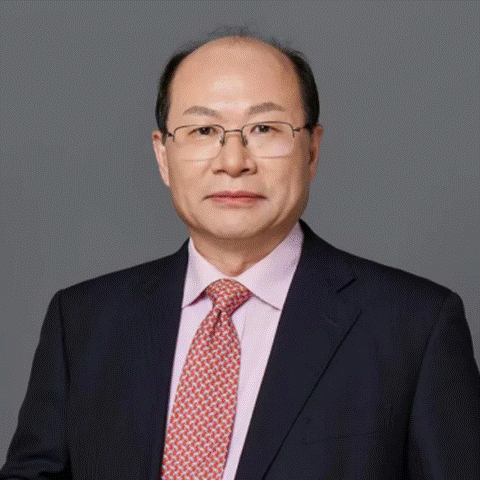
Professor Zhang Guojun