Editor's Note: HR+/HER2− breast cancer is the most common molecular subtype of breast cancer, and the combination of CDK4/6 inhibitors and endocrine therapy has become an important standard first-line treatment for patients with advanced disease. With the increasing availability of PI3K/AKT/mTOR (PAM) pathway inhibitors, novel endocrine therapies, and antibody-drug conjugates (ADCs), the treatment of advanced HR+/HER2− breast cancer is gradually evolving from a relatively fixed sequential treatment model toward precision stratification based on molecular characteristics.The 10th Yunling Breast Cancer Conference was held in Kunming from August 21–22, 2026. During the conference, Oncology Frontier interviewed Professor Yehui Shi of Tianjin Medical University Cancer Institute and Hospital. He provided an in-depth interpretation of first-line treatment selection in the CDK4/6 inhibitor era, treatment strategies following disease progression, and the value and challenges of biomarker testing in precision diagnosis and treatment.
01
Oncology Frontier: The combination of CDK4/6 inhibitors and endocrine therapy has become the standard first-line treatment for advanced HR+/HER2− breast cancer. In the “post-CDK4/6 inhibitor era,” with the emergence of new treatment approaches such as PAM pathway inhibitors, what new considerations and challenges do you think are emerging in first-line treatment selection for advanced HR+/HER2− breast cancer?
Professor Shi Yehui: The combination of CDK4/6 inhibitors and endocrine therapy has become an important standard first-line treatment for advanced HR+/HER2− breast cancer. Multiple CDK4/6 inhibitors have been widely adopted in clinical practice, and the inclusion of some of these agents in China’s national medical insurance system has further improved treatment accessibility. Their consistent and reproducible efficacy has also established this treatment approach as a cornerstone of first-line therapy.
However, CDK4/6 inhibitors cannot address every patient’s treatment needs. As basic research has continued to advance and genetic testing has become increasingly accessible, we have found that some patients harbor molecular alterations such as abnormalities in the PI3K/AKT/mTOR pathway or ESR1 mutations. These biological differences may affect patients’ sensitivity to CDK4/6 inhibitor plus endocrine therapy and have consequently made first-line treatment decisions more complex.
The key question that needs to be addressed now is how to determine the treatment sequence for patients with specific molecular abnormalities. For patients in whom PAM pathway abnormalities, ESR1 alterations, or other relevant molecular changes have already been identified before treatment, should we first use a CDK4/6 inhibitor plus endocrine therapy and then target the relevant alteration after disease progression? Or should treatment be guided by the molecular characteristics from the outset, using the corresponding pathway inhibitor in the first-line setting, or even exploring combinations with CDK4/6 inhibitors? At present, sufficient evidence is still lacking.
Therefore, the core challenge in the “post-CDK4/6 inhibitor era” is no longer simply choosing which drug to use, but rather determining the optimal treatment sequence according to each patient’s molecular characteristics. More prospective clinical studies are needed to provide clearer evidence-based guidance for first-line treatment strategies in specific molecular subgroups.
02
Oncology Frontier: With the widespread use of CDK4/6 inhibitors, treatment resistance has become increasingly apparent. How should subsequent treatment be planned for patients whose disease progresses after first-line therapy? What roles do ADCs and novel endocrine therapies play in this setting?
Professor Shi Yehui: For patients whose disease progresses after CDK4/6 inhibitor plus endocrine therapy, an important principle at present is to reassess the disease at the molecular level, using genetic testing to identify potential mechanisms of resistance and actionable therapeutic targets, thereby enabling a strategy of “targeting what can be targeted.”
For patients with clearly actionable abnormalities such as alterations in the PI3K/AKT/mTOR pathway or acquired ESR1 mutations, targeted therapies or novel endocrine therapies can be selected according to the corresponding molecular changes. As these drugs continue to enter clinical practice, this group of patients is beginning to have increasingly refined treatment options.
However, in the real-world setting, a considerable proportion of patients either do not have access to genetic testing or do not have clearly actionable driver alterations identified by testing.
For these patients, the traditional treatment pathway has often been to move toward chemotherapy. The emergence of ADCs is now changing this treatment landscape. ADCs combine the targeted recognition capabilities of antibodies with the antitumor effects of cytotoxic payloads. By improving treatment selectivity, they provide some patients with an alternative to conventional chemotherapy. As a result, ADCs are assuming an increasingly important position in the treatment sequence following progression on CDK4/6 inhibitors.
What has not yet been fully resolved is how ADCs should be sequenced relative to PAM pathway-targeted therapies and novel endocrine therapies. It remains unclear which treatment strategies should be used earlier and which patients are most likely to derive greater benefit from each approach, as there is still a lack of direct comparative evidence.
In the future, more large-scale phase III randomized controlled trials will be needed to directly compare different treatment pathways and establish a clearer and more practical treatment sequence for the post-CDK4/6 inhibitor setting.
03
Oncology Frontier: HR+/HER2− is the most common molecular subtype of breast cancer, representing a very large patient population. What is the current status of biomarker testing and its clinical application in the precision diagnosis and treatment of advanced HR+/HER2− breast cancer? What do you believe are the most important areas that need to be addressed in the future?
Professor Shi Yehui: With the growing emphasis on precision treatment, the clinical value of genetic testing in advanced HR+/HER2− breast cancer has been increasingly recognized by experts, and the number of patients undergoing molecular testing is gradually increasing.
Current evidence indicates that identifying actionable targets through genetic testing can help patients enter more precise targeted treatment pathways and provide important information for subsequent treatment decisions.
However, there remains a gap between the current situation and the widespread, standardized use of genetic testing.
First, quality control and standardization of results across different testing platforms need to be further strengthened. Second, there are regional disparities in testing capabilities, quality, and clinical accessibility. In addition, cost remains an important barrier to broader adoption. At present, most genetic testing programs are not covered by China’s medical insurance system, and the resulting financial burden on patients limits their clinical application to some extent.
One of the most important areas for future progress is therefore reducing testing costs while improving accessibility. With advances in sequencing technology, the price of genetic testing has already declined substantially compared with earlier years. However, if genetic testing is to become a routine tool in precision diagnosis and treatment of advanced breast cancer, the financial burden on patients needs to be reduced further so that more patients can undergo standardized molecular testing.
Only when biomarker testing becomes truly “detectable, interpretable, affordable, and capable of guiding treatment” can precision diagnosis and treatment evolve from an option available to a limited number of patients into a more broadly implemented clinical practice.
By increasing the coverage and accessibility of molecular testing, we can further identify actionable therapeutic targets, optimize treatment sequencing, and ultimately improve treatment outcomes and long-term survival for patients with advanced HR+/HER2− breast cancer.
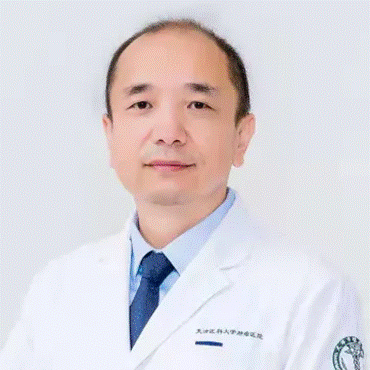
Professor Shi Yehui