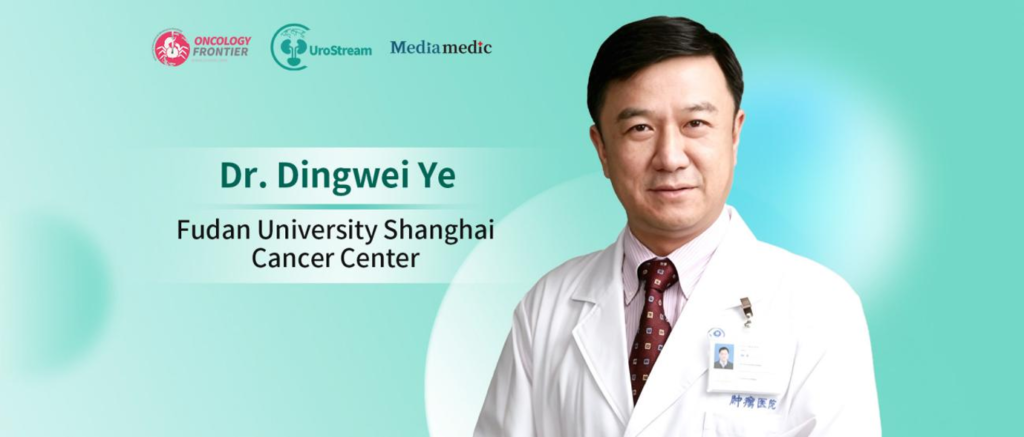
Editor's Note: The 2026 Pujiang Urological Oncology Academic Conference was held in Shanghai. In recent years, innovative approaches including antibody-drug conjugates (ADCs), immunotherapy, and precision diagnostics have developed rapidly, shifting the treatment goals of urothelial carcinoma from short-term disease control toward deeper responses, long-term survival, and comprehensive disease management. Enfortumab vedotin-based combination therapy has changed the first-line treatment standard for locally advanced or metastatic urothelial carcinoma (LA/mUC). At the same time, patient selection, standardized treatment, adverse event management, response assessment, and long-term follow-up in real-world practice have become critical to translating evidence-based benefits into meaningful clinical outcomes. Oncology Frontier · UroStream invited Professor Dingwei Ye of Fudan University Shanghai Cancer Center to share his clinical perspectives on first-line treatment transformation, standardized continuous treatment, and advances in perioperative research.01
Oncology Frontier · UroStream: In recent years, the management of urological malignancies has gradually evolved from a model dominated by conventional approaches such as surgery and chemotherapy toward one integrating immunotherapy, ADCs, and precision diagnostics. From the frontline clinical perspective, what are the defining features of this transformation? Which advances are most likely to translate into long-term patient benefit?
Professor Dingwei Ye: In recent years, the management of urological malignancies has gradually shifted from a model centered on surgery, radiotherapy, and conventional chemotherapy toward an approach integrating local and systemic therapies, multidisciplinary collaboration, and comprehensive disease management.
This transformation is mainly reflected in three aspects. First, systemic therapy is moving into earlier stages, with clinical goals expanding beyond tumor control in advanced disease to include reducing recurrence risk and improving long-term outcomes. Second, technologies such as circulating tumor DNA (ctDNA), measurable residual disease (MRD), and molecular biomarkers continue to advance, providing new tools for risk stratification and individualized treatment decisions. Third, clinical management is becoming increasingly comprehensive, encompassing pre-treatment assessment, treatment delivery, adverse event management, response evaluation, and long-term follow-up. The importance of standardized and continuous care is therefore growing.
Urothelial carcinoma is one of the areas where this transformation has been particularly evident. Supported by high-level clinical evidence, enfortumab vedotin-based combination therapy has changed the first-line treatment standard for LA/mUC. Phase III perioperative studies are also expanding our understanding of its potential clinical value. However, translating research evidence into meaningful patient benefit ultimately depends on appropriate patient selection, standardized treatment, effective adverse event management, and long-term follow-up.
02
Oncology Frontier · UroStream: Treatment options for urothelial carcinoma have expanded rapidly in recent years, moving from relatively limited choices to an increasing number of novel agents and combination regimens. Which developments do you consider the most important milestones? Which breakthroughs have truly driven clinical practice toward more proactive and precise comprehensive management?
Professor Dingwei Ye: For many years, platinum-containing chemotherapy formed the foundation of first-line treatment for LA/mUC. One of the most important milestone studies in recent years is undoubtedly the EV-302 trial.
The value of EV-302 is first reflected in the simultaneous improvement of its two key endpoints, PFS and OS. With a median follow-up of 2.5 years, compared with platinum-containing chemotherapy, enfortumab vedotin-based combination therapy approximately doubled both median PFS and median OS. In the pan-Asian subgroup, the complete response (CR) rate reached 41.1%. With extended follow-up to 3.5 years, the overall survival benefit remained durable.
More importantly, among patients who achieved a confirmed CR with enfortumab vedotin-based combination therapy, 66.2% had initially achieved a partial response (PR) and subsequently converted to CR during further treatment or observation. At the 3.5-year follow-up, the long-term OS rate among patients who converted from PR to CR was similar to that of the overall CR population.
This suggests that an early PR does not necessarily represent the maximum response that a patient can achieve. For patients who continue to derive benefit and tolerate treatment, subsequent therapy should be individualized based on response assessment and safety management. Supported by these high-level data, domestic and international guidelines have incorporated enfortumab vedotin-based combination therapy as a preferred or high-level first-line recommendation, making it an important current first-line treatment option.
However, selecting the appropriate regimen is only the first step. Standardized management and treatment continuity are equally important. No new safety signals were observed with the 3.5-year follow-up. Nevertheless, long-term treatment requires appropriate baseline assessment, early recognition and standardized management of adverse events, as well as reasonable dose modifications or temporary treatment interruptions according to individual tolerability. By dynamically balancing efficacy and safety through regular response assessment and toxicity management, we can more effectively translate evidence-based benefits into long-term patient benefit.
03
Oncology Frontier · UroStream: As more innovative drugs enter clinical practice, treatment of urothelial carcinoma is no longer simply about adding another drug; rather, it is reshaping the overall treatment landscape from first-line and subsequent-line therapy to the perioperative setting. Based on the clinical practice at Fudan University Shanghai Cancer Center, what major changes do you anticipate in future treatment models? How should Chinese clinicians translate international evidence into precision treatment strategies that are better suited to Chinese patients?
Professor Dingwei Ye: Future treatment of urothelial carcinoma will place greater emphasis on the coordinated transition between different stages of disease. Systemic therapy, surgery, and postoperative risk management will no longer be viewed as isolated components. The EV-303 and EV-304 phase III trials explored the perioperative value of enfortumab vedotin-based combination therapy in patients with muscle-invasive bladder cancer with different cisplatin eligibility statuses. These studies have further enriched the evidence base for perioperative systemic therapy and provided new directions for treatment selection and comprehensive management in different patient populations.
It is important to emphasize that perioperative treatment involves a complete pathway encompassing neoadjuvant therapy, radical surgery, and postoperative treatment. Clinical response to preoperative treatment should not be used as a reason to simply omit surgery or other necessary components of treatment.
At the same time, perioperative investigations should continue to be interpreted within the context of the specific study populations, treatment regimens, and evidence boundaries. Clinical application should follow approved indications and current diagnostic and treatment standards. Further research is needed to clarify patient selection, treatment duration, coordination with surgery, adverse event management, and biomarker-guided treatment.
For clinical practice in China, we need to rapidly incorporate high-level international evidence while also considering the disease characteristics, baseline health status, treatment preferences, and drug accessibility of Chinese patients. Through multidisciplinary collaboration, we should establish an integrated pathway encompassing patient assessment, standardized treatment, toxicity management, coordination with surgery, and long-term follow-up. Only in this way can clinical evidence be effectively translated into practical and sustainable treatment strategies for Chinese patients.
Summary
Enfortumab vedotin-based combination therapy has reshaped the first-line treatment landscape for LA/mUC, while phase III perioperative studies are providing new evidence for comprehensive management of urothelial carcinoma.
Professor Dingwei Ye emphasized that the value of an innovative treatment is determined not only by high-level clinical evidence, but also by whether clinical practice can translate that evidence into meaningful patient benefit through appropriate patient assessment, standardized treatment, adverse event management, response evaluation, and long-term follow-up.
Looking ahead, clinical practice should continue to operate within the framework of approved indications and established treatment standards, while strengthening multidisciplinary collaboration and integrating biomarkers with the characteristics of Chinese patients to develop a more standardized, continuous, and individualized comprehensive management pathway.
China Approved Indications Statement
PADCEV (enfortumab vedotin for injection) is approved in China for the following indications:
In combination with pembrolizumab for adult patients with locally advanced or metastatic urothelial carcinoma.
PADCEV is also indicated for adult patients with locally advanced or metastatic urothelial carcinoma who have previously received platinum-containing chemotherapy and a programmed death receptor-1 (PD-1) or programmed death ligand-1 (PD-L1) inhibitor.
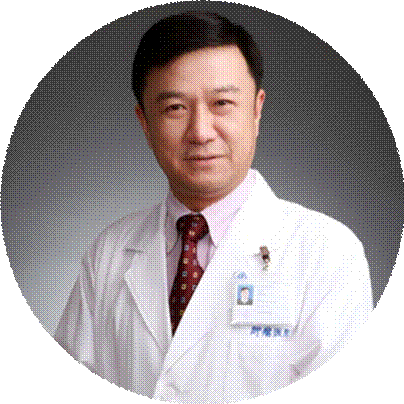
Dingwei Ye, MD, PhD, Professor
Fudan University Shanghai Cancer Center
MAT-CN-PAD-2026-00231
Preparation date: August 23, 2026
For medical and healthcare professionals only.