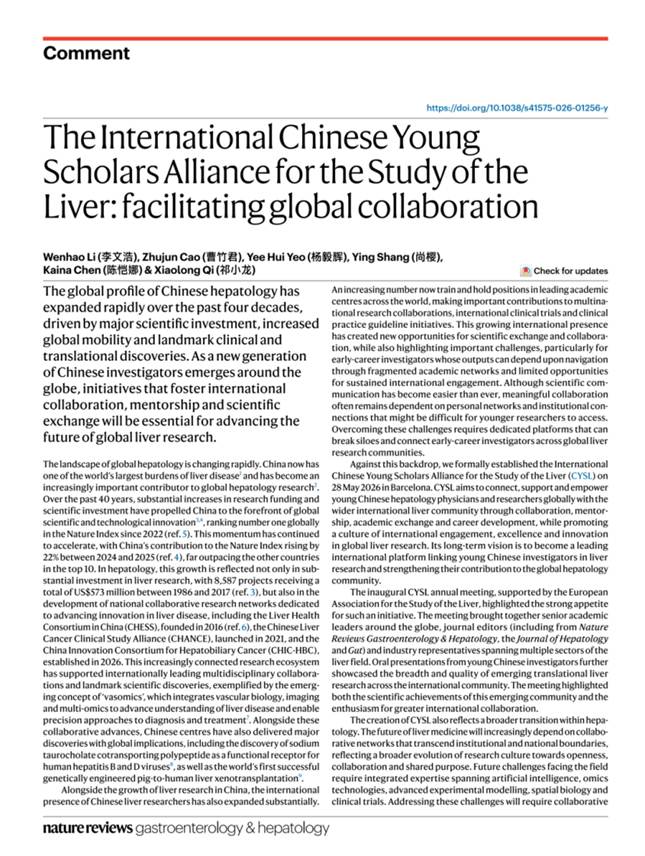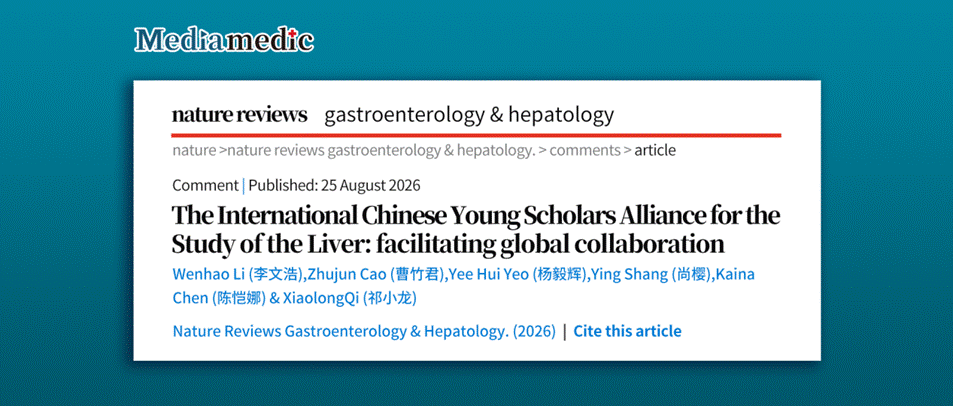
On August 25, 2026, Nature Reviews Gastroenterology & Hepatology (IF 57.5) published online a commentary titled "The International Chinese Young Scholars Alliance for the Study of the Liver: facilitating global collaboration," jointly completed by Xiaolong Qi (Zhongda Hospital Southeast University, China), Wenhao Li (Royal London Hospital, UK), Zhujun Cao (European Foundation for the Study of Chronic Liver Failure / Ruijin Hospital, School of Medicine, Shanghai Jiao Tong University, Shanghai, China), Yee Hui Yeo (Cedars-Sinai Medical Center, Los Angeles, USA), Ying Shang (Karolinska Institutet, Solna, Sweden), and Kaina Chen (Singapore General Hospital, Singapore).The landscape of global hepatology is changing rapidly. China now has one of the world’s largest burdens of liver disease and has become an increasingly important contributor to global hepatology research. Over the past 40 years, substantial increases in research funding and scientific investment have propelled China to the forefront of global scientific and technological innovation, ranking number one globally in the Nature Index since 2022. This momentum has continued to accelerate, with China’s contribution to the Nature Index rising by 22% between 2024 and 2025, far outpacing the other countries in the top 10.
In hepatology, this growth is reflected not only in substantial investment in liver research, but also in the development of national collaborative research networks dedicated to advancing innovation in liver disease, including the Liver Health Consortium in China (CHESS), founded in 2016, the Chinese Liver Cancer Clinical Study Alliance (CHANCE), launched in 2021, and the China Innovation Consortium for Hepatobiliary Cancer (CHIC-HBC), established in 2026. These interconnected scientific research ecosystems have supported multiple international-level academic collaborations and landmark achievements.
Alongside the growth of liver research in China, the international presence of Chinese liver researchers has also expanded substantially. An increasing number now train and hold positions in leading academic centres across the world, making important contributions to multinational research collaborations, international clinical trials and clinical practice guideline initiatives. This growing international presence has created new opportunities for scientific exchange and collaboration, while also highlighting important challenges. particularly for early-career investigators whose outputs can depend upon navigation through fragmented academic networks and limited opportunities for sustained international engagement. Although scientific communication has become easier than ever, meaningful collaboration often remains dependent on personal networks and institutional connections that might be difficult for younger researchers to access.
Against this backdrop, the International Chinese Young Scholars Alliance for the Study of the Liver (CYSL) was officially established in Barcelona on May 28, 2026. Standing on the shoulders of giants, CYSL builds upon the foundations established by a number of international networks such as the Hepatology Committee of the World Association of Chinese Doctors and the Chinese American Liver Society. CYSL aims to connect, support and empower young Chinese hepatology physicians and researchers globally with the wider international liver community through collaboration, mentor ship, academic exchange and career development, while promoting a culture of international engagement, excellence and innovation in global liver research. Established during the Chinese Year of the Horse — symbolizing motivation, passion and ambition — the alliance’s long-term vision is to become a leading international platform linking young Chinese investigators in liver research and strengthening their contribution to the global hepatology community.
Official Website Link: https://www.cysl.link/