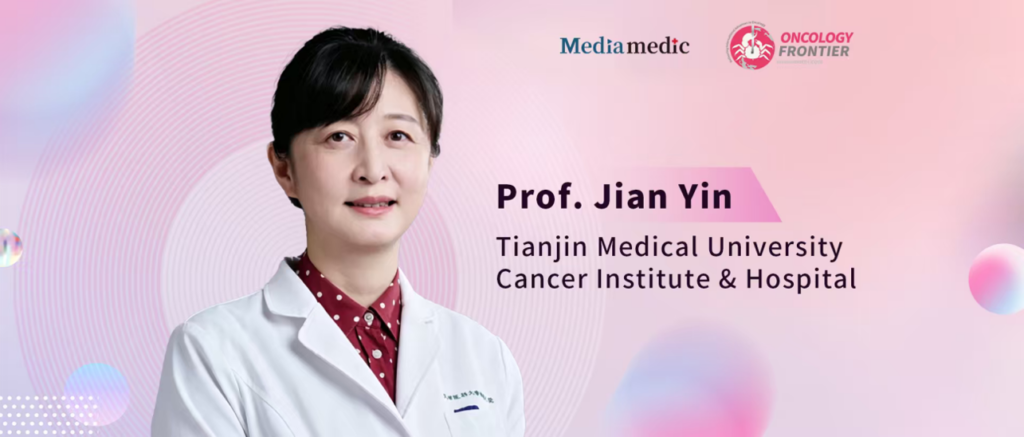
Editor's Note: Breast cancer is one of the most common malignancies affecting women worldwide. With the widespread adoption of early screening and diagnosis and continued advances in comprehensive treatment, survival rates among patients with breast cancer have improved significantly. As a result, the need for postoperative quality of life and physical and psychological rehabilitation has become increasingly important. Recently, the 23rd World Breast Health Congress was held in Tianjin from May 8 to 10, 2026. During the congress, Oncology Frontier interviewed Prof. Jian Yin of Tianjin Medical University Cancer Institute and Hospital, who provided a systematic overview of the current adoption and standardization of breast reconstruction techniques in China, key technical challenges and future directions, China's advances in integrating oncologic safety with functional and aesthetic outcomes, and the pathway for Chinese breast reconstruction techniques to reach the international stage and contribute Chinese solutions to patients worldwide.Oncology Frontier: You have pioneered a number of advances in breast reconstruction and oncoplastic breast surgery. Could you introduce the current adoption rate and level of standardization of breast reconstruction techniques in China?
Prof. Jian Yin: In recent years, the concept that breast reconstruction is an integral component of comprehensive breast cancer treatment has gained widespread recognition. In 2023, the Oncoplastic Surgery Committee of the Chinese Anti-Cancer Association conducted a nationwide survey on the current status of breast reconstruction and oncoplastic breast-conserving surgery. Data collected from 195 member institutions nationwide in 2022 showed that approximately 85% of hospitals had already implemented oncoplastic breast-conserving surgery and immediate breast reconstruction, indicating a substantial increase in the adoption of these techniques.
However, there are still significant gaps in the standardization and comprehensive implementation of breast reconstruction. First, revision procedures and nipple-areola reconstruction remain relatively uncommon. Approximately 85%–90% of hospitals do not routinely perform these procedures, even though they are critical for achieving bilateral breast symmetry and improving postoperative aesthetic outcomes. Second, there is still room for improvement in complication management. Although approximately 85% of institutions have achieved effective overall control of complications, the management of inflammation-related complications still requires further standardization.
To promote the standardization of these techniques, the Guideline for Oncoplastic Breast Surgery was developed in 2023 under the leadership of Academician Daiming Fan, followed by a nationwide series of educational lectures and training programs. In 2025 alone, 24 guideline lectures were conducted. These initiatives have been characterized by broad coverage, deep penetration into grassroots institutions, and rapid dissemination of updates. The program has covered almost all provinces and municipalities across China, extending from provincial capitals to prefecture-level cities and grassroots medical institutions.
Following the release of the updated guideline at the CCHIO Congress in November 2025, four dedicated educational sessions were organized within just one month to rapidly disseminate the latest concepts to primary healthcare institutions. These efforts have helped more grassroots physicians master standardized techniques and ultimately benefit more patients.
Oncology Frontier: As the proportion of breast-conserving surgery continues to increase and patients place greater emphasis on quality of life, what technical challenges does the field of breast reconstruction still face? What are the future directions of development?
Prof. Jian Yin: The fundamental goal of breast reconstruction is to reduce postoperative complications and achieve better aesthetic outcomes while strictly ensuring oncologic safety. At present, the major technical challenges facing the field include optimizing the timing and sequencing of radiotherapy and breast reconstruction, preventing complications following implant-based reconstruction, improving bilateral breast symmetry, and performing postoperative revision procedures.
To address these challenges, the field will primarily develop in two directions in the future.
The first is minimally invasive surgery. Endoscopic surgery is an important manifestation of minimally invasive approaches, but minimally invasive treatment should not simply mean shorter incisions. More importantly, it should minimize the overall physical trauma associated with surgery as much as possible.
The second is intelligent surgery. Integrating artificial intelligence into oncoplastic breast surgery could effectively shorten the learning curve for surgeons, facilitate more precise implant selection, and enable accurate localization of perforator vessels, thereby reducing postoperative complications and improving aesthetic outcomes.
Oncology Frontier: Which topics related to breast reconstruction, patient rehabilitation, and quality of life in particular deserve attention at this year’s congress?
Prof. Jian Yin: Relevant topics have been incorporated into multiple sessions of the congress, including the breast surgery session, nursing session, basic and translational research session, as well as the China–Latin America session that I am responsible for. These sessions place particular emphasis on issues such as lymphedema management and improving postoperative quality of life.
This reflects an important shift in the philosophy of breast cancer treatment. Patients’ needs have evolved beyond simply “survival” toward preserving their appearance and achieving a higher quality of life. This is also a central focus of continued development in the field of oncoplastic breast surgery.
Oncology Frontier: How will hosting the World Breast Health Congress in China promote the internationalization of China’s breast reconstruction techniques and attract global collaborative research? Do you believe China has the potential to develop a leading Chinese approach in this field?
Prof. Jian Yin: The fact that this congress is being held in China is itself a recognition by the international community of the research and technical capabilities that China has developed in breast reconstruction.
The congress provides an important platform for bringing Chinese techniques to the international stage. On the one hand, we can showcase the research achievements of Chinese experts. At this congress, specialists from institutions including Tianjin Medical University Cancer Institute and Hospital, Sun Yat-sen University Cancer Center, and Shanghai Ninth People’s Hospital, Shanghai Jiao Tong University School of Medicine, have shared their respective clinical experiences and research advances, allowing international colleagues to gain a more comprehensive understanding of the development of breast reconstruction in China.
On the other hand, in-depth exchanges with international experts can further expand global collaborative networks and promote the international translation and dissemination of Chinese clinical experience.
Oncology Frontier: You pioneered the “Tianjin Cancer Hospital approach,” proposed the concept of moving from “preserving life” to “preserving aesthetics,” and established China’s first dedicated breast reconstruction department. What key conceptual and technical breakthroughs has China achieved in integrating oncologic safety with functional and aesthetic outcomes in breast surgery? How does China compare with international standards?
Prof. Jian Yin: Tianjin Medical University Cancer Institute and Hospital performed Tianjin’s first autologous tissue breast reconstruction procedure in 2001 and established China’s first dedicated breast reconstruction department in 2010. In 2019, we collaborated with Russia to establish the China–Russia Joint Research Center for Oncoplastic Breast Surgery.
The development of our discipline has consistently focused on three core objectives: ensuring oncologic safety, reducing postoperative complications, and improving aesthetic outcomes.
The key conceptual breakthrough has been the establishment of a model in which the same medical team performs both definitive oncologic resection and breast reconstruction. At a time when delayed breast reconstruction was widely considered safer, our 10-year follow-up study demonstrated that immediate and delayed breast reconstruction have comparable oncologic safety, while immediate reconstruction can significantly improve patients’ psychological well-being. These findings provided an evidence-based foundation for the broader adoption of immediate breast reconstruction.
From a technical perspective, we independently developed an implant selection assistance system and were among the first to apply domestically manufactured surgical meshes in clinical breast reconstruction. These innovations have helped reduce postoperative complications and further improve aesthetic outcomes.
Oncology Frontier: The Guideline for Oncoplastic Breast Surgery that you led has been presented in more than 30 educational sessions across China and was taken overseas in 2025. In line with the congress’s goal of promoting global collaborative development, what lessons can other countries learn from China’s experience in breast reconstruction? Through the “Belt and Road” public welfare initiative, what kind of Chinese approach do you hope to share with the world?
Prof. Jian Yin: Since the nationwide guideline lecture series began in 2023, the Guideline for Oncoplastic Breast Surgery has been widely disseminated and implemented across China. In 2025, the guideline education program expanded internationally, with dedicated lectures held in countries including Russia, Azerbaijan, and Uzbekistan.
In 2026, we plan to travel to Uzbekistan to conduct a public welfare breast reconstruction initiative. In addition to promoting the guideline, we will provide clinical demonstrations and hands-on training.
China’s experience and techniques in breast reconstruction have important value for other Asian countries. Because the breast morphology and disease characteristics of Asian women are highly similar to those of Chinese women, China’s clinical experience and technical approaches may be particularly well suited for adoption in other Asian countries. They can help these countries rapidly improve the standardization of breast reconstruction.
Oncology Frontier: This congress emphasizes the establishment of a full-cycle management model encompassing “early screening–diagnosis–treatment–rehabilitation.” As a surgical specialist, how do you view the role of breast reconstruction in the full-cycle management of breast cancer? How can we better connect surgical treatment with postoperative rehabilitation and psychological support to establish a seamless physical and psychological rehabilitation pathway?
Prof. Jian Yin: Breast reconstruction is an integral and indispensable component of comprehensive breast cancer treatment. The involvement of an oncoplastic breast surgeon should not be limited to the period after mastectomy. Instead, it should begin at the time of initial diagnosis, with the oncoplastic team participating throughout the formulation of the patient’s comprehensive treatment plan.
To achieve this goal, we emphasize multidisciplinary collaboration. Our hospital is preparing to establish an oncoplastic breast surgery MDT clinic, where specialists from breast surgery, medical oncology, radiation oncology, radiology, pathology, and other disciplines will work together to develop individualized treatment plans.
While ensuring oncologic safety, we aim to maximize patients’ opportunities to achieve optimal postoperative appearance and quality of life.
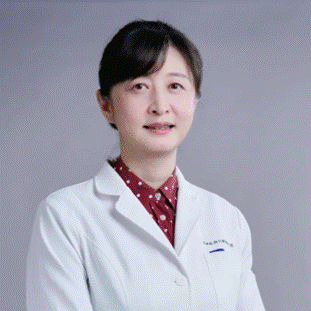
Prof. Jian Yin