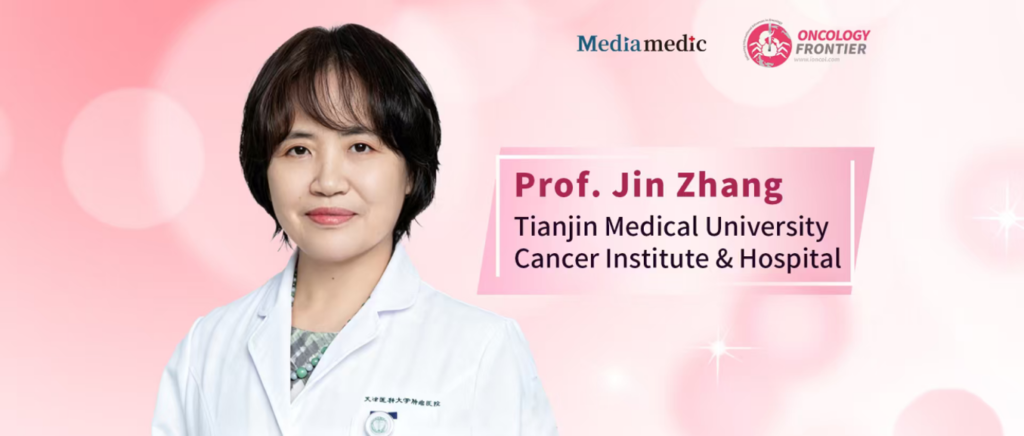
Editor's Note: Breast cancer is a malignancy that poses a serious threat to women's health worldwide. Establishing a whole-life-cycle management system covering prevention, screening, diagnosis, treatment, and rehabilitation has become a key consensus and development direction in the global breast health community. Recently, the 23rd World Breast Health Congress was held in Tianjin from May 8 to 10, 2026. During the meeting, Oncology Frontier interviewed Prof. Jin Zhang of Tianjin Medical University Cancer Institute and Hospital, who provided an in-depth interpretation of China's overall progress in breast cancer prevention and control, the achievements of Tianjin Medical University Cancer Institute and Hospital, and the significance of this international academic exchange.Oncology Frontier: You will represent your hospital and deliver a presentation at this congress. Could you introduce the main topics you will discuss?
Prof. Jin Zhang: At this congress, I will present an overview of the current epidemiological landscape of breast cancer in China to experts from around the world, with a particular focus on the progress China has made in establishing an integrated, full-process management system encompassing breast cancer prevention, screening, diagnosis, treatment, and rehabilitation.
My presentation will cover several aspects, including strategies for improving the overall capacity for breast cancer prevention, screening, diagnosis, treatment, and rehabilitation nationwide; the implementation of hierarchical diagnosis and treatment policies at the grassroots level; the dissemination of prevention and control concepts and implementation of standardized clinical guidelines; public education and patient awareness initiatives; and efforts to strengthen the diagnostic and treatment capabilities of primary healthcare institutions and establish specialist training systems.
This includes improving the technical capabilities of breast cancer specialists in county-level and prefecture-level cities. I will also share the developments and innovative achievements of the breast cancer discipline in China, highlighting the contributions of Chinese original research to global breast cancer care and demonstrating how cutting-edge technologies can be rapidly translated into clinical practice in China.
Ultimately, our core objective is to improve breast cancer cure rates and overall survival among Chinese patients.
Oncology Frontier: You mentioned that breast cancer care in China is transitioning from “following” to “leading.” What specific achievements have China and Tianjin made in breast cancer diagnosis and treatment?
Prof. Jin Zhang: The Breast Cancer Center of Tianjin Medical University Cancer Institute and Hospital is one of the world’s largest single-center breast cancer diagnosis and treatment centers in terms of patient volume. Benefiting from this substantial patient population, the center’s annual volume of breast cancer surgeries ranks among the highest globally. In 2025, more than 12,000 newly diagnosed breast cancer patients underwent surgery at our center.
Since its establishment in 2003, the center has undergone remarkable development. In 2023, marking its 20th anniversary, the center relocated to the Binhai New Area and became an independent branch campus. It is now working toward the goal of establishing the world’s largest integrated breast cancer diagnosis and treatment region.
In terms of academic and clinical infrastructure, the Breast Cancer Center of Tianjin Medical University Cancer Institute and Hospital is an independent medical campus integrating medical care, education, research, prevention and screening, diagnosis and treatment, and rehabilitation. It operates as an independent first-level discipline and includes dedicated professional units for prevention and screening, diagnosis, treatment, and rehabilitation.
Through a model in which these units operate independently while working in close coordination, we are able to provide whole-life-cycle management for patients with breast cancer.
In terms of clinical outcomes, the 5-year disease-free survival rate for breast cancer at our hospital reached 94% in 2025, significantly higher than the overall level in China and comparable with leading international outcomes.
Oncology Frontier: The congress has brought together experts and scholars from around the world. What are your expectations for this international exchange, and what significance do you believe it holds?
Prof. Jin Zhang: The World Breast Health Congress was previously held in China in 2007 and 2016. This year’s global congress, centered on the theme of breast health and care, fully reflects the integrated concept of whole-life-cycle management encompassing breast cancer prevention, screening, diagnosis, treatment, and rehabilitation.
The congress features ten parallel sessions, comprehensively covering the latest developments across the entire breast cancer care continuum and the full life cycle of breast health management.
Scholars from different countries will have the opportunity to exchange ideas and share practical experiences in breast health management under different healthcare philosophies and policy environments. Through this exchange, we can learn from one another, complement each other’s strengths, and advance together.
I believe the 23rd World Breast Health Congress will generate new concepts and perspectives for whole-life-cycle breast cancer management and contribute to the overall advancement of global breast health.
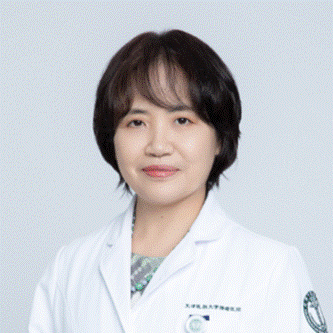
Prof. Jin Zhang